


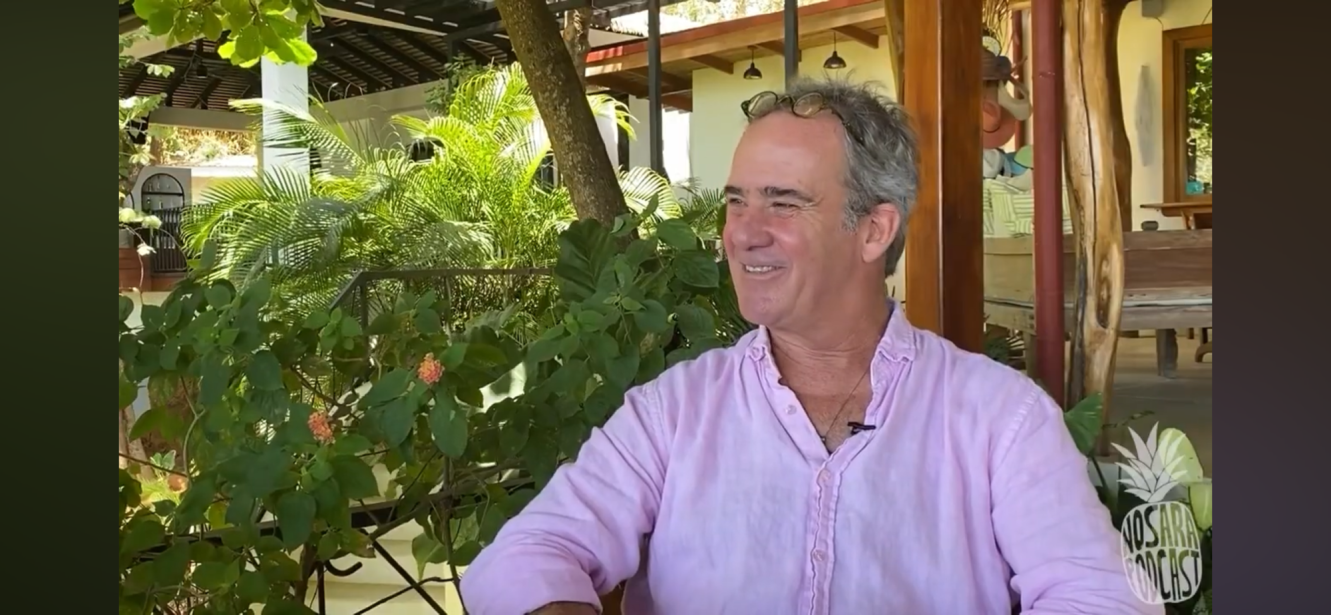
The Steve Jacobus story is a fun one & we hope you enjoy hearing it! This is a fun conversation between long time friends about their journeys to, & experiences in, Nosara, Costa Rica. Steve shares some good tales with Rich & provides all kinds of upfront info in this candid, and interesting conversation.


Episode Transcript
00:00 – Arrival in Nosara and Leaving the US Logistics Sector
Rich Burnam (Rich): Steve, welcome to the podcast.
Steve: Thank you. I’ve been really excited about this and kind of wishing I could have been on it earlier.
Rich: Well, your story is interesting and you fought hard to make all this happen. And now as we’re sitting at Tierra Magnifica, now you can rattle off awards and all the stuff that you win and all the, all the stuff. And it just seemed like it was so easy, but I knew you a long time ago.
Steve: Yeah. So, 20 years ago.
Rich: Yeah. So congratulations on 20.
Steve: Thank you.
Rich: And let’s just get right into your story. Talk us through arriving here, setting it up, and then while you’re talking, we’re going to play some photos of before and after of, of the whole thing. So just—
Steve: That sounds like fun. Let’s get going. In 2004, I came down here with my family and we were on vacation and I was in the process of selling the companies in the United States. I had a group of companies involved in logistics and warehousing and trucking. It was based in Wisconsin, but we had operations in California and I think like 28 states.
Rich: You’re clearing it out.
01:30 – The Beach Encounter with Chickie and Purchasing Henny’s House
Steve: And so, I’m on the beach. We’re on vacation, 2004. I run into Chickie on the beach. And I said, “Chickie, I’m kind of, you know, we’re here checking this out to see if this is a good spot to move with my kids for a little while.” Chickie, of course, right away, you know, you know Chickie, and he brings me up here to Henny’s house and introduces me to Pauline, who’s, you know, a real estate broker at the time and representing Henny’s house, and he’s selling it, and I bought it.
Rich: You’re hitting some heavy names in a cool story just right off the bat, man.
Steve: Yeah, yeah, so that’s how it started. So I decided, what the hell, I bought it. And I put money down in 2004 and we moved here 2005.
02:45 – The September 2005 Rainy Season Arrival and Casa Toucan
Steve: And being as brilliant and planning organized as I am, we moved here in the middle of September and couldn’t even get to the house. So the first two nights we slept at Casa Toucan in their rooms there. It was a disaster, but it was fun. It was an adventure. And then that whole September, October, you know, I sold my companies. I had some cash. I was thinking about getting involved in real estate and everything else. You couldn’t do a damn thing because it rained so hard. I literally would have to put my laptop in the refrigerator just so I could get the humidity out to start it up.
Rich: Man, you’re bringing back some memories for me now too.
03:30 – Dial-Up Internet Constraints and the 2000s Paradise Tax
Steve: Yeah, and the internet was the dial up. That was it. It would take you 45 minutes to get one little email out to your family to let them know you’re okay.
Rich: The pram let me do that. You say we have internet now. It’s like 2002 or something.
Steve: Yeah. And I sat there. It was like 10 to 15 minutes, and it’s yeah, that’s the paradise tax. But it also was cool because if you need to see someone or talk to someone about something, you didn’t have the cell phone network yet either. So you drive down to the main entrance and you stroll down it and you run into typically the person you want to see and then about four other people that you have a conversation with, and that’s, that’s how the community was back then.
04:15 – The 2008 Real Estate Crash and San Juan Hill Developments
Rich: All right, so how did you take it from then to where it is now? Talk us through that journey of like through 2010 and 12 and 15 all the way to the pandemic to now. Cause as you sit here now, you have a marvelous restaurant. You just had this awesome expansion thing. Like, it seems like, like if I was just walking in here, it’s like, oh, this guy’s always had it made. Like, you know what I mean? That’s, and there is money here now. So people don’t always know. Some of us like fought hard to make it happen and it was work and it was an adventure and it was worth it, but it wasn’t easy.
Steve: No, you know, and obviously a lot of good fortune and good luck and blessings have come my way along, along the line too. But so I bought this house 2006. I bought a much larger piece of property in the hills up in San Juan. So I had some investment here. And I started creating a development up there. 2008 hit and everything dropped through the floor and real estate in particular. It was only supposed to be a two year stay with my kids. And then I was going to go back and start a new company in the States. And I bought this piece of property, which was two and a half hectares. And I figured, well, I could probably do something with that too. Subdivided or something like that. Real estate tanked and I couldn’t go anywhere because I was underwater here in real estate.
Rich: So you locked yourself in?
Steve: Locked myself in. Yeah. And then, kids were here for, well, the kids lived in Costa Rica for a total of six years and three were here. And then we rented a house in Escazu and enrolled them in Lincoln and then three years at Lincoln. And then they went back to the States, but I couldn’t go. I had too much tied up here.
Rich: So you painted yourself in a corner, and you had to find a way to make it. Mm hmm. So, hospitality industry it is?
06:00 – Transitioning from Trucking to a Santa Marta Bed & Breakfast
Steve: Yeah, and I knew nothing about it. So I come from a trucking and warehousing background, but I know what I enjoy in hospitality, and I did well enough in my career before that I could stay in nice places, and I knew what I liked. So, post 2008, I figured, well, I better start an income stream here, because money’s not going to last forever, and I started playing around with bed and breakfast kind of thing and in fact rented a house next door to the Santa Marta school because my kids went to Santa Marta for four months, learned Spanish, made their friends with the local kids, and we had so much fun in that house that I lived in that house, and we just used this as a rental, and then we added a couple rooms, we added a yoga shala, we built on a little more, built on a little more, and just kept going.
Rich: So a true, what was that movie? Was it Field of Dreams? If you build it, they’ll come. Am I getting that right?
Steve: Yeah, you’re actually kind of a cross between Field of Dreams and the Mosquito Coast, you know, too, because I don’t want people to think I was Harrison Ford losing it. But my family back home sure thought it was, so they might not have been all that wrong.
Rich: Yeah.
07:30 – Operational Partnership with Erica and Business Scaling in 2010
Steve: So, the real game changer came when my wife, Erica, had helped me start a travel company also in 2006. And she was in San Jose and she’s been in hospitality now for over 40 years in hotel management and so forth. And so our relationship shifted to a personal relationship in 2010. And by the end of that year, I said, “Would you be interested in joining me in really building something really special? Because I think we’ve got something, we’ve got a really special property in a very special community.” And that’s why I came in the first place, the protected beach, a safe place for my kids to hop on a bicycle and take off and come back at dark and really good community that included truly local, Nosara folks that own businesses, like Roosevelt. So that’s what I love about this.
Rich: So it kind of caught your heart and set up before your mind, your initiative got you into this mess. Then Erica was the brains to help connect between your initiative and drive and vision and belief and feeling her operation skills. That’s how we got to, well, your restaurant’s full now every night.
Steve: Yeah. Yeah.
09:00 – Leveraging COVID-19 Closures for Structural Footprint Building
Rich: But you’re also in a spot where there’s not restaurants normally, and people don’t even know to come here. So the quality must be there. So. What you’re doing has been working, but these early years are interesting because you didn’t have enough space to really cash flow a ton, right? You have eight rooms for a while, I believe.
Steve: Yeah, we never, because I always wanted a very high level of guest experience, whether it’s a restaurant or the rooms. So we never made money. We lost money every year. It was a labor of love and a little bit of financial hardship.
Rich: But people liked it.
Steve: Yeah, people loved it. And we got great reviews. We’re still, we have the highest five bubble rating in Costa Rica. But so, you know, every year we would make some money during high season and then we’d kind of give it all back in low season and we maybe would break even or make a little bit, but not much. So, Erica and I just decided we would add what we could. So every year we would build what we could accomplish in three or four months. You know, so we’re sitting on top of two rooms. We built these in four months where, over there we built that and the room over there we built in three months. So that’s how we operated.
Steve: But the real opportunity for us was, you know, a big hardship for a lot of people, but a silver lining for us was COVID. So COVID hit, we were having a record year with advanced reservations. We had to give all that money back, closed in March. And I said to Erica, I said, “This is our opportunity. Now we can build that one building that’s going to take more than four months to build. And not disrupt our reputation, not disrupt our guest experience.” So we closed and we, I already had the design. We broke ground in June on that building and we delivered it in December, six new suites. That was the financial game changer.
11:15 – Chef Valerios and Post-Pandemic Menu Architecture
Steve: And then we were able to build this restaurant. So we doubled the size of the restaurant and we consistently, the quality of the restaurant kept going up and up and up. But then post COVID we had the opportunity to meet our chef, Valerios. And he had gone through financial hardship in San Jose. He lost his restaurants and he’s a talented guy. And so we flew him out here. We interviewed him and we said, “Well, if you could go from doing smoked meat and things like that to delicate foods and learning delicate foods, let’s give it a try.” And he’s been a phenomenal partner and he’s the architect behind the menus. We always do the tastings together. We always agree on that. I do the wine list. And the mixology has been outstanding.
Rich: So you’re still having fun, but now it’s evolved to fine dining. And finally, you have capacity to actually make some money.
Steve: Yeah. So now we’re making money, which is fun. All right. That’s really fun. It’s supporting our lifestyle.
Rich: It only took 20 years to really get it dialed in.
Steve: It did. It did.
12:00 – Employee Development Stories: Karina’s Mixology and Danny’s English Transition
Steve: You know, and, but the thing that I’m really proud of, too, is our head bartender, mixologist, Karina, born and raised here in Nosara.
Rich: Oh, beautiful.
Steve: And on the other side of the river. And when we close every October, she went to—Erica signed her up with a mixology class in San Jose. Karina, in one weekend, accomplished these firsts that terrified her. She flew on a plane on Sansa. She had to take an Uber for the first time. She checked into an Airbnb in a high rise tower. She was on an elevator for the first time.
Rich: Jeez, man, you poured it on her.
Steve: I know, right? Everything in one weekend. And she was so funny. And she kept texting Erica like, “Oh my god, oh my god, I can’t believe I’m doing this, I’m doing that. These are all the things I always was afraid of.” But she’s killing it. She’s doing great stuff. So it’s fun, you know, and then, like, Danny, we hired Danny as a dishwasher. And this guy had the attitude, like, in Ted Lasso, you know, Danny Rojas? He loved his job and he had such a positive attitude. We made him a runner. And then we said, “If you learn English, you can become a waiter.” He didn’t tell anybody, and in six months, he had command of English well enough to become a waiter. Now he’s the backup bartender. He’s taking mixology classes. Born and raised, you know, and so—
13:30 – The Realities of Educational System Deficiencies for Local Staff
Rich: How beautiful is initiative? Like, I think as a business owner here, there’s not much better than seeing someone truly progress their lives and get a shot. Because making it in Nosara is not easy. It’s expensive, it’s hard, it’s competitive. There’s people from all around the world wanting to come into this place. And the people from here generally don’t have the educational systems and the support to get the skill sets to get the top tier jobs, because if you’re going to run a business here at a high end, it’s not easy. There’s not supply stores all around. There’s not a Home Depot right down the corner. So it’s really cool to hear stories from inside your organization of people busting through and making it and getting positioned well.
Steve: Yeah, it is. We have employees that have been with us for a long time. Every year we have very few people that we’re replacing. And then the management team, the upper level folks stay with us, you know, but we also continue to educate them and give them opportunity to learn and grow. We send them to courses, and in October when we close, the chef picks wherever he wants to go in the world. We buy him a plane ticket and an Airbnb and he goes in and studies cuisine. This coming year he’s going to go to Italy. Last year he was in Argentina, Lima before, and Oaxaca, Mexico before.
Rich: Wow, you’ve been doing that for a long time. Where’d you get that from? I remember way back in the event Caesar. That was really impressive that you send your people to improve in the rain season. They get to experience something new. And then also—
15:00 – Off-Season Global Training Internships (Milwaukee to Soda Mari)
Steve: Yeah, we sent Cesar to the top elegant old, historic old hotel in Milwaukee, Wisconsin. And I know the owner and he gave Cesar an opportunity to be, for a month, he worked every department in that hotel.
Rich: And changed his life. He’s a phenomenal, phenomenal representative. So many different skill sets now from that exposure.
Steve: Yeah, you know that you touch on another thing being here as long as we have. Juan Carlos of Howlers started out here, Cesar came from here, you know, we’ve got a lot of folks in the community that I’m really proud of that learned, grew and moved on. Marianne owns an organic Vivero and next to, and she has Soda Mari. She was a waitress here and we started teaching the families of our staff how to grow organic groceries, prep products. And if you did, we would buy them from you versus creating your own garden. Hers got so big that she left here. That’s what she’s doing.
Rich: Beautiful.
Steve: Yeah, it’s fun. Those are good stories. And those are things I’m really proud of. And the development of our team is what gives me great joy. In my past companies, it’s always been the development of the team. Not necessarily the customer, but this is the first time that I really, I also really love our customers too.
16:30 – Defining the Adult Sanctuary and Gilded Iguana Beach Club Alliance
Rich: So tell us about that. Who’s your clientele who should stay here? Because all the buzz is down by the beach, right?
Steve: Yeah.
Rich: You have something different. It’s, I mean, outside of Lagarta, which is big and on the other side. It’s about the only, like, business that’s a true, like, hotel restaurant setup up in the hills. So, I’m trying to say, who should leave the popular beach areas and come up here and give this a go?
Steve: First of all, we have a minimum age of 15 in the restaurant and the hotel. So we create an environment that’s really perfect, very conducive for couples on romantic getaways or a date night dinner, solo travelers doing a wellness vacation or working remotely, and families with adult or older children who appreciate this very quiet environment and our culinary offerings. And it’s peaceful up here. And it’s, we got a breeze, and it’s not dusty, and it’s not hot, and we’ve got 14 beautiful rooms. We’re small enough that my staff knows everybody’s name, and uses their name, and greets them when they come back from a tour and asks them about the tour. So it’s a very personalized hospitality experience.
Steve: We have a huge wellness program with over 45 different modalities that we offer. So it’s geared towards people that are looking for a rejuvenating or quiet or reconnecting kind of experience. And we’re surrounded with nature. I mean, there’s monkeys everywhere. So it’s the peace and quiet. And then we have a relationship with the Gilded Iguana. So all of our hotel guests have complimentary use of the Gilded Iguana Beach Club. They get towels, lockers. So they got their beach space. And then they can retreat back up. And that’s how it works. Probably 70 percent of our guests dine in and then go out one or two times during their stay. But the food’s really good here. The service is great. So, you know, and it’s convenient. And all of our hotel guests always have a table. A lot of our dinner guests thank me that they have a date night spot. You know, it’s fun to go to La Luna and all these other spots with your family and be at the beach and have the kids run around. And I raised, I’ve got four of them. So it was a lot of fun. But now there’s a little sanctuary for adults to get away. And that’s good for a family’s health too.
Rich: Congratulations on this is awesome. This is, this is, this is really cool. It’s interesting to be sitting here as we record this High Season 24. A lot’s changed, a lot’s changed, but the place is still the same in a way, you know what I mean?
Steve: Yeah. I’m happy with the way it’s evolving. I’m happy with the fact that we don’t have any big, large landowners building resorts or big hotels or big condominium projects and things like that. And it’s still, to me, retains its very local boutique feel. Just, I was walking down the street on Tuesday during the farmer’s market, you know, and you’re bumping into everybody and it’s fun. It’s kind of like how it always has been. So it’s just more people and more expensive homes.
19:45 – The Evolution Beyond the Core Surf-Yoga Persona
Rich: Did you ever expect Nosara to catch like this? Because I definitely did not by 2013, 14, 15. I realized it had something. The crowds weren’t going away, but I didn’t expect it to catch with the upper echelon, the higher end at the level that it has. I really didn’t see that coming. I always thought it was going to stay a little more low key surf yoga based town. But the reality is most of the people come in here now, they’re not diehard surfers, they’re not diehard yogis. They like the idea of it. They like being around it. And that’s a pull, but it’s not the original folks that set up, which were pretty committed surf yogi, it was kind of that or nothing, you know what I mean?
Steve: It’s true. The folks that came in the eighties, you know, and it was hard getting here. They came by boat because it was a great wave.
20:30 – Historical Offshoots: Vietnam Veterans, Iran-Contra, and Endless Summer 2
Rich: Also the eighties even brings in, well, the people who in Vietnam, this is back, shout out to Chickie. Rest in peace, Chickie. We miss you. Chickie used to tell me about how the Nosara hotel people who were on the offshoots of the Iran-Contra whole thing. And then the Nicaragua setup was their getaway.
Steve: Yeah. I’ve heard some of those stories too.
Rich: So then, and then you had the early pioneers and then through the nineties, I guess it was the mid nineties when surf caught. Endless Summer 2 came out. If you remember that movie, and that was a big old thing for surfers. Cause from the moment I first saw that movie in 95 or 96, I watched it every night until I moved here. 2009, early 2009. And before that, but literally I watched it every night. Just: how am I getting to Costa Rica? I want to get to Costa Rica. I want to surf that wave. I want to be there. I want to be there so bad. But it was exotic back then. It was crazy. Now it’s found, now your grandma’s here, but then it was something.
Steve: Yeah.
21:15 – Geographic Scaling: North Guiones Boom and Pelada’s Covid Launch
Rich: So I didn’t expect it to ever leave that core surf yoga thing, especially cause it really was that—it was the yoga Institute. Yeah. And the north side of Guiones was like, that’s where we sent the backpacker renters or the people who wanted to party. You had Blue Dogs and you had Gilded and eventually Kayasol. And this wasn’t even that long ago. Now look at North Guiones. It’s exploded. There’s not an inch.
Steve: It’s bustling.
Rich: Uh, and now Pelada caught up through COVID’s explosion. Pelada launched. It’s not, “Oh, Pelada, that’s way over there.” And then Guiones Beach Club, which you see from here, that used to be way over there. Now the town’s really gotten a lot smaller, people are on golf carts, the walking paths reignited to connect everywhere, so that’s been a real big blessing.
Steve: I’m living on the other side of Santa Marta, and back then it was like, way out of town.
Rich: Isn’t that funny? Yeah. The road’s paved.
Steve: But you know, you’re right, and it goes back to about 2016, when it really started to ramp up again. And I think what the appeal was is, it first starts with somebody from Boulder that discovers this and then they start telling their friends, or from LA or from San Diego and they start telling their friends and they come down here and it’s such a laid back escape and it is a good consistent wave and there is holistic activities going on all around. It’s a healthy environment to live in. It’s not overrun with tourist t-shirt shops and things like that. So it has this authenticity that a lot of people, people with a lot of money and people who’ve made a lot of money are attracted to it.
Rich: Is that why it’s so sticky? That people go home feeling better. Like when they think about it as a memory, it’s like, “Hey, that felt good.” Yeah. Cause you are a little bit more healthy here. You are eating something a little different. The fruit tastes differently. And then Nosara’s vibe is very, very different. No offense to every other town, but as far as kind of its own country within a country in my opinion because if you look at any other spot there’s nothing like it.
Steve: No there isn’t. We started a travel company in 2006 so we have people traveling all over Costa Rica. Nosara is its own unique destination. It’s not like any other beach town. It has its own personality and DNA that’s unique and different and that’s what’s attracting these people and it’s going to continue to attract people because of its uniqueness. And people are starting to move up into the hills now. You know, San Juan, the real estate I bought in San Juan is back on now. And that area is becoming popular as a nice quiet respite from the beach town.
23:40 – The Machine of Real Estate and the Post-Crash Grind
Rich: It’s interesting to watch a town evolve. I, yeah, it’s been a fun run. I could be wrong in this. I’m just making this up, but this is how I feel. I think like the past 10, 12 years in the next 8 to 10 are the prime of this place for me. Because now there’s medical services. And I didn’t use to feel this way. I used to think the luster was gone. I’ve changed my mind on that from talking to people who’ve been here a long time, like Beverly Kitson and Alice Olson and a lot of these other folks, cause I was expecting them to be angry and they were like, “Wait, I liked it. There’s a doctor. I liked it. I can move around more freely. I liked that the nature reserves are still blocking big widespread development, but it’s not all bad.” And it’s very easy to look at the bad. Cause I think lack of crowds and pricing.
Rich: And in my day job, I can’t afford to buy the very properties that I sell and believe in the most and I think have the least amount of risk. So I get bitter daily because I can’t afford to participate in the machine that I’m part of. Um, but at the same time, being here is worth it.
Steve: But you’re here. You are part of it and you’re established.
Rich: Yeah, but it’s a machine. It’s hard. Like, I don’t want to keep selling properties every day until I die. I’ve sold the same properties eight times. I’m tired of—I don’t even want to hear my own voice. It’s not like I wake up saying, “Real estate!” It’s just the only way I know how to make it in this town and I want to live here that bad. Like, I mean, it meant the world to me to raise our kids here. And I’m so grateful for that, as are you. I wouldn’t change it, but just like you, I didn’t come into this with money. The crash came. I was in real estate and mortgages back in the states of financial services. So when the crash came, I lost it all. So I was sitting there like, I was this close. I’d dedicated my twenties and my thirties to working 80 hours a week. And I kept telling my wife and kids, it’s like, “we’re going to get to Costa Rica.” So I thought I lost it all. Then the phone rang and it was Eric saying, “I’m launching a rental division. Job’s yours. You got to take it or die.” And I remember I went numb. I was like, I don’t have any reason to say no at this point.
Rich: So just like you, when you bought this place and the peak of the rainy season, then you locked yourself in and then 2008 happened and you couldn’t go back and start the other companies. You had to find a way to make it work. Instead of going around the circle this way, you went around it that way. I did too. And a lot of us who’ve made it here, that’s kind of the story. It was a big old chance. You just jumped all the way in and here we are.
Steve: Maybe there’s another start to a new chapter in your life. You don’t know. You know, I didn’t ever think I was going to be a hotelier or in the hospitality industry, I’m a truck driver, you know, and a warehouse operator. I knew how to operate forklifts and trucks and now I’m in the hotel business and we’re doing well with it, but never expected it. There’s something that’s out there for you. You just haven’t seen it yet. And it’s probably gonna be different than selling real estate, but there is something.
26:15 – Access to Capital Constraints for Local Business Operations
Rich: It’s access to capital. Cause here as a business owner, there’s not the bank to borrow from in the same capacity. It’s not like, “Hey, here’s my business. Here’s what I know. I have this knowledge.” I kind of feel like I have this—my analogy is a weapon. I think I have like one of the best weapons in the world at my hand. I just don’t have a bullet to put in it, but the people coming through have the ammunition. So I haven’t figured out how to—I’m doing okay, but I haven’t figured out how to do what you did as far as homogenize it. Like you expanded.
27:00 – Quarantined Cocktail Social Media Classes and Keeping Staff Salaries Intact
Rich: Let’s talk about COVID. Like when COVID came, I was freaking out. Cause I’ve always said whenever a plane stops flying, that’s when I’m worried. Let’s talk about your version of COVID because when COVID came, you did the expansion. Talk about what happened for your employees because business owners were going to have to trim and it was a mess. You found a way through it that I found pretty interesting.
Steve: You know, there’s nothing we can do about it. So we resigned ourselves to it. We had to return money. It was actually kind of fun in the very beginning because we had this really sweet older couple from Norway who couldn’t get out. And so they lived with us for a week and a half. And so, well, there’s no kitchen service, there’s no housekeeping, you know, but I’m not going to ask you to leave until a plane can take you. And we had our mixologist at the time from Sevilla, Spain living with us. So it was my wife and I, my daughter, her boyfriend, a mixologist, and then this one couple for a couple weeks. So, you know, we didn’t know what to do. And so we just started—we had a full kitchen of food and a full bar. So we just started making dinners and having cooking competitions and making new cocktails. And the bartender and I created an every Saturday quarantine cocktail class on social media that all kinds of people were signing up and watching it and they’d have all their ingredients prepared and we do two different cocktails. And so we’re having some fun.
Steve: But at the same time, we also decided we can’t reopen in June or whatever. We knew why, because we’ll lose money. So let’s stay closed until December. Nobody’s going to fault us for that. And we’ll build this new building and we’ll build this restaurant addition and we’ll completely renovate the spa and the yoga shala. And then that gave us the opportunity to offer to our employees, our team, anybody who wanted to keep their salary intact: you got it. You know, you just might be pushing a wheelbarrow or sanding or whatever it is. Men and women. Two thirds took us up on that. A third, you know, hunkered down and went home with their families. But two thirds showed up and did whatever they needed to do. They were on one side of a yellow tape and we were on the other side and it was crazy time. But you know, you can’t sit and do nothing. I’ve never been one to really sit in fear. Figure, well, okay, where’s the opportunity here? Let’s figure it out. And it was a little risky because we didn’t know, but it’s paid off for us. Those rooms made all the difference in the world and it allowed us in expanding. This allowed us to elevate our hospitality offerings. So it’s worked out really well.
Rich: And the COVID break and the energy that came from it of people wanting to get out and see stuff was the perfect time to launch your whole new thing. And it gave you time to build it. It worked out well. Just fantastic.
Steve: It did, it did indeed. So it didn’t seem like that in the beginning though.
Rich: No, no.
Steve: But you know, I’ve had several instances in my life where you didn’t see something coming and it did, and you just pivoted. Y2K time, you know, I had a few companies that were very heavily involved in software and logistics and so forth, and that worked out. You just gotta roll with it. Figure out where’s the silver lining or where’s the opportunity out of it.
29:30 – Infrastructure Fragility: The Electrical Grid, Internet, and Nicoya Tax Drain
Rich: Alright, Steve, I want to know your negatives with Nosara in general, like what are your dislikes?
Steve: The dislikes? Well, the one frustrating thing is that I don’t think the electrical grid infrastructure is getting improved. And as more people are moving in here, the service quality is going down sharply. As is internet, so that’s a little, that’s frustrating because that shouldn’t be the case. There’s a lot of money being generated by this town, but not a lot of it is going into the town. That’s frustrating to me. I have a lot of concern about the local Nosara residents who—those were our friends when I first moved here—getting pushed further and further out and their kids not getting a decent education. Those things worry me. Water quality, that worries me. And those are the, I don’t know if I call them dislikes, but those are the things that concern me about Nosara.
Rich: What message would you have for people who are looking at entering the community? Like, if you were coming in now and you were giving yourself advice, what would you say?
Steve: Well, first of all, when people do ask me that question, I say, well, definitely rent, don’t buy something, don’t do what I did. But rent and get a sense of it, get a feel for our community, where you’d like to be, and so forth. Be sure that you’re in a place where you know you can protect your home and yourself. There are some areas that aren’t as safe. So, and take some time and get to know it and get used to it.
31:00 – The Economics of Town Survival vs. The Perception of a Great Living
Steve: The one thing that I do tell people is it’s not an easy place to make a living. It’s a very difficult place to make a living. And a lot of people have this perception that they can come down here, offer their services, and they’re going to make a killing, or make a great living. It’s expensive in this era. It’s very expensive. So, unless you’re going to adapt to a true Costa Rican diet—rice and beans and the basics that are available here—you’re going to spend a lot more money here than you will in the States on the foods that you like to eat, the drinks you like to have, wine you’d like to drink, you’re gonna spend a lot more money here. So it’s more expensive. And it’s more difficult to actually make a living from this community. Now we have folks here that are working remotely and able to make a living and do well, but making a living from this community, it’s hard.
Rich: The town changes once you have to extract money from it for your survival. Everything changes. The curtains all come back and the challenges of it surface.
Steve: Yep. And it’s, I feel for the folks that come down here with a great idea for a restaurant and they’re a talented chef and they struggle because it’s hard and there’s a lot of competition. That’s the kind of advice I give people is, how are you going to sustain yourself? You know, what are the things you want to do? There are some folks that are down here that are really geared towards trying to make a difference in the community. Um, you touched on that before. I wish—we’re trying to work with a couple of organizations too. Try to get other ones to fold into it or participate together or collaborate together so that we can harness all these folks that want to do good things here and their contributions into a mainstream targeted direction. That would be huge. And that’s, yeah, that’s a struggle.
32:45 – Squeezing the NGO Funding Turnip and the High Season Census Problem
Rich: That’s—boy, that’s it. That one’s, it’s close to home podcast. We were recording just before this, we were talking about that and there’s no shortage of NGOs. Like we currently have over 50.
Steve: I know.
Rich: Most of them are competing for money from the same place. So people do move here from wherever they’re from with a great idea, whether it’s opening a business or doing good for the community. They’re like, “Let’s do this,” and then they get here and then it’s a whole different ballgame. So, well, you touched on it earlier that we don’t have the governmental funding and most of our tax money goes to Nicoya and basically see, we need a census. I’m going to start saying that a lot more on podcasts. We need a census so that we accurately know how many people are here. Cause I think they currently have us registered as like 5,000 to 8,000 people. So we get the funding for just that. We’re way bigger than that at this point.
Steve: I’ve heard that during high season, we swell to 22,000, 23,000 people, right?
Rich: Right? So that’s why our ambulances aren’t funded, right? That’s why the Bomberos are taking on so much additional stuff is because it doesn’t exist without them, but they’re all privately funded. So Nosara has kind of become its own funding machine with 50 plus places. We’re squeezing blood from the same turnip. So what we need to do is tap into the new people who are arriving, the people who have means, and a lot of the people, those of us who have been here a long time. It’s very easy to get bitter, but the reality is that we’re closer to a solution, in my opinion, to most of our problems than we’ve ever been. You and I never thought that road was going to be paved like it is. Cayamodello just happened. You actually have drainage, Animal Crossing Pass, like a fine example of how things can be.
Steve: Well, you guys came up our road, and that’s the whole Las Huacas community pitched in.
Rich: That’s right.
Steve: I never thought that we would achieve raising that much money in this community, just in this community, Las Huacas. It’s a great community. People are stepping up.
Rich: We have examples of it actually happening right now. And that extends, we just got to get to the local populace. Like you said, if we can get the organizations and people to get to the local populace, then the local people from here can get jobs at places like this and it can work.
34:15 – Proposing a Dedicated Hospitality and Trade School Blueprint
Steve: Well, one of the things that we’re—I’ve got a few folks that have been around for a long time in business that we’re talking about building a trade school, hospitality trades. But a hospitality trade school goes beyond teaching chefs, you know, cooks and housekeepers, things like that. It’s mechanics, electricians, it’s landscape management. It’s so many things. And I think that would be phenomenal is to give some of these kids that just—university’s not in their horizon at all, or you give them an opportunity to find a skillset.
Rich: A skillset to make it. You’re spot on. I hope people listening to this will consider getting involved in this type of stuff, and I appreciate you bringing it up.
35:00 – Steve’s Local Restaurant Picks (Howler’s, Mama Gee, Harmony, La Luna, Coyol, La Brasa)
Rich: I’m gonna ask you a weird question now. What are your three favorite restaurants in the area that you’d like to go to? And you, outside of this fantastic restaurant here, which by the way, we’re getting a lot of people bringing up Las Huacas. I asked this question to everybody and this one’s coming up a bunch, but you’re not allowed to say here.
Steve: Okay, I won’t say Huacas is my favorite, but I eat here more than anywhere else. No, I would say my favorites are—I mean, I love Carpaccio at Howler’s in the afternoon. My wife and I, we go down there quite a bit. I’m enjoying Mama Gee. Like I think they’re putting together a really nice offering. And so I’m enjoying that one. We go to Harmony frequently. Okay, I’ll give you a couple more. For me, my daughter and I have our kind of date afternoons. We frequently go to La Luna for around two o’clock on a Sunday and have our little chat. That’s priceless to me. That’s the environment of La Luna. And I enjoy the environment of Coyol, too. Going up there, again, for like a late afternoon lunch. I enjoy that a lot, too. So, those are, I’d say those are probably my top picks. Oh, I do, I’m sorry, I also do enjoy La Brasa. We have so many options.
Rich: We got a lot of options.
Steve: There’s a lot of good restaurants. Great restaurants in town and great lunch spots and dinner spots and, again, that’s—the people that are moving into this community are supporting those businesses and a lot of them are succeeding.
36:30 – Secret Beaches and Quad Exploration Eras in San Juanillo
Rich: We have a lot of beaches up and down this coast. If you had to name two or three that those were your beaches you’re visiting for the rest of your days, what would be your top two or three?
Steve: Well, Guiones would definitely be my first choice. I like Pelada too. I love Garza, you know, so I like to fish and I like to go out on Kaia’s sailboat. And so I enjoy that one too. We even, for my son’s 25th birthday, we brought down water skis and they hired a fishing boat. We went water skiing in the bay. It was fun and really hard. It’s hard to water ski on an ocean.
Steve: But apart from those, every once in a while, I like to go up with Erica and we do a little picnic with our family on that little beach in San Juanillo, not the public one, that one that you gotta walk down the path on. I love that beach.
Rich: It’s a special spot.
Steve: Yeah, it is a special spot. When I first came here, my son Ryan, he was 12, he got a quad, I got a quad, we put the other two boys on the back of it and we went north. Didn’t know where we were going. Made a left-hand turn in San Juanillo, I found that beach, we pitched a tent and camped there for a night. Had a blast. Then we went to Marbella, we camped there. You know, remember the Argentinian camping spot? We camped with those guys, these little kids. Then we went up to Junquillal, we camped there on the beach. It was just exploring. Never been up that road.
37:45 – Building in Junquillal in 2006 to Overcoming Local Stigmas
Rich: Man, I didn’t camp, but I did the same thing. Tamarindo was thundering so far south and so strong. I got at least his 2002, 2004 range. And Nosara between 2002 and 2004 had basically tripled. And I was like, “I’ve missed that. I’m going to get in between and enjoy the ride.” So my first purchase, because I missed Nosara, was in Junquillal.
Steve: Was it?
Rich: It was in Junquillal. That’s where we built our first house there in 2006. Second kid was born down here in 07. And then by early 09, I moved full time all the time. But my plan wasn’t to get here in that way. My plan was to make enough money to live on my own terms because I thought, I thought making a living down here would be very challenging. And boy, was that accurate.
Steve: Yeah, it’s true.
Rich: Uh, but that being said, I’m glad I did it. I hope it’s an example for, for kids and also for other people. Like, that’s another reason for the podcast. It was to get to know someone’s story. Because some people, if you just say, “Steve at Tierra Magnifica,” people just think, “Oh, he doesn’t have any financial problems. He can’t relate to me. That guy’s up there on the hill with all this money,” if they didn’t get to know you. So thanks for coming on this platform, and sharing that with me too. I want kids to know you can make it here. All you gotta do is bust your ass for a long period of time consistently, and you can make it.
Steve: Look at, you know, my kids’ friends, you know, they went to Santa Marta, so a lot of their friends are now the kids that have their own surf school, or they’re surf instructors, or they’re guides, or they’re, you know, Adrian. I got to know Adrian from Agua Tibia because he was working at his family’s, at La Roca, in the restaurant, and his English was pretty good. And I said, “You know, you ought to come to Nosara and check it out. There’s opportunities there in tourism.” He worked hard and made it. A lot. I love those. I love those stories. I’m celebrating it. So I just, I hope people can understand the positive. You can still make it here. It’s just, it’s just not easy. But that, that’s life.
Rich: I hope the kids can get that message as opposed to just thinking people from somewhere come with a bunch of means. And there are people doing that. Those are my clients and your clients now, but I hope that the kids from here and the families from here can have hope that they can make it. And I hope that the people who are coming in will help get to them because we have so many talented people from around here. You know what I mean? We just need to get the cultures to, to continue to merge. And you try to get organizations to cooperate. Well, now we’re starting to break rule number one. My rule number one to live in here is don’t make sense. So, I do hope we can make sense of the education stuff. You’re onto something like with the technical—what was the term that you used?
Steve: It’d be a hospitality trade school, right? And it teaches the various trades that get incorporated into hospitality. And it gives some—some people just are not good learning in a school environment or books and things like that. Versus working hands-on, being an apprentice, and a lot of kids are successful that way. And if you really do learn how to become an electrician, or a plumber, or AC repair, you can make a living and survive here in Nosara.
Rich: It’s always relevant.
Steve: Yeah. It’s always needed.
Rich: You definitely can.
Steve: So, there’s always possibilities. But, I feel particularly because I’ve been here for so long, it’s our responsibility to help expose those possibilities and bring more of the community into there.
Rich: I appreciate your time. And you coming on this year. I do. I do. Any parting jokes, messages, ideas, thoughts, anything you want to get out there while you have the platform?
Steve: No, no, it’s just good to see you again, Rich. Love having you up here. You need to bring your wife up here. She’ll enjoy it. Nobody’s going to want to talk your ear off. Everybody’s left alone here and you’ll have a really nice dinner.
Rich: Hey, when you first launched, she did, and she does love it. Yeah. You’re on the short list. Like, you have good stuff happening.
41:15 – Tour of the Canopy Jungle Lounge and Custom Local Furniture
Steve: Now I’m feeling really, really honored. That’s great. So this is super exciting. We just opened this in December, beginning of December. It was an idea that I had in 2019, but, you know, COVID hit and we built the other buildings. So now we built it this year and we built it around four trees. So we maintain the canopy above the roof. The monkeys still have their trail and we call this the jungle lounge. It’s a pool table and dartboard. And it’s a place for our hotel guests to lounge. It’s a place where the community can come and hang out. We’ve got, you know, these wonderful—all of this is custom made, our furniture, the bar. We have a kitchen that we’re preparing a menu for that we’re going to start offering on weekends. It’ll be pizzas and kind of, you know, casual finger food while you’re just hanging out here.
Steve: Built a conference room so people can flip on the A.C. if they want, close it up and have a Zoom meeting, and our guests and the community are reserving that every day. So that’s been a cool addition. And then we built over here our jungle nests. And these are awesome. And people are coming here and hanging out. I came up here one day and this guy was asleep for an hour in that one over there. And so these have been really fun. And it’s fun to watch people try to get into them. Some people get a little nervous because you can see through it. But these have been fun. We engineered these and designed them ourselves. On weekends, we’re playing sporting events. The Super Bowl, we were packed. We probably had 200, 200 plus people in this room.
Rich: So the public can come on up and hang out in this area?
Steve: It’s for the public, yeah.
Rich: Alright.
Steve: Yeah, you know, so before, with the restaurant being kind of fine dining, we wanted to create a casual spot so that people felt comfortable coming in and hanging out, shooting a game of pool, throwing some darts, having a couple of beers or a glass of wine and an appetizer.
Rich: Yeah. Yeah, this is, what a cool add-on. Darts, pool, pizza, healthy Blue Zone style food.
Steve: Yeah, yeah, the chef on Wednesdays is doing a Blue Zone tasting menu and demonstration up there in his Nicoya kitchen.
Rich: Uh-huh.
Steve: Um, so we’re having a lot of fun with it. We’re coming up with new ways to utilize it. It’s also available for people to rent privately. So, we have a big birthday party in a couple of weeks where they have this place. It’s private, just for them. We’ll have it staffed. We can move all the lounge furniture out and bring in tables so we can do a sit-down dinner for about 80 um, or have a combination of tables and, and lounge furniture.
Rich: This is rad.
Steve: Yeah, isn’t it fun?
Rich: Yeah.
Steve: And it literally is in the forest and, you know, the monkeys in the afternoon will be right there on that tree. They’ll be on this tree right here. You know, so the people hanging out here, even the local residents are like, “Wow, I’m not seeing these monkeys down by my house.” So it’s, it’s really pretty special.
Rich: Well, you did it. You have fine dining, fancy. You can look elegant and be all exquisite over there. Then you come over here and play pool or throw a dart.
Steve: Well, my wife gets a ton of credit. She’s the general manager here. The quality of the service belongs to her because she’s, you know, they’re her employees. We collaborate, we worked well together and, you know, I, we have the visions for these kinds of things. And fortunately we’ve been able to execute them.
Rich: Apparently so.
Steve: Hmm. Yeah, so you have to come on back up and we’ll shoot a game of pool or throw some darts together.
Rich: Okay. All right.
Leave a Reply