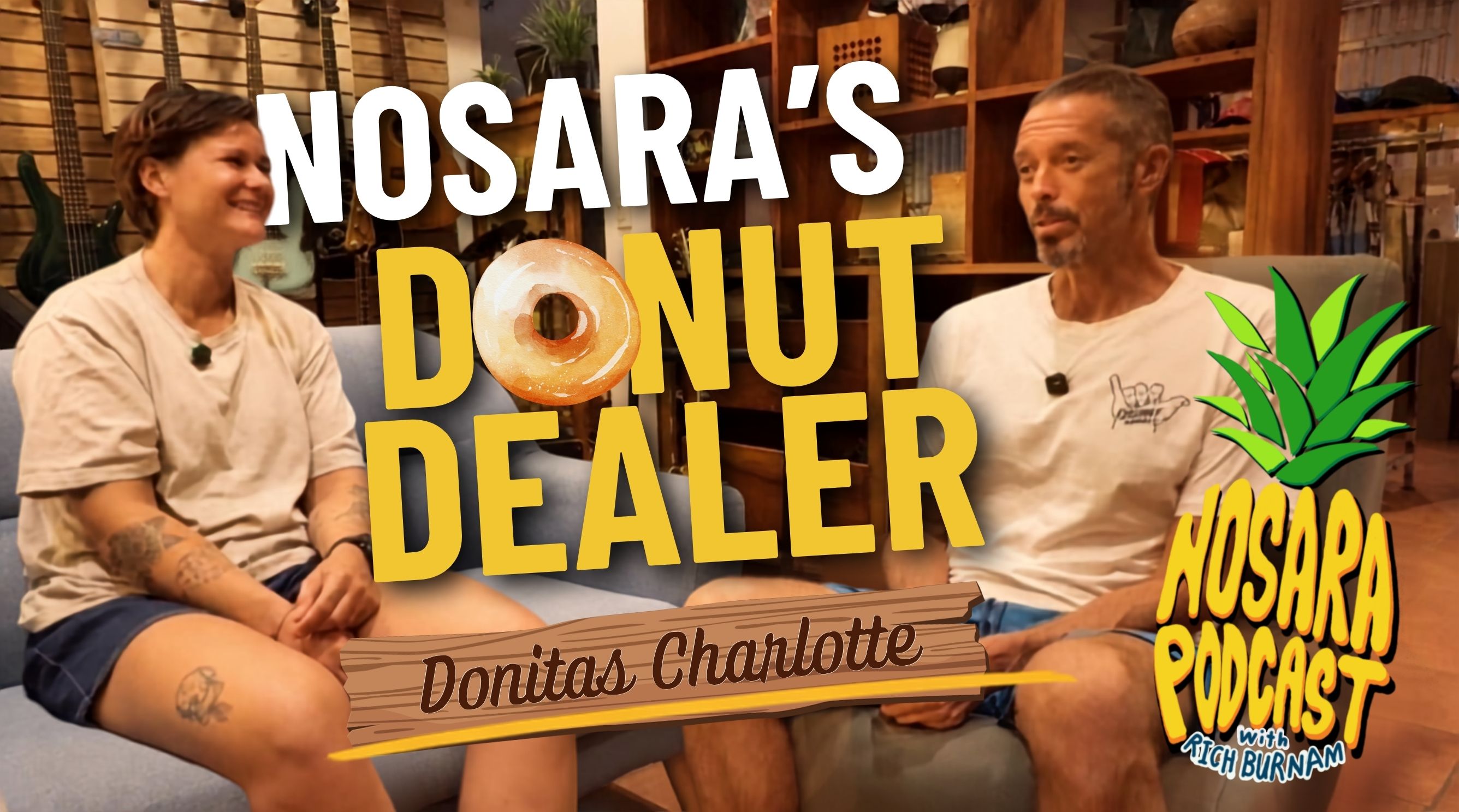
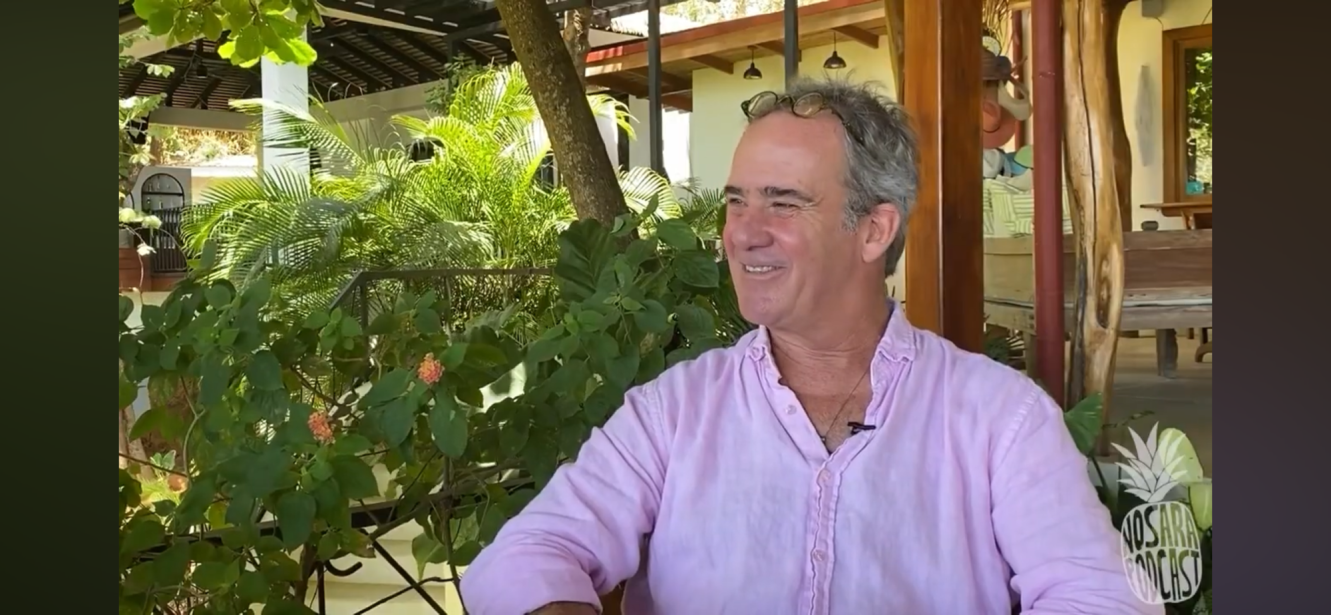
In this episode of the Nosara Podcast, Charlotte, the founder of Donitas, shares her journey of building a unique business in Nosara, Costa Rica. Moving from Switzerland, she talks about how she unexpectedly fell in love with the area and decided to open a donut shop without prior experience. Her story is a testament to the power of community, resilience, and the willingness to learn through challenges… but Rich just cares about one thing: “What is your favorite donut”, so they go into that as well!
Go get some super fresh donuts right now at Donitas in North Guiones, opposite to Mini Super las Delicias del Mundo where the food trucks are. (Editors’ favorite are the salted honey latte & cinnamon sugar donut)
• The challenges and rewards of starting a business in Nosara
• How the local community acts as a support system
• Embracing the “Nosara” lifestyle despite extreme weather
• Turning failures into opportunities for growth
• The importance of gratitude in entrepreneurship
• Building meaningful connections with neighbors and customers
• Balancing professional goals with personal well-being
• Her favorite local ingredients and, of course, the best treats to order
Full Transcript
Rich: Welcome to the podcast. It’s a long time coming. I’m excited to have the first doughnut shop ever on the podcast.
Charlotte: Thank you so much for having me. I really appreciate the opportunity.
Rich: I love donuts. And when you opened, do you remember I was like the first person who smiled and frowned in the same moment? I love donuts. So, tell us who you are and what is going on. Thank you so much for not bringing donuts, because I would be eating them all right now.
Charlotte: I actually feel really bad for not bringing some, but it was a rushed morning, so I will bring you some tomorrow. I am Charlotte, 31, turning 32 on Monday. I have been here since 2021. Originally from Switzerland, I was born in Geneva and grew up between Geneva and the mountains. As soon as I graduated high school, I started traveling as much as I could. I think I’ve been to 36 countries now.
Rich: Was it because it was so cold, or did you just need to get out of there?
Charlotte: I love the cold, surprisingly, even though I live here. It is customary in Switzerland to take a gap year after high school before you start university. I took a year and a half. I started law school and hated every second of it. I am not a very book-smart person. Then I started hospitality school and graduated in 2020 from EHL, a fancy hospitality school in Switzerland.
Rich: Okay.
Charlotte: I originally had no interest in this industry, but I kind of fell in love with it. I love the hands-on part and the creative side. I just love being around people all day. That school also gave me a lot of opportunities to travel. I spent eight months in the Maldives and eight months in Singapore. It really opened up my mind in terms of food and what I wanted to do for the rest of my life, which I thought would be more corporate than what I am doing now.
Rich: You went the opposite of that. You seem like you have an artist’s angle, but you’re also very matter-of-fact. I’ve known you for years now and see you daily. You seem very pragmatic and calculated. And then when you opened the doughnut shop in Nosara, it fits you, but it also doesn’t at the same time.
Charlotte: I realized when I got to Costa Rica, which was completely random—I was working in Washington D.C. for the Swiss embassy—that I just stayed here when the pandemic started. I fell in love with the place. I love extreme places. I’ve always loved remote places and environments that are a bit rough. I like that every day is an adventure. Sometimes you want to bang your head against the wall because nothing is working, but it’s part of why I love this place. I think life is pretty short, and I want to make the most out of every second. This place hands you stories.
Rich: Let’s go straight into the donut shop. Tell me a few stories.
Charlotte: I was going to open a street seafood place and I started making donuts to put something sweet on the menu. I went down the rabbit hole because I get obsessive. I started handing them out to friends and people said, “Can you please open a doughnut shop?” We changed our minds two weeks before we were supposed to open, and I had never done donuts before. My first two weeks of opening in high season, my coffee machine broke. I have so many people that have contributed to this project. My friends at Sunrise lent me their coffee machine for a week. They don’t have to do those things, but this place is special.
Rich: Community is the number one bonding factor. When things go wrong, it comes together.
Charlotte: It amazes me. People ask why I stayed here, because there are pretty beaches and cool places to surf all around the world. But the people make the space special. My friend Tati from Scarpetta let me use her coffee machine. My friend Juan helped me fix mine. We are all in the same boat, and there is space for everyone.
Rich: You’ve learned to take a punch in business.
Charlotte: Growth comes out of discomfort. In the moment, it doesn’t feel great, but when you have a second to think about it, you realize you learned something new. I’m an impatient person, and I can be demanding, but I have learned to work on that.
Rich: I appreciate you being open about the negatives. Do you have any messages for the community?
Charlotte: I’m really grateful. We opened May 17th last year. People in this community have supported the project from day one. They have been patient because our product has evolved. I’ve gotten a lot of honest feedback, which made us who we are now. We focused on new equipment, then on drinks, and finally on hiring a team. I wanted to know the work myself before I asked a team to do it.
Rich: What is your favorite donut?
Charlotte: I’m a classics girl, so I really love the cinnamon sugar. When it comes out warm and has that crunch, it’s my favorite. The OG classic glaze is a best-seller, as is the chocolate sea salt and passion fruit. For drinks, our honey salt latte is the bestseller. I use so much local honey. All my money goes into honey!
Rich: Where do people find you?
Charlotte: We are located right behind Mini Super Las Delicias. We’re here every day from 7:00 a.m. to 3:00 p.m., except for Tuesday.
Rich: Any final words for the surfers?
Charlotte: I don’t feel like I’m good enough to criticize anyone in the lineup, but for etiquette: don’t be a jerk.
TWIN 44 is a super fun one which hopefully conveys a ‘real’ look at Nosara this time of year. We have some good weather & happy people, plus some bad weather & what it looks like on the rainy days. Not everyone is unhappy when raining though… Legendary figure Mimi is cooking authentic Tico food, Alex ‘Adub’ Wilksonson is enjoying the plants & creek by his house, Casa Tindaya. There’s a bunch of scenes in this episode & I hope you enjoy it!
Last week in Nosara was a BIG one! Guanacaste’s 200th Anniversary, the 2nd event of Nosara’s Triple Crown Series (this event was at Barrigona), some fun surf in Guiones, all kinds of community updates… Hope you enjoy this one!
The Steve Jacobus story is a fun one & we hope you enjoy hearing it! This is a fun conversation between long time friends about their journeys to, & experiences in, Nosara, Costa Rica. Steve shares some good tales with Rich & provides all kinds of upfront info in this candid, and interesting conversation.
Episode Transcript
00:00 – Arrival in Nosara and Leaving the US Logistics Sector
Rich Burnam (Rich): Steve, welcome to the podcast.
Steve: Thank you. I’ve been really excited about this and kind of wishing I could have been on it earlier.
Rich: Well, your story is interesting and you fought hard to make all this happen. And now as we’re sitting at Tierra Magnifica, now you can rattle off awards and all the stuff that you win and all the, all the stuff. And it just seemed like it was so easy, but I knew you a long time ago.
Steve: Yeah. So, 20 years ago.
Rich: Yeah. So congratulations on 20.
Steve: Thank you.
Rich: And let’s just get right into your story. Talk us through arriving here, setting it up, and then while you’re talking, we’re going to play some photos of before and after of, of the whole thing. So just—
Steve: That sounds like fun. Let’s get going. In 2004, I came down here with my family and we were on vacation and I was in the process of selling the companies in the United States. I had a group of companies involved in logistics and warehousing and trucking. It was based in Wisconsin, but we had operations in California and I think like 28 states.
Rich: You’re clearing it out.
01:30 – The Beach Encounter with Chickie and Purchasing Henny’s House
Steve: And so, I’m on the beach. We’re on vacation, 2004. I run into Chickie on the beach. And I said, “Chickie, I’m kind of, you know, we’re here checking this out to see if this is a good spot to move with my kids for a little while.” Chickie, of course, right away, you know, you know Chickie, and he brings me up here to Henny’s house and introduces me to Pauline, who’s, you know, a real estate broker at the time and representing Henny’s house, and he’s selling it, and I bought it.
Rich: You’re hitting some heavy names in a cool story just right off the bat, man.
Steve: Yeah, yeah, so that’s how it started. So I decided, what the hell, I bought it. And I put money down in 2004 and we moved here 2005.
02:45 – The September 2005 Rainy Season Arrival and Casa Toucan
Steve: And being as brilliant and planning organized as I am, we moved here in the middle of September and couldn’t even get to the house. So the first two nights we slept at Casa Toucan in their rooms there. It was a disaster, but it was fun. It was an adventure. And then that whole September, October, you know, I sold my companies. I had some cash. I was thinking about getting involved in real estate and everything else. You couldn’t do a damn thing because it rained so hard. I literally would have to put my laptop in the refrigerator just so I could get the humidity out to start it up.
Rich: Man, you’re bringing back some memories for me now too.
03:30 – Dial-Up Internet Constraints and the 2000s Paradise Tax
Steve: Yeah, and the internet was the dial up. That was it. It would take you 45 minutes to get one little email out to your family to let them know you’re okay.
Rich: The pram let me do that. You say we have internet now. It’s like 2002 or something.
Steve: Yeah. And I sat there. It was like 10 to 15 minutes, and it’s yeah, that’s the paradise tax. But it also was cool because if you need to see someone or talk to someone about something, you didn’t have the cell phone network yet either. So you drive down to the main entrance and you stroll down it and you run into typically the person you want to see and then about four other people that you have a conversation with, and that’s, that’s how the community was back then.
04:15 – The 2008 Real Estate Crash and San Juan Hill Developments
Rich: All right, so how did you take it from then to where it is now? Talk us through that journey of like through 2010 and 12 and 15 all the way to the pandemic to now. Cause as you sit here now, you have a marvelous restaurant. You just had this awesome expansion thing. Like, it seems like, like if I was just walking in here, it’s like, oh, this guy’s always had it made. Like, you know what I mean? That’s, and there is money here now. So people don’t always know. Some of us like fought hard to make it happen and it was work and it was an adventure and it was worth it, but it wasn’t easy.
Steve: No, you know, and obviously a lot of good fortune and good luck and blessings have come my way along, along the line too. But so I bought this house 2006. I bought a much larger piece of property in the hills up in San Juan. So I had some investment here. And I started creating a development up there. 2008 hit and everything dropped through the floor and real estate in particular. It was only supposed to be a two year stay with my kids. And then I was going to go back and start a new company in the States. And I bought this piece of property, which was two and a half hectares. And I figured, well, I could probably do something with that too. Subdivided or something like that. Real estate tanked and I couldn’t go anywhere because I was underwater here in real estate.
Rich: So you locked yourself in?
Steve: Locked myself in. Yeah. And then, kids were here for, well, the kids lived in Costa Rica for a total of six years and three were here. And then we rented a house in Escazu and enrolled them in Lincoln and then three years at Lincoln. And then they went back to the States, but I couldn’t go. I had too much tied up here.
Rich: So you painted yourself in a corner, and you had to find a way to make it. Mm hmm. So, hospitality industry it is?
06:00 – Transitioning from Trucking to a Santa Marta Bed & Breakfast
Steve: Yeah, and I knew nothing about it. So I come from a trucking and warehousing background, but I know what I enjoy in hospitality, and I did well enough in my career before that I could stay in nice places, and I knew what I liked. So, post 2008, I figured, well, I better start an income stream here, because money’s not going to last forever, and I started playing around with bed and breakfast kind of thing and in fact rented a house next door to the Santa Marta school because my kids went to Santa Marta for four months, learned Spanish, made their friends with the local kids, and we had so much fun in that house that I lived in that house, and we just used this as a rental, and then we added a couple rooms, we added a yoga shala, we built on a little more, built on a little more, and just kept going.
Rich: So a true, what was that movie? Was it Field of Dreams? If you build it, they’ll come. Am I getting that right?
Steve: Yeah, you’re actually kind of a cross between Field of Dreams and the Mosquito Coast, you know, too, because I don’t want people to think I was Harrison Ford losing it. But my family back home sure thought it was, so they might not have been all that wrong.
Rich: Yeah.
07:30 – Operational Partnership with Erica and Business Scaling in 2010
Steve: So, the real game changer came when my wife, Erica, had helped me start a travel company also in 2006. And she was in San Jose and she’s been in hospitality now for over 40 years in hotel management and so forth. And so our relationship shifted to a personal relationship in 2010. And by the end of that year, I said, “Would you be interested in joining me in really building something really special? Because I think we’ve got something, we’ve got a really special property in a very special community.” And that’s why I came in the first place, the protected beach, a safe place for my kids to hop on a bicycle and take off and come back at dark and really good community that included truly local, Nosara folks that own businesses, like Roosevelt. So that’s what I love about this.
Rich: So it kind of caught your heart and set up before your mind, your initiative got you into this mess. Then Erica was the brains to help connect between your initiative and drive and vision and belief and feeling her operation skills. That’s how we got to, well, your restaurant’s full now every night.
Steve: Yeah. Yeah.
09:00 – Leveraging COVID-19 Closures for Structural Footprint Building
Rich: But you’re also in a spot where there’s not restaurants normally, and people don’t even know to come here. So the quality must be there. So. What you’re doing has been working, but these early years are interesting because you didn’t have enough space to really cash flow a ton, right? You have eight rooms for a while, I believe.
Steve: Yeah, we never, because I always wanted a very high level of guest experience, whether it’s a restaurant or the rooms. So we never made money. We lost money every year. It was a labor of love and a little bit of financial hardship.
Rich: But people liked it.
Steve: Yeah, people loved it. And we got great reviews. We’re still, we have the highest five bubble rating in Costa Rica. But so, you know, every year we would make some money during high season and then we’d kind of give it all back in low season and we maybe would break even or make a little bit, but not much. So, Erica and I just decided we would add what we could. So every year we would build what we could accomplish in three or four months. You know, so we’re sitting on top of two rooms. We built these in four months where, over there we built that and the room over there we built in three months. So that’s how we operated.
Steve: But the real opportunity for us was, you know, a big hardship for a lot of people, but a silver lining for us was COVID. So COVID hit, we were having a record year with advanced reservations. We had to give all that money back, closed in March. And I said to Erica, I said, “This is our opportunity. Now we can build that one building that’s going to take more than four months to build. And not disrupt our reputation, not disrupt our guest experience.” So we closed and we, I already had the design. We broke ground in June on that building and we delivered it in December, six new suites. That was the financial game changer.
11:15 – Chef Valerios and Post-Pandemic Menu Architecture
Steve: And then we were able to build this restaurant. So we doubled the size of the restaurant and we consistently, the quality of the restaurant kept going up and up and up. But then post COVID we had the opportunity to meet our chef, Valerios. And he had gone through financial hardship in San Jose. He lost his restaurants and he’s a talented guy. And so we flew him out here. We interviewed him and we said, “Well, if you could go from doing smoked meat and things like that to delicate foods and learning delicate foods, let’s give it a try.” And he’s been a phenomenal partner and he’s the architect behind the menus. We always do the tastings together. We always agree on that. I do the wine list. And the mixology has been outstanding.
Rich: So you’re still having fun, but now it’s evolved to fine dining. And finally, you have capacity to actually make some money.
Steve: Yeah. So now we’re making money, which is fun. All right. That’s really fun. It’s supporting our lifestyle.
Rich: It only took 20 years to really get it dialed in.
Steve: It did. It did.
12:00 – Employee Development Stories: Karina’s Mixology and Danny’s English Transition
Steve: You know, and, but the thing that I’m really proud of, too, is our head bartender, mixologist, Karina, born and raised here in Nosara.
Rich: Oh, beautiful.
Steve: And on the other side of the river. And when we close every October, she went to—Erica signed her up with a mixology class in San Jose. Karina, in one weekend, accomplished these firsts that terrified her. She flew on a plane on Sansa. She had to take an Uber for the first time. She checked into an Airbnb in a high rise tower. She was on an elevator for the first time.
Rich: Jeez, man, you poured it on her.
Steve: I know, right? Everything in one weekend. And she was so funny. And she kept texting Erica like, “Oh my god, oh my god, I can’t believe I’m doing this, I’m doing that. These are all the things I always was afraid of.” But she’s killing it. She’s doing great stuff. So it’s fun, you know, and then, like, Danny, we hired Danny as a dishwasher. And this guy had the attitude, like, in Ted Lasso, you know, Danny Rojas? He loved his job and he had such a positive attitude. We made him a runner. And then we said, “If you learn English, you can become a waiter.” He didn’t tell anybody, and in six months, he had command of English well enough to become a waiter. Now he’s the backup bartender. He’s taking mixology classes. Born and raised, you know, and so—
13:30 – The Realities of Educational System Deficiencies for Local Staff
Rich: How beautiful is initiative? Like, I think as a business owner here, there’s not much better than seeing someone truly progress their lives and get a shot. Because making it in Nosara is not easy. It’s expensive, it’s hard, it’s competitive. There’s people from all around the world wanting to come into this place. And the people from here generally don’t have the educational systems and the support to get the skill sets to get the top tier jobs, because if you’re going to run a business here at a high end, it’s not easy. There’s not supply stores all around. There’s not a Home Depot right down the corner. So it’s really cool to hear stories from inside your organization of people busting through and making it and getting positioned well.
Steve: Yeah, it is. We have employees that have been with us for a long time. Every year we have very few people that we’re replacing. And then the management team, the upper level folks stay with us, you know, but we also continue to educate them and give them opportunity to learn and grow. We send them to courses, and in October when we close, the chef picks wherever he wants to go in the world. We buy him a plane ticket and an Airbnb and he goes in and studies cuisine. This coming year he’s going to go to Italy. Last year he was in Argentina, Lima before, and Oaxaca, Mexico before.
Rich: Wow, you’ve been doing that for a long time. Where’d you get that from? I remember way back in the event Caesar. That was really impressive that you send your people to improve in the rain season. They get to experience something new. And then also—
15:00 – Off-Season Global Training Internships (Milwaukee to Soda Mari)
Steve: Yeah, we sent Cesar to the top elegant old, historic old hotel in Milwaukee, Wisconsin. And I know the owner and he gave Cesar an opportunity to be, for a month, he worked every department in that hotel.
Rich: And changed his life. He’s a phenomenal, phenomenal representative. So many different skill sets now from that exposure.
Steve: Yeah, you know that you touch on another thing being here as long as we have. Juan Carlos of Howlers started out here, Cesar came from here, you know, we’ve got a lot of folks in the community that I’m really proud of that learned, grew and moved on. Marianne owns an organic Vivero and next to, and she has Soda Mari. She was a waitress here and we started teaching the families of our staff how to grow organic groceries, prep products. And if you did, we would buy them from you versus creating your own garden. Hers got so big that she left here. That’s what she’s doing.
Rich: Beautiful.
Steve: Yeah, it’s fun. Those are good stories. And those are things I’m really proud of. And the development of our team is what gives me great joy. In my past companies, it’s always been the development of the team. Not necessarily the customer, but this is the first time that I really, I also really love our customers too.
16:30 – Defining the Adult Sanctuary and Gilded Iguana Beach Club Alliance
Rich: So tell us about that. Who’s your clientele who should stay here? Because all the buzz is down by the beach, right?
Steve: Yeah.
Rich: You have something different. It’s, I mean, outside of Lagarta, which is big and on the other side. It’s about the only, like, business that’s a true, like, hotel restaurant setup up in the hills. So, I’m trying to say, who should leave the popular beach areas and come up here and give this a go?
Steve: First of all, we have a minimum age of 15 in the restaurant and the hotel. So we create an environment that’s really perfect, very conducive for couples on romantic getaways or a date night dinner, solo travelers doing a wellness vacation or working remotely, and families with adult or older children who appreciate this very quiet environment and our culinary offerings. And it’s peaceful up here. And it’s, we got a breeze, and it’s not dusty, and it’s not hot, and we’ve got 14 beautiful rooms. We’re small enough that my staff knows everybody’s name, and uses their name, and greets them when they come back from a tour and asks them about the tour. So it’s a very personalized hospitality experience.
Steve: We have a huge wellness program with over 45 different modalities that we offer. So it’s geared towards people that are looking for a rejuvenating or quiet or reconnecting kind of experience. And we’re surrounded with nature. I mean, there’s monkeys everywhere. So it’s the peace and quiet. And then we have a relationship with the Gilded Iguana. So all of our hotel guests have complimentary use of the Gilded Iguana Beach Club. They get towels, lockers. So they got their beach space. And then they can retreat back up. And that’s how it works. Probably 70 percent of our guests dine in and then go out one or two times during their stay. But the food’s really good here. The service is great. So, you know, and it’s convenient. And all of our hotel guests always have a table. A lot of our dinner guests thank me that they have a date night spot. You know, it’s fun to go to La Luna and all these other spots with your family and be at the beach and have the kids run around. And I raised, I’ve got four of them. So it was a lot of fun. But now there’s a little sanctuary for adults to get away. And that’s good for a family’s health too.
Rich: Congratulations on this is awesome. This is, this is, this is really cool. It’s interesting to be sitting here as we record this High Season 24. A lot’s changed, a lot’s changed, but the place is still the same in a way, you know what I mean?
Steve: Yeah. I’m happy with the way it’s evolving. I’m happy with the fact that we don’t have any big, large landowners building resorts or big hotels or big condominium projects and things like that. And it’s still, to me, retains its very local boutique feel. Just, I was walking down the street on Tuesday during the farmer’s market, you know, and you’re bumping into everybody and it’s fun. It’s kind of like how it always has been. So it’s just more people and more expensive homes.
19:45 – The Evolution Beyond the Core Surf-Yoga Persona
Rich: Did you ever expect Nosara to catch like this? Because I definitely did not by 2013, 14, 15. I realized it had something. The crowds weren’t going away, but I didn’t expect it to catch with the upper echelon, the higher end at the level that it has. I really didn’t see that coming. I always thought it was going to stay a little more low key surf yoga based town. But the reality is most of the people come in here now, they’re not diehard surfers, they’re not diehard yogis. They like the idea of it. They like being around it. And that’s a pull, but it’s not the original folks that set up, which were pretty committed surf yogi, it was kind of that or nothing, you know what I mean?
Steve: It’s true. The folks that came in the eighties, you know, and it was hard getting here. They came by boat because it was a great wave.
Rich: Also the eighties even brings in, well, the people who in Vietnam, this is back, shout out to Chickie. Rest in peace, Chickie. We miss you. Chickie used to tell me about how the Nosara hotel people who were on the offshoots of the Iran-Contra whole thing. And then the Nicaragua setup was their getaway.
Steve: Yeah. I’ve heard some of those stories too.
Rich: So then, and then you had the early pioneers and then through the nineties, I guess it was the mid nineties when surf caught. Endless Summer 2 came out. If you remember that movie, and that was a big old thing for surfers. Cause from the moment I first saw that movie in 95 or 96, I watched it every night until I moved here. 2009, early 2009. And before that, but literally I watched it every night. Just: how am I getting to Costa Rica? I want to get to Costa Rica. I want to surf that wave. I want to be there. I want to be there so bad. But it was exotic back then. It was crazy. Now it’s found, now your grandma’s here, but then it was something.
Steve: Yeah.
21:15 – Geographic Scaling: North Guiones Boom and Pelada’s Covid Launch
Rich: So I didn’t expect it to ever leave that core surf yoga thing, especially cause it really was that—it was the yoga Institute. Yeah. And the north side of Guiones was like, that’s where we sent the backpacker renters or the people who wanted to party. You had Blue Dogs and you had Gilded and eventually Kayasol. And this wasn’t even that long ago. Now look at North Guiones. It’s exploded. There’s not an inch.
Steve: It’s bustling.
Rich: Uh, and now Pelada caught up through COVID’s explosion. Pelada launched. It’s not, “Oh, Pelada, that’s way over there.” And then Guiones Beach Club, which you see from here, that used to be way over there. Now the town’s really gotten a lot smaller, people are on golf carts, the walking paths reignited to connect everywhere, so that’s been a real big blessing.
Steve: I’m living on the other side of Santa Marta, and back then it was like, way out of town.
Rich: Isn’t that funny? Yeah. The road’s paved.
Steve: But you know, you’re right, and it goes back to about 2016, when it really started to ramp up again. And I think what the appeal was is, it first starts with somebody from Boulder that discovers this and then they start telling their friends, or from LA or from San Diego and they start telling their friends and they come down here and it’s such a laid back escape and it is a good consistent wave and there is holistic activities going on all around. It’s a healthy environment to live in. It’s not overrun with tourist t-shirt shops and things like that. So it has this authenticity that a lot of people, people with a lot of money and people who’ve made a lot of money are attracted to it.
Rich: Is that why it’s so sticky? That people go home feeling better. Like when they think about it as a memory, it’s like, “Hey, that felt good.” Yeah. Cause you are a little bit more healthy here. You are eating something a little different. The fruit tastes differently. And then Nosara’s vibe is very, very different. No offense to every other town, but as far as kind of its own country within a country in my opinion because if you look at any other spot there’s nothing like it.
Steve: No there isn’t. We started a travel company in 2006 so we have people traveling all over Costa Rica. Nosara is its own unique destination. It’s not like any other beach town. It has its own personality and DNA that’s unique and different and that’s what’s attracting these people and it’s going to continue to attract people because of its uniqueness. And people are starting to move up into the hills now. You know, San Juan, the real estate I bought in San Juan is back on now. And that area is becoming popular as a nice quiet respite from the beach town.
23:40 – The Machine of Real Estate and the Post-Crash Grind
Rich: It’s interesting to watch a town evolve. I, yeah, it’s been a fun run. I could be wrong in this. I’m just making this up, but this is how I feel. I think like the past 10, 12 years in the next 8 to 10 are the prime of this place for me. Because now there’s medical services. And I didn’t use to feel this way. I used to think the luster was gone. I’ve changed my mind on that from talking to people who’ve been here a long time, like Beverly Kitson and Alice Olson and a lot of these other folks, cause I was expecting them to be angry and they were like, “Wait, I liked it. There’s a doctor. I liked it. I can move around more freely. I liked that the nature reserves are still blocking big widespread development, but it’s not all bad.” And it’s very easy to look at the bad. Cause I think lack of crowds and pricing.
Rich: And in my day job, I can’t afford to buy the very properties that I sell and believe in the most and I think have the least amount of risk. So I get bitter daily because I can’t afford to participate in the machine that I’m part of. Um, but at the same time, being here is worth it.
Steve: But you’re here. You are part of it and you’re established.
Rich: Yeah, but it’s a machine. It’s hard. Like, I don’t want to keep selling properties every day until I die. I’ve sold the same properties eight times. I’m tired of—I don’t even want to hear my own voice. It’s not like I wake up saying, “Real estate!” It’s just the only way I know how to make it in this town and I want to live here that bad. Like, I mean, it meant the world to me to raise our kids here. And I’m so grateful for that, as are you. I wouldn’t change it, but just like you, I didn’t come into this with money. The crash came. I was in real estate and mortgages back in the states of financial services. So when the crash came, I lost it all. So I was sitting there like, I was this close. I’d dedicated my twenties and my thirties to working 80 hours a week. And I kept telling my wife and kids, it’s like, “we’re going to get to Costa Rica.” So I thought I lost it all. Then the phone rang and it was Eric saying, “I’m launching a rental division. Job’s yours. You got to take it or die.” And I remember I went numb. I was like, I don’t have any reason to say no at this point.
Rich: So just like you, when you bought this place and the peak of the rainy season, then you locked yourself in and then 2008 happened and you couldn’t go back and start the other companies. You had to find a way to make it work. Instead of going around the circle this way, you went around it that way. I did too. And a lot of us who’ve made it here, that’s kind of the story. It was a big old chance. You just jumped all the way in and here we are.
Steve: Maybe there’s another start to a new chapter in your life. You don’t know. You know, I didn’t ever think I was going to be a hotelier or in the hospitality industry, I’m a truck driver, you know, and a warehouse operator. I knew how to operate forklifts and trucks and now I’m in the hotel business and we’re doing well with it, but never expected it. There’s something that’s out there for you. You just haven’t seen it yet. And it’s probably gonna be different than selling real estate, but there is something.
26:15 – Access to Capital Constraints for Local Business Operations
Rich: It’s access to capital. Cause here as a business owner, there’s not the bank to borrow from in the same capacity. It’s not like, “Hey, here’s my business. Here’s what I know. I have this knowledge.” I kind of feel like I have this—my analogy is a weapon. I think I have like one of the best weapons in the world at my hand. I just don’t have a bullet to put in it, but the people coming through have the ammunition. So I haven’t figured out how to—I’m doing okay, but I haven’t figured out how to do what you did as far as homogenize it. Like you expanded.
27:00 – Quarantined Cocktail Social Media Classes and Keeping Staff Salaries Intact
Rich: Let’s talk about COVID. Like when COVID came, I was freaking out. Cause I’ve always said whenever a plane stops flying, that’s when I’m worried. Let’s talk about your version of COVID because when COVID came, you did the expansion. Talk about what happened for your employees because business owners were going to have to trim and it was a mess. You found a way through it that I found pretty interesting.
Steve: You know, there’s nothing we can do about it. So we resigned ourselves to it. We had to return money. It was actually kind of fun in the very beginning because we had this really sweet older couple from Norway who couldn’t get out. And so they lived with us for a week and a half. And so, well, there’s no kitchen service, there’s no housekeeping, you know, but I’m not going to ask you to leave until a plane can take you. And we had our mixologist at the time from Sevilla, Spain living with us. So it was my wife and I, my daughter, her boyfriend, a mixologist, and then this one couple for a couple weeks. So, you know, we didn’t know what to do. And so we just started—we had a full kitchen of food and a full bar. So we just started making dinners and having cooking competitions and making new cocktails. And the bartender and I created an every Saturday quarantine cocktail class on social media that all kinds of people were signing up and watching it and they’d have all their ingredients prepared and we do two different cocktails. And so we’re having some fun.
Steve: But at the same time, we also decided we can’t reopen in June or whatever. We knew why, because we’ll lose money. So let’s stay closed until December. Nobody’s going to fault us for that. And we’ll build this new building and we’ll build this restaurant addition and we’ll completely renovate the spa and the yoga shala. And then that gave us the opportunity to offer to our employees, our team, anybody who wanted to keep their salary intact: you got it. You know, you just might be pushing a wheelbarrow or sanding or whatever it is. Men and women. Two thirds took us up on that. A third, you know, hunkered down and went home with their families. But two thirds showed up and did whatever they needed to do. They were on one side of a yellow tape and we were on the other side and it was crazy time. But you know, you can’t sit and do nothing. I’ve never been one to really sit in fear. Figure, well, okay, where’s the opportunity here? Let’s figure it out. And it was a little risky because we didn’t know, but it’s paid off for us. Those rooms made all the difference in the world and it allowed us in expanding. This allowed us to elevate our hospitality offerings. So it’s worked out really well.
Rich: And the COVID break and the energy that came from it of people wanting to get out and see stuff was the perfect time to launch your whole new thing. And it gave you time to build it. It worked out well. Just fantastic.
Steve: It did, it did indeed. So it didn’t seem like that in the beginning though.
Rich: No, no.
Steve: But you know, I’ve had several instances in my life where you didn’t see something coming and it did, and you just pivoted. Y2K time, you know, I had a few companies that were very heavily involved in software and logistics and so forth, and that worked out. You just gotta roll with it. Figure out where’s the silver lining or where’s the opportunity out of it.
29:30 – Infrastructure Fragility: The Electrical Grid, Internet, and Nicoya Tax Drain
Rich: Alright, Steve, I want to know your negatives with Nosara in general, like what are your dislikes?
Steve: The dislikes? Well, the one frustrating thing is that I don’t think the electrical grid infrastructure is getting improved. And as more people are moving in here, the service quality is going down sharply. As is internet, so that’s a little, that’s frustrating because that shouldn’t be the case. There’s a lot of money being generated by this town, but not a lot of it is going into the town. That’s frustrating to me. I have a lot of concern about the local Nosara residents who—those were our friends when I first moved here—getting pushed further and further out and their kids not getting a decent education. Those things worry me. Water quality, that worries me. And those are the, I don’t know if I call them dislikes, but those are the things that concern me about Nosara.
Rich: What message would you have for people who are looking at entering the community? Like, if you were coming in now and you were giving yourself advice, what would you say?
Steve: Well, first of all, when people do ask me that question, I say, well, definitely rent, don’t buy something, don’t do what I did. But rent and get a sense of it, get a feel for our community, where you’d like to be, and so forth. Be sure that you’re in a place where you know you can protect your home and yourself. There are some areas that aren’t as safe. So, and take some time and get to know it and get used to it.
31:00 – The Economics of Town Survival vs. The Perception of a Great Living
Steve: The one thing that I do tell people is it’s not an easy place to make a living. It’s a very difficult place to make a living. And a lot of people have this perception that they can come down here, offer their services, and they’re going to make a killing, or make a great living. It’s expensive in this era. It’s very expensive. So, unless you’re going to adapt to a true Costa Rican diet—rice and beans and the basics that are available here—you’re going to spend a lot more money here than you will in the States on the foods that you like to eat, the drinks you like to have, wine you’d like to drink, you’re gonna spend a lot more money here. So it’s more expensive. And it’s more difficult to actually make a living from this community. Now we have folks here that are working remotely and able to make a living and do well, but making a living from this community, it’s hard.
Rich: The town changes once you have to extract money from it for your survival. Everything changes. The curtains all come back and the challenges of it surface.
Steve: Yep. And it’s, I feel for the folks that come down here with a great idea for a restaurant and they’re a talented chef and they struggle because it’s hard and there’s a lot of competition. That’s the kind of advice I give people is, how are you going to sustain yourself? You know, what are the things you want to do? There are some folks that are down here that are really geared towards trying to make a difference in the community. Um, you touched on that before. I wish—we’re trying to work with a couple of organizations too. Try to get other ones to fold into it or participate together or collaborate together so that we can harness all these folks that want to do good things here and their contributions into a mainstream targeted direction. That would be huge. And that’s, yeah, that’s a struggle.
32:45 – Squeezing the NGO Funding Turnip and the High Season Census Problem
Rich: That’s—boy, that’s it. That one’s, it’s close to home podcast. We were recording just before this, we were talking about that and there’s no shortage of NGOs. Like we currently have over 50.
Steve: I know.
Rich: Most of them are competing for money from the same place. So people do move here from wherever they’re from with a great idea, whether it’s opening a business or doing good for the community. They’re like, “Let’s do this,” and then they get here and then it’s a whole different ballgame. So, well, you touched on it earlier that we don’t have the governmental funding and most of our tax money goes to Nicoya and basically see, we need a census. I’m going to start saying that a lot more on podcasts. We need a census so that we accurately know how many people are here. Cause I think they currently have us registered as like 5,000 to 8,000 people. So we get the funding for just that. We’re way bigger than that at this point.
Steve: I’ve heard that during high season, we swell to 22,000, 23,000 people, right?
Rich: Right? So that’s why our ambulances aren’t funded, right? That’s why the Bomberos are taking on so much additional stuff is because it doesn’t exist without them, but they’re all privately funded. So Nosara has kind of become its own funding machine with 50 plus places. We’re squeezing blood from the same turnip. So what we need to do is tap into the new people who are arriving, the people who have means, and a lot of the people, those of us who have been here a long time. It’s very easy to get bitter, but the reality is that we’re closer to a solution, in my opinion, to most of our problems than we’ve ever been. You and I never thought that road was going to be paved like it is. Cayamodello just happened. You actually have drainage, Animal Crossing Pass, like a fine example of how things can be.
Steve: Well, you guys came up our road, and that’s the whole Las Huacas community pitched in.
Rich: That’s right.
Steve: I never thought that we would achieve raising that much money in this community, just in this community, Las Huacas. It’s a great community. People are stepping up.
Rich: We have examples of it actually happening right now. And that extends, we just got to get to the local populace. Like you said, if we can get the organizations and people to get to the local populace, then the local people from here can get jobs at places like this and it can work.
34:15 – Proposing a Dedicated Hospitality and Trade School Blueprint
Steve: Well, one of the things that we’re—I’ve got a few folks that have been around for a long time in business that we’re talking about building a trade school, hospitality trades. But a hospitality trade school goes beyond teaching chefs, you know, cooks and housekeepers, things like that. It’s mechanics, electricians, it’s landscape management. It’s so many things. And I think that would be phenomenal is to give some of these kids that just—university’s not in their horizon at all, or you give them an opportunity to find a skillset.
Rich: A skillset to make it. You’re spot on. I hope people listening to this will consider getting involved in this type of stuff, and I appreciate you bringing it up.
35:00 – Steve’s Local Restaurant Picks (Howler’s, Mama Gee, Harmony, La Luna, Coyol, La Brasa)
Rich: I’m gonna ask you a weird question now. What are your three favorite restaurants in the area that you’d like to go to? And you, outside of this fantastic restaurant here, which by the way, we’re getting a lot of people bringing up Las Huacas. I asked this question to everybody and this one’s coming up a bunch, but you’re not allowed to say here.
Steve: Okay, I won’t say Huacas is my favorite, but I eat here more than anywhere else. No, I would say my favorites are—I mean, I love Carpaccio at Howler’s in the afternoon. My wife and I, we go down there quite a bit. I’m enjoying Mama Gee. Like I think they’re putting together a really nice offering. And so I’m enjoying that one. We go to Harmony frequently. Okay, I’ll give you a couple more. For me, my daughter and I have our kind of date afternoons. We frequently go to La Luna for around two o’clock on a Sunday and have our little chat. That’s priceless to me. That’s the environment of La Luna. And I enjoy the environment of Coyol, too. Going up there, again, for like a late afternoon lunch. I enjoy that a lot, too. So, those are, I’d say those are probably my top picks. Oh, I do, I’m sorry, I also do enjoy La Brasa. We have so many options.
Rich: We got a lot of options.
Steve: There’s a lot of good restaurants. Great restaurants in town and great lunch spots and dinner spots and, again, that’s—the people that are moving into this community are supporting those businesses and a lot of them are succeeding.
36:30 – Secret Beaches and Quad Exploration Eras in San Juanillo
Rich: We have a lot of beaches up and down this coast. If you had to name two or three that those were your beaches you’re visiting for the rest of your days, what would be your top two or three?
Steve: Well, Guiones would definitely be my first choice. I like Pelada too. I love Garza, you know, so I like to fish and I like to go out on Kaia’s sailboat. And so I enjoy that one too. We even, for my son’s 25th birthday, we brought down water skis and they hired a fishing boat. We went water skiing in the bay. It was fun and really hard. It’s hard to water ski on an ocean.
Steve: But apart from those, every once in a while, I like to go up with Erica and we do a little picnic with our family on that little beach in San Juanillo, not the public one, that one that you gotta walk down the path on. I love that beach.
Rich: It’s a special spot.
Steve: Yeah, it is a special spot. When I first came here, my son Ryan, he was 12, he got a quad, I got a quad, we put the other two boys on the back of it and we went north. Didn’t know where we were going. Made a left-hand turn in San Juanillo, I found that beach, we pitched a tent and camped there for a night. Had a blast. Then we went to Marbella, we camped there. You know, remember the Argentinian camping spot? We camped with those guys, these little kids. Then we went up to Junquillal, we camped there on the beach. It was just exploring. Never been up that road.
37:45 – Building in Junquillal in 2006 to Overcoming Local Stigmas
Rich: Man, I didn’t camp, but I did the same thing. Tamarindo was thundering so far south and so strong. I got at least his 2002, 2004 range. And Nosara between 2002 and 2004 had basically tripled. And I was like, “I’ve missed that. I’m going to get in between and enjoy the ride.” So my first purchase, because I missed Nosara, was in Junquillal.
Steve: Was it?
Rich: It was in Junquillal. That’s where we built our first house there in 2006. Second kid was born down here in 07. And then by early 09, I moved full time all the time. But my plan wasn’t to get here in that way. My plan was to make enough money to live on my own terms because I thought, I thought making a living down here would be very challenging. And boy, was that accurate.
Steve: Yeah, it’s true.
Rich: Uh, but that being said, I’m glad I did it. I hope it’s an example for, for kids and also for other people. Like, that’s another reason for the podcast. It was to get to know someone’s story. Because some people, if you just say, “Steve at Tierra Magnifica,” people just think, “Oh, he doesn’t have any financial problems. He can’t relate to me. That guy’s up there on the hill with all this money,” if they didn’t get to know you. So thanks for coming on this platform, and sharing that with me too. I want kids to know you can make it here. All you gotta do is bust your ass for a long period of time consistently, and you can make it.
Steve: Look at, you know, my kids’ friends, you know, they went to Santa Marta, so a lot of their friends are now the kids that have their own surf school, or they’re surf instructors, or they’re guides, or they’re, you know, Adrian. I got to know Adrian from Agua Tibia because he was working at his family’s, at La Roca, in the restaurant, and his English was pretty good. And I said, “You know, you ought to come to Nosara and check it out. There’s opportunities there in tourism.” He worked hard and made it. A lot. I love those. I love those stories. I’m celebrating it. So I just, I hope people can understand the positive. You can still make it here. It’s just, it’s just not easy. But that, that’s life.
Rich: I hope the kids can get that message as opposed to just thinking people from somewhere come with a bunch of means. And there are people doing that. Those are my clients and your clients now, but I hope that the kids from here and the families from here can have hope that they can make it. And I hope that the people who are coming in will help get to them because we have so many talented people from around here. You know what I mean? We just need to get the cultures to, to continue to merge. And you try to get organizations to cooperate. Well, now we’re starting to break rule number one. My rule number one to live in here is don’t make sense. So, I do hope we can make sense of the education stuff. You’re onto something like with the technical—what was the term that you used?
Steve: It’d be a hospitality trade school, right? And it teaches the various trades that get incorporated into hospitality. And it gives some—some people just are not good learning in a school environment or books and things like that. Versus working hands-on, being an apprentice, and a lot of kids are successful that way. And if you really do learn how to become an electrician, or a plumber, or AC repair, you can make a living and survive here in Nosara.
Rich: It’s always relevant.
Steve: Yeah. It’s always needed.
Rich: You definitely can.
Steve: So, there’s always possibilities. But, I feel particularly because I’ve been here for so long, it’s our responsibility to help expose those possibilities and bring more of the community into there.
Rich: I appreciate your time. And you coming on this year. I do. I do. Any parting jokes, messages, ideas, thoughts, anything you want to get out there while you have the platform?
Steve: No, no, it’s just good to see you again, Rich. Love having you up here. You need to bring your wife up here. She’ll enjoy it. Nobody’s going to want to talk your ear off. Everybody’s left alone here and you’ll have a really nice dinner.
Rich: Hey, when you first launched, she did, and she does love it. Yeah. You’re on the short list. Like, you have good stuff happening.
41:15 – Tour of the Canopy Jungle Lounge and Custom Local Furniture
Steve: Now I’m feeling really, really honored. That’s great. So this is super exciting. We just opened this in December, beginning of December. It was an idea that I had in 2019, but, you know, COVID hit and we built the other buildings. So now we built it this year and we built it around four trees. So we maintain the canopy above the roof. The monkeys still have their trail and we call this the jungle lounge. It’s a pool table and dartboard. And it’s a place for our hotel guests to lounge. It’s a place where the community can come and hang out. We’ve got, you know, these wonderful—all of this is custom made, our furniture, the bar. We have a kitchen that we’re preparing a menu for that we’re going to start offering on weekends. It’ll be pizzas and kind of, you know, casual finger food while you’re just hanging out here.
Steve: Built a conference room so people can flip on the A.C. if they want, close it up and have a Zoom meeting, and our guests and the community are reserving that every day. So that’s been a cool addition. And then we built over here our jungle nests. And these are awesome. And people are coming here and hanging out. I came up here one day and this guy was asleep for an hour in that one over there. And so these have been really fun. And it’s fun to watch people try to get into them. Some people get a little nervous because you can see through it. But these have been fun. We engineered these and designed them ourselves. On weekends, we’re playing sporting events. The Super Bowl, we were packed. We probably had 200, 200 plus people in this room.
Rich: So the public can come on up and hang out in this area?
Steve: It’s for the public, yeah.
Rich: Alright.
Steve: Yeah, you know, so before, with the restaurant being kind of fine dining, we wanted to create a casual spot so that people felt comfortable coming in and hanging out, shooting a game of pool, throwing some darts, having a couple of beers or a glass of wine and an appetizer.
Rich: Yeah. Yeah, this is, what a cool add-on. Darts, pool, pizza, healthy Blue Zone style food.
Steve: Yeah, yeah, the chef on Wednesdays is doing a Blue Zone tasting menu and demonstration up there in his Nicoya kitchen.
Rich: Uh-huh.
Steve: Um, so we’re having a lot of fun with it. We’re coming up with new ways to utilize it. It’s also available for people to rent privately. So, we have a big birthday party in a couple of weeks where they have this place. It’s private, just for them. We’ll have it staffed. We can move all the lounge furniture out and bring in tables so we can do a sit-down dinner for about 80 um, or have a combination of tables and, and lounge furniture.
Rich: This is rad.
Steve: Yeah, isn’t it fun?
Rich: Yeah.
Steve: And it literally is in the forest and, you know, the monkeys in the afternoon will be right there on that tree. They’ll be on this tree right here. You know, so the people hanging out here, even the local residents are like, “Wow, I’m not seeing these monkeys down by my house.” So it’s, it’s really pretty special.
Rich: Well, you did it. You have fine dining, fancy. You can look elegant and be all exquisite over there. Then you come over here and play pool or throw a dart.
Steve: Well, my wife gets a ton of credit. She’s the general manager here. The quality of the service belongs to her because she’s, you know, they’re her employees. We collaborate, we worked well together and, you know, I, we have the visions for these kinds of things. And fortunately we’ve been able to execute them.
Rich: Apparently so.
Steve: Hmm. Yeah, so you have to come on back up and we’ll shoot a game of pool or throw some darts together.
Luis López Alfaro es propietario y opera Transportes Guiones y es un hombre popular y querido que es un buen ejemplo del que pueden aprender los niños. Tiene muchas habilidades y continúa evolucionando. Comenzó a trabajar en la construcción, luego aprendió a ser mecánico… En el camino adquirió la pasión por andar en motocicleta y surfear. Luis explica su trayectoria desde él hasta convertirse en un emprendedor exitoso y cómo sigue su lema de “Trabaja duro y juega más duro” en su vida diaria. ¡Esperamos que disfrutes conociendo a Luis!
**Nuestros subtítulos están bastante desviados y nos disculpamos por ello. ¡No hay suficiente tiempo en el día para hacer todo! Estamos muy respaldados con los episodios y buscamos voluntarios que nos ayuden con los episodios.
Luis Lopez Alfaro owns and operates Guiones Transports & is a popular, well liked man who is a good example for children to learn from. He is a many of many skills and continues to evolve. He started working in construction, then learned how to be mechanic… Along the way he picked up a passion for riding motorcycles & surfing. Luis explains his journey to a successful entrepreneur and how he follows his motto of “Work hard & play harder” in his daily life. We hope you enjoy getting to know Luis!
**Our subtitles are off a good bit & we apologize for this. There’s not enough time in the day to get everything done! We are super backed up on episodes and looking for volunteers to help us with the episodes.
Gregory Gremillion from Alt Fin Co is incredibly interesting… He looks at the end point of things first, then will design a plan. His restaurant in New Orleans was super successful, although it was seemingly a strange idea initially. His new project, Alt Fin Co is another interesting one which doesn’t seem to make much sense on the surface, but once again he has a plan. Gregory explains this in his episode plus much more & we hope you enjoy meeting both Gregory & Alt Fin Co in this episode!
Gregory Gremillion from Alt Fin Co TRANSCRIPT
Rich: You got a lot going on and I don’t know how your business is going to make it. It doesn’t make any sense to me, and that’s why I’m so excited about this podcast. Greg, welcome to the podcast.
Greg: Hey, thanks dude. You make no sense to me. I met you in the water. I met you in the water and you said, yeah, I think I’m starting a lounge, this thing around fins, and then just watch a lot of surf movies.
Rich: And I was like, that sounds like heaven, but how is that a business in a place where things are very expensive? It truly is expensive here to have a business, to pay everything, to pay all the taxes. Especially if you do it the right way.
Greg: I think on the surface, if what you’re looking at is just the fin shop, then yes, that probably makes zero sense. But I see the end first. It’s how I’ve always operated. I have the fin shop, Alt Fin Co. I’m there Tuesday through Friday, 11 to 3. Wake up, bring the kids to school, go surf, come back, I’m in there. It’s my office. It’s a fin shop. If you want to come in and check out some surf fins, you know where to get them in town. And then after four o’clock, it evolves into a cocktail lounge. Surf culture themed cocktail bar. We’re screening films, all that stuff.
Rich: And we’re going to do that once a month?
Greg: That’s the goal. What we’re going to try is a little series where we maybe get some of the local surfers in town, let them come in, check out some fins, grab some fins, go for a surf, film them surfing, and then come back and put them on the screen.
Rich: Dude. That’s rad. Can you tell me your story, man? How did you get here? I know you had a restaurant in New Orleans, but what you’re doing sounds so freaking cool.
[5:00] From the Gulf Coast to Portugal to Nosara — Greg’s Surf Origin Story
Greg: We’re both from the South, we have that in common. You’re from Florida, I’m from New Orleans. I remember being pushed out at a young age, always into the surf magazines. Like, where is this blue water? That is not here. I want to find this blue water.
Rich: I’m finding your commonality pretty quick.
Greg: Completely enamored by the color of the water and just how cool this thing looked. It must have been junior or senior year, around ’93, ’94, ’95, something like that. Surfer Magazine, there’s this expo on different boards and shapers. I see this one board being surfed by Taj Burrow
at the time. It’s a Maurice Cole board — MC board — has a little koala bear logo. I still have it. It’s actually signed by Laird Hamilton, who I never met but ended up coming to our fishing camp with my dad at some point. But anyway, I either wrote him a letter or called him on the old school landline, and a few months later a surfboard from Hawaii popped up in a huge box at my grandfather’s machine shop.
Rich: What?
Greg: The secretary’s like, what is this? It’s usually boat parts and engine parts. So yeah, it’s a surfboard, and I try and go out and surf in an area called Fort Fourchon
where these big offshore supply boats come out, they service the oil rigs in the Gulf, and I’m trying to surf out there.
Rich: What if they have tanker waves there now? Are there foilers there?
Greg: There is a channel and it’s very possible, but it’s just people fishing. Dirty water. That board made absolutely no sense. It was like a gun made for the North Shore, and here’s the Gulf of Mexico and I don’t know what I’m doing. Fast forward to around ’03 to ’05. I went to graduate school in London and I did a surfing safari in Portugal. I was like, I’m going to go surf, I’m going to figure this out. That was probably the first time I stood up on a board. That was with an outfit called Atlantic Riders.
Rich: What year was this?
Greg: That was probably 2004. I did it for a week. We started at the top of Porto and surfed all the way down to the Algarve. And I loved it and I did it again and I did it again — three weeks in a row. I’m hooked. But I’m not a surfer. I’m a beginner who learned how to stand up on a board and got that feeling.
[12:00] The New Orleans Chapter — Building the Swoop Duggins House
Greg: Some years pass and I’ve done a lot of different things — started a company, sold a company. And then, all right, the first dream, which was also a terrible idea by the way. I’m going to buy the single oldest building in downtown New Orleans — not the French Quarter, but the CBD, the Central Business District. This building called the Swoop Duggins House,
falling apart, but just a gem of a building. I saw the potential.
Rich: So your vision sees stuff way down the road.
Greg: I saw the end first. I didn’t see the ten years of work it was going to take to get it there. I had a restaurant for eight years that was wildly successful. The design was really good — both aesthetically and the business design. Owner-operator, you have your commercial real estate, you own it, but then you’re also the tenant, you’re producing the cash flow, you’re controlling everything. And if you do that for a decade in an area of a downtown city that then becomes the burgeoning district — the pandemic hit and at the end of that I was like, all right, let’s remodel right now while we have the opportunity. And when I decided to sell, I had a fully permitted, fully restored property downtown. Turnkey. Here you go.
Rich: Here’s what I just heard. Turns out you’re a very astute businessman, and your endgame has more ways to succeed than one. Can I fast forward to Costa Rica — how we got here?
Greg: Friends of friends recommended the place. We first came down around 2015. The first two and a half, three years was renting, learning how to surf. Then the pandemic — I sell my place, come back, sell my business, come back, buy a place. What do I do? Who am I? Complete crisis. Hit the rainy season. Two rainy seasons ago, which was tough on me personally, just because of the way I entered it — not having a career, not really having purpose. And I thought it would be almost disrespectful to start trying to sell boards. These guys shaped for a long time, they put in a lot of work. But there are all these little components. What about fins? And then you do the research — it’s a $300 million annual business and it’s going up.
Rich: I was about to make a joke. I think I am one percent of that because I buy fins all the time.
Greg: And there’s no better way to change your board than to buy a new fin. It changes everything — especially if you’re surfing a longboard or a mid-length or a twin fin.
[20:00] The Surf Industry Shift — Why Fins Are the New Frontier
Rich: If you told me ten years ago that twin fins would get popular, mid-lengths would be the emerging thing — you’d see professional longboarders heading to it, even shortboarders. The surf industry changed so much because it used to be magazines, movies, contests. After the internet came, you didn’t have to be a contest surfer to produce content. Now you and I get to see people riding different boards all the time. Mason Ho, Jamie O’Brien, Coe Roth — Dane Reynolds doesn’t have to go on tour and be miserable. He can put out a three-minute clip and we’re like, holy crap. You happen to launch a fin business. You are in front of a huge thing because your average surfer and your high-level surfer are heading to the mid-length market.
Greg: Look, I haven’t succeeded yet. I’m just trying. But everyone I’ve reached out to — I’m working with all independent shapers. I’m not going after FCS, not going after Futures. I’m working with Captain Finn, working with a couple from J-Bay, working with Corey Nolan from the Northeast — Hydrophile Surfcraft.
Rich: Tell me about how you found Sieve Fins. The recycled ones.
Greg: I was looking up recycled fins. I wanted to either 3D print or manufacture quality recycled fins somehow. And I see this couple running it — they started coastal in northwestern Europe somewhere, then moved to Germany. They’re using recycled bottle caps — a blend of 70 percent recycled ocean-found bottle caps and fiberglass. And they’re also doing a recycled carbon fiber. I first reached out and said, look, I’m opening a fin shop, I’d love to carry your product. Then months later I came back and said — you’re doing exactly what I’d love to do. You’re not out here in Central America, it’s probably not even on your radar. How do you feel about maybe doing some co-branding? Let me put my brand on your fin, you handle manufacturing, and we all sell a little more. They agreed. And that’s why their logo is a little bigger than mine on the fin.
Rich: Dude. Your weird story that makes no sense is making a lot of sense. You’re co-branding with companies that are very little known now but are probably about to be. You’re basically creating a craft brewing company of fins. Ahead of schedule.
[30:00] Fear, Family, and Operating on the Edge
Rich: You said you can’t live in fear. I wildly disagree. I think most people live in fear. I know I live in fear. That’s part of what keeps me motivated. Even this podcast, a lot of it is from fear. I don’t want to run out of money to provide for my family. As an entrepreneur here, there are ups and downs. People might think, because you have a nice car, that everything’s great. They might not realize the amount of money it takes to operate, keep employees, pay taxes, do everything. Fear keeps me on the line of waking up every day.
Greg: Look, maybe on the surface I can talk that game — but in all honesty, I’ve laid it on the line. I’m operating on the edge right now. I’ve got a wife and two little boys I need to look after. And I’ve always gone for the home runs. Sometimes they work and sometimes you strike out. But you can’t hit the grand slam if you’re not swinging for the fences. For better or worse, I’ve always lived that way.
Rich: I want to know how you got that way. Most people don’t think that way. When I moved down here with no money, two kids, I sold everything, had maybe $2,500 total to my name, and put it on the line. I wouldn’t change it for anything. The pains of here are way better than the pains of not trying. I watched Endless Summer every night from 1999 to the day I moved here in 2009. Programming myself, thinking about Playa Negra and the waves. I fought so hard to get here. I don’t want to lose it. So the fear is instilled.
Greg: I’m at the beginning stages. I spent all the startup capital. I should be living like a 23-year-old entrepreneur right now. I was promoting a DJ party on Instagram last night. I’m 45 with two kids. What the actual — that makes no sense. That aspect of what I’m doing.
Rich: It does if you want to make it here.
Greg: And this is the answer to all of it, honestly. For us to be able to go out and surf consistently — because we’re from the South, from flat places, without many waves — I have a friend, Robert Barbieri, who said, Rich, if you can get me down there and I can go surf for an hour every morning, you can punch me right in the face when I get out and I’ll be happier than going so hard back home. Whenever things are tough, that’s what I remind myself. I went surfing today.
[38:00] Learning on a Gun in Guiones — The Board That Made No Sense
Greg: When I first moved here and I needed to get a board, I knew nothing about the different types. I went over to Juan Surfo.
This was rainy season, around 2015, 2016. I knew I didn’t want to learn on a longboard, but I also knew I probably wasn’t going to figure it out at 36 or 37 on a shortboard. And I saw this shape in the middle. It was a 7’3 semi-gun. A 7’3 pintail quad — Backyard Shaper, brand new. I learned on that board. As the waves got bigger, the board started to work better, started to work like it was intended. By this weird fate, I started to get better as the waves got bigger, and I wanted them bigger because I noticed my board worked better. I still have it. It’s on display at my house.
Rich: I think subconsciously that’s what got you into fin angles — because you’re associated with guns your whole life.
Greg: My first two boards were guns. One I’ve never even ridden because I just couldn’t ride it at the time. My brother ended up moving to Hawaii and I sent him off with it. He beat it up pretty good for him, but then I later got it back.
[47:00] Inside Alt Fin Co — The Shop, the Fins, the Art
Rich: Gregory. We’re at your place. I took one of your pictures and shared it. I think I said something like this strange new place.
Greg: Strange was the word.
Rich: I was 100 percent right. You have fins everywhere that I can buy or look at. You have surfing stuff everywhere. You have music playing. I guess drinks — we’re in a lounge?
Greg: Yeah. We’re in like half cocktail bar, half surfing shop, which doubles as my office during the day. Had three different groups drop in today, all from Austin, Texas, which is just really strange. Sold a few fins, some wax and leashes. Those people said, man, we want to come back at night and check this out because this looks like an interesting place in the evening. That’s the idea. Your underground weird surf shop during the day that evolves into a cocktail spot at night. Maybe we have some DJs, maybe live music. We’re going to do an eighties night thing with a vintage clothing store — Hot Tamale.
Rich: What gave you the idea for that wave?
Greg: I’ve been working with this young designer for years — found him on 99designs. Very talented, and he’s not even a surfer. I said I want a flat screen long-ways with my logo, and then let’s get some kind of wave graphic. And he sends this back a week later — it’s looking down the barrel of a wave.
Rich: It set the tone. When I walked in here I was instantly happier. The blue, the color of happiness. And then I put my head close to it to pretend I was getting barreled and I heard the ocean.
[55:00] The Shapers on the Wall — J-Bay, Douglas Evans, Sieve Fins
Rich: That blue twin fin, goodness gracious. Tell us about Douglas.
Greg: Douglas Evans, he’s out in Marbella holding it down.
He shaped boards for decades out in Bali and trained under a well-known shaper there. He’s got a really nice little shop — if you’re heading down to Marbella, it’s on your right. He and I had a lot of fun. I wanted to create some boards to go with the aesthetic. It’s all about alternative surfing. I’m not trying to rep the big boys that have already made it. It’s Captain Finn and then down to your independent backyard shapers from all over the world.
Greg: The Sieve fins — those are 70 percent recycled ocean-found bottle caps, 30 percent fiberglass. Any of the colored ones are that blend. Any of the black ones are recycled carbon fiber. I don’t even know how you do that, but they’ve come up with a way. And I’m not just another fin on the wall — I’m co-branded with them, front and center. That’s how that happened.
Rich: This is the second podcast I’ve recorded today where a business owner was implementing recycled materials back into the product.
Greg: I’m not some big freedom fighter. I just hate when I see a ton of plastic on the beach. I don’t want to surf in a bunch of plastic. This is one way to cut off that life cycle. We’re taking the plastic out of the ocean and surfing with it. Which I think is pretty cool.
[1:03:00] The Fins Conversation — Changing Your Board Without Buying One
Rich: I think fins are the unknown thing in surfing right now. Board shaping — if you look from 1982 to now, a lot of the shortboards are basically the same. The one thing we don’t have a handle on is fins. If I take my Tomo and adjust from one setup to another, the same board couldn’t ride more differently. It’s the cheapest and easiest way to get a new surfboard, without a doubt.
Greg: I’ve changed my fin on my longboard three times in the last two days just to see what the different fins do. First I had a really fat Joel Tudor-style fin — rode like you’d imagine a Lexus or a Cadillac. Old school comfort. Then I switched to this one from J-Bay. It’s a poplar
template. And this one from Corey Nolan. The way he describes it — there was a longboard built in the ’60s or ’70s called a pig: really fat on the back and the bottom, then pulls in toward the nose. A Del Valle, I believe.
His idea is to take that older shape and give it a little more modern feel. Let it flow and grab a little — more maneuverability.
Rich: Hey, can I ask your opinion? Fins are the unknown thing in surfing right now. If you’re riding a standard setup and adjust, the same board couldn’t ride more different. It’s the cheapest and easiest way to get a new surfboard. And now if we’re talking about single fins, twin fins, bonzers — it’s completely wide open.
[1:12:00] The Board Greg’s Been Riding — Christensen Long Fish
Greg: If you’ve seen me surfing for the last two years, this is the board I’ve been on 99 percent of the time. It’s a 6’6 — it’s called a long fish. And if you look on Christensen’s website,
he describes this board as: if you were stuck on a deserted island and had one board to surf big waves and small waves, this is it. You can surf this in longboard Guiones conditions, low energy, catch waves easy. And you can surf it at max Guiones and it will just fly. The glassing was done at Moonlight Glassing.
The flex you get from a good glass job that’s meant to give a little is absolutely worth the pressure marks.
[1:18:00] The Cocktail Side — Sound System, DJs, Listening Nights
Greg: My background before I moved out here — I had a restaurant and a cocktail bar in downtown New Orleans. I wanted to bring some of that cocktail culture here into the surf shop. I’ve always been into music, so I brought in my two Technics 1200s.
Rich: Would you do that again?
Greg: No. They got absolutely beat up on the way in. But they look really good and when it’s all said and done they’ll probably stay here because they just weigh too much. The mixer made it in alright. I put in a cool little boutique hi-fi audio setup so that whenever we watch films you get good sound, when we’re just listening to music you get good sound. We’ve been doing a listening night with an artist by the name of Carlos Saldana.
He’s not a DJ, not mixing records — just brings his curated vinyl selection. He brought in some Radiohead, some Beatles. Really eclectic. And then we have DJs — tomorrow night it’ll be some downbeat ambient, mushroom jazzy, slower, more sophisticated. On Thursdays, we have Juan, the cafe manager upstairs, who’s also deejayed for years out in San Jose. More of a deep house or minimal house vibe.
Greg: In the evening, what we’re going for is a surf culture arts club kind of place. Come in, have some cocktails, have a beer. We have a few different mocktails. I even made a point to bring in a non-alcoholic Bellini — that’s sparkling and pureed peach, but non-alcoholic. I’m 45. I’ve got a lot of friends that don’t drink anymore. I’m trying not to drink as much. Not too easy when you own a place like this. But I want people to be able to come in and have a non-alcoholic option because this is a healthy town.
[1:25:00] Russell Spencer’s Photography and the Art Wall Coming In
Greg: I saw this guy Russell Spencer — he had really cool abstract, superimposed fin images that were on the cover of The Surfer’s Journal a few years ago.
I wrote him an email: look, I’m opening this fin shop, I love your photography, I’d love to work with you in some capacity. We chatted for a year and a half, two years. He let me license a few of his photos from his double exposure project — all from the California Surf Museum.
We had them printed on the West Coast, had them signed. He signed them as editions of ten, numbered them. They’re in San Jose being framed right now. I’ll have one of each framed here at the shop — you can purchase them framed or unframed. I’ve always tried to put the art first, and I think you can build a business out of anything.
Rich: The end game — talk me through where this goes.
Greg: What I’d like to do is take it online. And there’s not one all-encompassing surf fin shop online — there are a few board warehouse-type places, but everyone’s doing their own thing. The goal is to create the central hub, and more for everybody. But I have to build it. I’m not some tech guy in San Francisco trying to crank out a surfing website. You have to live it. You have to be here, be surfing, have the beach life credibility — and then someone might patronize what you’re trying to do. The physical shop is the proof of concept.
Greg: Gut-wrenching as hell to be an entrepreneur, man. It’s been rough lately, straight up. I’ve been really stressed. But just lately I’m starting to see it turn the corner like it always does. You have to get through the difficult part. High season is here, waves will be small for a while, but come out of December — January, February starts getting bigger. That’s my ride up. Please come in, support the shapers, support the people in their backyards who are trying to make a living putting artistic surf fins out into the world.
Rich: I wish you the best, man. You and your family. The absolute best of luck.