In this episode of the Nosara Podcast, Charlotte, the founder of Donitas, shares her journey of building a unique business in Nosara, Costa Rica. Moving from Switzerland, she talks about how she unexpectedly fell in love with the area and decided to open a donut shop without prior experience. Her story is a testament to the power of community, resilience, and the willingness to learn through challenges… but Rich just cares about one thing: “What is your favorite donut”, so they go into that as well!
Go get some super fresh donuts right now at Donitas in North Guiones, opposite to Mini Super las Delicias del Mundo where the food trucks are. (Editors’ favorite are the salted honey latte & cinnamon sugar donut)
• The challenges and rewards of starting a business in Nosara
• How the local community acts as a support system
• Embracing the “Nosara” lifestyle despite extreme weather
• Turning failures into opportunities for growth
• The importance of gratitude in entrepreneurship
• Building meaningful connections with neighbors and customers
• Balancing professional goals with personal well-being
• Her favorite local ingredients and, of course, the best treats to order
Full Transcript
Rich: Welcome to the podcast. It’s a long time coming. I’m excited to have the first doughnut shop ever on the podcast.
Charlotte: Thank you so much for having me. I really appreciate the opportunity.
Rich: I love donuts. And when you opened, do you remember I was like the first person who smiled and frowned in the same moment? I love donuts. So, tell us who you are and what is going on. Thank you so much for not bringing donuts, because I would be eating them all right now.
Charlotte: I actually feel really bad for not bringing some, but it was a rushed morning, so I will bring you some tomorrow. I am Charlotte, 31, turning 32 on Monday. I have been here since 2021. Originally from Switzerland, I was born in Geneva and grew up between Geneva and the mountains. As soon as I graduated high school, I started traveling as much as I could. I think I’ve been to 36 countries now.
Rich: Was it because it was so cold, or did you just need to get out of there?
Charlotte: I love the cold, surprisingly, even though I live here. It is customary in Switzerland to take a gap year after high school before you start university. I took a year and a half. I started law school and hated every second of it. I am not a very book-smart person. Then I started hospitality school and graduated in 2020 from EHL, a fancy hospitality school in Switzerland.
Rich: Okay.
Charlotte: I originally had no interest in this industry, but I kind of fell in love with it. I love the hands-on part and the creative side. I just love being around people all day. That school also gave me a lot of opportunities to travel. I spent eight months in the Maldives and eight months in Singapore. It really opened up my mind in terms of food and what I wanted to do for the rest of my life, which I thought would be more corporate than what I am doing now.
Rich: You went the opposite of that. You seem like you have an artist’s angle, but you’re also very matter-of-fact. I’ve known you for years now and see you daily. You seem very pragmatic and calculated. And then when you opened the doughnut shop in Nosara, it fits you, but it also doesn’t at the same time.
Charlotte: I realized when I got to Costa Rica, which was completely random—I was working in Washington D.C. for the Swiss embassy—that I just stayed here when the pandemic started. I fell in love with the place. I love extreme places. I’ve always loved remote places and environments that are a bit rough. I like that every day is an adventure. Sometimes you want to bang your head against the wall because nothing is working, but it’s part of why I love this place. I think life is pretty short, and I want to make the most out of every second. This place hands you stories.
Rich: Let’s go straight into the donut shop. Tell me a few stories.
Charlotte: I was going to open a street seafood place and I started making donuts to put something sweet on the menu. I went down the rabbit hole because I get obsessive. I started handing them out to friends and people said, “Can you please open a doughnut shop?” We changed our minds two weeks before we were supposed to open, and I had never done donuts before. My first two weeks of opening in high season, my coffee machine broke. I have so many people that have contributed to this project. My friends at Sunrise lent me their coffee machine for a week. They don’t have to do those things, but this place is special.
Rich: Community is the number one bonding factor. When things go wrong, it comes together.
Charlotte: It amazes me. People ask why I stayed here, because there are pretty beaches and cool places to surf all around the world. But the people make the space special. My friend Tati from Scarpetta let me use her coffee machine. My friend Juan helped me fix mine. We are all in the same boat, and there is space for everyone.
Rich: You’ve learned to take a punch in business.
Charlotte: Growth comes out of discomfort. In the moment, it doesn’t feel great, but when you have a second to think about it, you realize you learned something new. I’m an impatient person, and I can be demanding, but I have learned to work on that.
Rich: I appreciate you being open about the negatives. Do you have any messages for the community?
Charlotte: I’m really grateful. We opened May 17th last year. People in this community have supported the project from day one. They have been patient because our product has evolved. I’ve gotten a lot of honest feedback, which made us who we are now. We focused on new equipment, then on drinks, and finally on hiring a team. I wanted to know the work myself before I asked a team to do it.
Rich: What is your favorite donut?
Charlotte: I’m a classics girl, so I really love the cinnamon sugar. When it comes out warm and has that crunch, it’s my favorite. The OG classic glaze is a best-seller, as is the chocolate sea salt and passion fruit. For drinks, our honey salt latte is the bestseller. I use so much local honey. All my money goes into honey!
Rich: Where do people find you?
Charlotte: We are located right behind Mini Super Las Delicias. We’re here every day from 7:00 a.m. to 3:00 p.m., except for Tuesday.
Rich: Any final words for the surfers?
Charlotte: I don’t feel like I’m good enough to criticize anyone in the lineup, but for etiquette: don’t be a jerk.
At just 17 years old, Ziggi has already spent years coaching surfing and helping people become more confident and independent in the ocean.
In this episode of the Nosara Podcast, Ziggi talks about growing up around surfing, learning to read the ocean, understanding rip currents, staying calm in dangerous situations, and why ocean awareness is about much more than simply learning how to surf.
He also shares the story of a recent surf session in Playa Guiones where he encountered two young girls caught in a powerful rip current — and had to step in to help get them safely back to shore.
We talk about:
Reading the ocean and identifying rip currents
Why fighting a current can make things worse
Staying calm when things go wrong
Teaching kids to become independent in the ocean
Surfing and ocean safety in Playa Guiones
Ziggi’s experience rescuing two girls from a rip current
His Ocean Awareness Guide and upcoming kids camps
And, of course, a few favorite Nosara food spots
Ziggi’s favorite restaurants: Rosi’s, Almendros (chifrijo con pollo), Yaya’s
Ziggi: (0:00) I was heading out for a surf session and on the way I saw two small girls in danger screaming, “Oh my god, big big big wave.” Don’t know what would have happened if I wasn’t there. It’s much better to be safe. Learn to avoid the situations than to be sorry.
Rich: (0:23) Ziggy’s episode. Thanks for coming on our podcast. You’re up to cool things. I’ve known you for a long time now. Give us a quick intro on who you are, what you’re up to.
Ziggi: (0:33) So, I’m just truly so passionate about the ocean, whether it’s surfing, body surfing, just being in it. I’m extremely passionate about being in the water. And I feel that it affects me in such a positive way, even outside of doing the actual sport. And what I want to what I want people to know about me is that I deliver that to you. And I’ve now been coaching for 4 years. And what I’m passionate about is teaching surfing, teaching how to be in the ocean with more awareness. So yeah, I grew up in Denmark. My mom is from there. My dad is Guatemalan. And I moved here to Costa Rica in 2016. And throughout all of my life, I’ve always seen my dad coach. And it inspired me to start my own thing. And I’ve learned to coach in his way. I’ve learned to coach surfing, body surfing, everything he does.
Rich: (1:30) Okay. So, water activities across the board your whole life.
Ziggi: (1:34) Yeah, for sure. And I want to now move on to my next step which I feel is like ocean safety and how to stay aware in the ocean because I think the ocean can give you and teach you so many beautiful things and I feel that fear can kind of block
Rich: (1:55) Yeah. it can humble you too when you’re scared. Fear is a strong motivator or demotivator.
Ziggi: (2:00) Yeah. And I’ve seen like so many people get traumatized from situations like being in a rip current, feeling like they have no control. So I want to find a solution for those people.
Rich: (2:12) Okay. So tell us what that solution is and what’s your idea.
Ziggi: (2:15) Right now I’m doing surf lessons primarily. I’m doing it mostly for kids around the age of eight to 13. I’m doing it for adults, too. But that’s kind of my main age group that I’m teaching. And it’s mainly surfing for now. But what I teach with the surfing as well is ocean awareness. Like how can you stay safe in the ocean while surfing? And what I
Rich: (2:40) really that’s powerful, man. Like that’s big. That’s big stuff. That’s not a surf lesson. That’s like knowledge that like
Ziggi: (2:46) And what I really want to bring to these kids, too, is independency. I want them to be independent in the ocean and not have to rely on me. So that’s kind of I’m giving them the tools to be able to go out there and have fun by themselves, you know, because if I push them on every single wave, they’ll have fun in the moment, but when they actually go out to do it by themselves, what are they going to do? They’re going to have to rely on me. So my goal for these kids and my clients in general is for them to be able to have fun and have the tools to be able to enter the ocean in a safe way where they can maximize their joy in the water.
Rich: (3:23) So what are the most important tools?
Ziggi: (3:27) So for sure being able to read the ocean. Now that’s like a really broad topic for sure. Once you’re able to read the ocean though, you can like not only will you become a better surfer because you’ll know exactly what waves, what peaks to go to, and what points to avoid. You’re also going to stay much much much safer because you’re going to learn to identify where the rip currents are at, identify where the good surf is at, identify what spots to avoid.
Rich: (4:01) Let’s talk about rip currents. So, just today we had a rescue just right out front and from the hurricane a couple weeks ago, our sand’s really disproportioned. It’s making the surf phenomenal. But the entry to the water is different. And fellow was just riding his bike and wave waves are big today. Knocked him off, got sucked into the ocean and he got stuck in that one spot over by the volleyball courts where the harmony path is. That’s very dangerous right now.
Ziggi: (4:28) So yeah, it’s insane right now. But what’s also so strange is just 50 m north or south, people are standing in knee deep water. Yes. And so here’s this guy like drowning and it’s just I was just sitting there staring at it and I was just thinking if people knew how to read this we might be able to avoid more situations and that’s what I think it’s all about. I think of course it’s super important to know what to do when you’re actually in the situation. But the most important thing is avoiding it completely to begin with. Right? If you can read and you can identify, okay, there’s a rip current here, there’s a good peak here, you’ll avoid the danger zone, the danger situation, and not be there in the first place, right? Because when you’re there, it’s hard. No matter how much you know, no matter how good of a swimmer you are, especially with these gnarly rip currents right now, it can be super hard to get out of them.
Rich: (5:23) So, let’s talk about that for a moment. Uh, I’m assuming rip currents are probably the number one thing people are scared of in the water, which makes sense. That’s something that we all experience. If you play in the ocean, you’re going to be in rip currents. Especially here, they’re almost unavoidable. Um, but it can be daunting like when you get drugged out and all of a sudden you’re trying to swim against something, you’re like, “Wait, this isn’t working.” Uh, panic and fear is the number one cause of issues, right? So, you want to keep people calm. How do people stay calm when they find themselves getting pulled into recurring? What do they do?
Ziggi: (5:59) So I think the deeper layer of the fear of being in a rip current is the fear of not being able to have control over the situation. So the the key to letting go of this fear in my opinion is to let go of the control. You don’t in reality like yes you can paddle you can paddle or swim to the side swim to the other side but the ocean has it the ocean is huge and I think letting go of that control is a big big first step to letting go of the fear
Rich: (6:36) so is that are you saying relax
Ziggi: (6:38) relax that’s the first thing before you think about how you’re going to get out of the situation first relax and I’ve been in situations too where I feel like oh my gosh this wave is holding me down for way longer than I thought it was going to. And I start panicking. I’m like, “Whoa, whoa, whoa, whoa.” But in reality, this is just wasting my energy and wasting oxygen. So, first step, before you think of the solution, think of how you can calm your body. Think of something that calms you and let go of the control first step.
Rich: (7:14) What’s it like being 17, about to be 18, heading into adulthood? Mhm. Like guiding entire families. How do you hold that together at such a young age?
Ziggi: (7:24) So yeah, I feel that definitely because of all of the experience I’ve had, it’s I feel confident. I feel for sure confident in my experience and my knowledge, even when I’m with people who are older than me, because I know that I’ve been around the ocean my whole life. I’ve learned from the best coaches in the world, and I know exactly what I’m talking about. The ocean can be so intimidating when you see it from an outside perspective. But yeah, what I try to teach too is we’re taking this step by step. We’re stepping over your comfort zone. That’s the goal for sure. But we’re doing it step by step and in a way that you’re comfortable with.
Rich: (7:49) You said get out of your comfort zone. You have to do that to grow. We have to do that.
Ziggi: (8:07) For sure. 10,000%.
Rich: (8:09) You’re helping people control their own comfort zone.
Ziggi: (8:12) Yes. I’m helping people step out of their comfort zone in a comfortable way where it’s not too much either. The the next level up becomes comfortable. So, they have to face it. So, you’re taking them surfing and swimming and putting them by rip rip currents and then showing them how to avoid it and then getting them in them occasionally. Say, “Hey, okay, we’re in a current. Here’s what this feels like.” And then you show them how to navigate through it. And and actually on that note, rip currents if people just calm the heck down, things work out almost every time. It’s only when you panic and you find and like
Ziggi: (8:46) Yeah. the thing too is that the rip current ends up pulling you to the side and at that point you can swim in for sure.
Rich: (8:50) Let’s talk about least favorite rip current locations on the subject. I’ll start. Least favorite. I want to start this one at the Palada at the turn. So you have the right where the reef is. There’s the curve right around the And I see people fight that one hard. Mhm. Like I wish we could put up something and thank God for the salva videos and the bomberos and donate. They need money. But the that spot I’ve seen so many people panic a lot of rescue there. If they just stay calm, they’ll take you around and you’ll come out over the spot where you can
Ziggi: (9:22) thousand%. Yeah. There’s two ways to get out of a rip current. One, stay calm till the rip current drags you to the side, then swim in or swim to the side. get to a point where waves are breaking because usually the force of the rip current kind of stalls the waves. You want to get to a point where waves are breaking so you can utilize their power to actually get in because they’ll help you. They’ll help you in for sure. And that’s the tricky thing about a rip current as well is that there’s usually no waves there to help you in. So, it can be so hard to fight against it, man. If you and once you learn how to stay calm, letting waves push you in so beautiful. Like just like when the wave’s coming, if you just notice they come and let it just drag you, what a wonderful thing. But when you’re scared of it and you’re dodging that, you might be missing part of the the escaper route, right?
Rich: (10:12) 100%. Like that’s
Ziggi: (10:14) So that’s what I mean for sure. Like also for younger kids, it is just almost impossible for them to stay calm and it’s almost impossible for them to even think straight when they’re in those types of situations. So that’s why I’m saying like first it’s so important just to learn to read the currents to avoid them completely as parents.
Rich: (10:38) Oh, you got to name your least favorite on that note.
Ziggi: (10:41) Yes. The one in front of there’s such a gnarly one in front of Harmony right now. And actually unfortunately yesterday there were two girls. Two girls like maybe one of them was nine, one of them was 11, something like this. I think they were sisters. And yeah, I was heading out for a surf session and as a surfer, as an experienced surfers surfer, I used the current to paddle out like as an elevator almost to the outside. And on the way, I saw two two small girls on this big board and this maybe 19 year old woman trying to help them, but she didn’t know what she was doing either. So in reality, there was three people now in danger. And I saw this guy right next to me and I told him like, “Hey, go get a lifeguard.” No lifeguards were there. No lifeguards were in the tower. So I told him to grab my board, paddle in, try and find a lifeguard and I had to help these and they were far out. It it was pretty serious situation where like bigger waves, maybe four or five foot waves of white waters were hitting them and they were both panicking like I’ve never seen anybody panic before. Screaming, “Oh my god, big big big wave.” And I just I feel so bad for them because I think that’s creating a fear in their body of the ocean and it’s blocking them from actually experiencing it with 100% joy. And well, so at the end I helped them got them out of the current. I told the younger lady to swim. I asked her if she was a good swimmer. She was. I told her to move away. Grabbed the board. had to literally duck dive this 9- ft board over these waves with the two girls on it and had to swim to the side. Finally got out of this huge rip current and then um they got in front of the board. We paddled. We caught a wave in. Fortunately, like if I don’t know what honestly I don’t know what would have happened if I wasn’t there. And man, I got in. Both of the parents were standing there, ran to me, gave me the biggest hug, like broke down in front of me. And I This thing that they said is something that I remember. They said like, “Yeah, we’ve just been coming here for so long. We’ve we’d never we would have never imagining anything like this happening. And it’s like I feel that so many people are telling themselves, I got this under control and I know I know what I’m doing. And they feel like this wouldn’t happen to me. But I feel like definitely with situations like these, it’s much better to be safe. Learn to avoid the situations than to be sorry.
Rich: (13:40) Strong synopsis for what you’re doing. You
Ziggi: (13:42) Yeah, that was a gnarly gnarly experience. And I’m glad I was there and I’m glad I was able to pull them out for sure.
Rich: (13:48) All right. So, people need to contact you, hit you up, find you on socials and we can put all that stuff online if you can’t get a hold of me or I’m not in Costa Rica. anything. I have a ocean awareness guide that teaches you the exact tools to be able to to stay safer yourself and most importantly keep your children and others around you safe.
Rich: (14:10) So, you’ll share that with people. I recommend that for for anybody living near wilder oceans.
Rich: (14:16) Well, thanks for putting that out there. That’s really cool, man.
Ziggi: (14:18) Yeah.
Rich: (14:20) All right. Hard-hitting questions. What is your three favorite restaurants? What do you like to get there? Here.
Ziggi: (14:25) I got to put Rosies up there. I go there every single day. Love their casados. Um I’ve been going to Yaya’s more recently and like super cheap food. I love cases again. They have such good cases. I love the burgers there as well. So I got to put that up there for sure. And then I love Almendros as well. Alandros. I go I’ve gone there ever since I moved here basically.
Rich: (14:50) What’s your favorite things there?
Ziggi: (14:52) Alendros. I like the chifrijo, but I do it instead of with the the pig, I put chicken in it. Yeah, love that. So good. Well, yeah, I have a lot of things coming. I’m building a whole online community of ocean aware and surfers. So, go follow Ziggy Ocean on Instagram to stay tuned for everything coming up. I’m hosting if you have any kids around the age of anything from six to 14, I’m doing kids camps. So, if you follow my Instagram, I always put that out there. And yeah, for sure. I have a some things that I’m working on right now that I’m really excited to share.
Rich: (15:32) All right, man. Don’t stop practicing music. Congrats on getting that content out there. You did it before 18. You got it out there. You’re on this like you’re getting after it. I’m proud of you, man. You’re doing a good job.
Ziggi: (15:42) I appreciate that so much. Yeah, man. Thanks for coming on the podcast.
Dr. Leo has been part of the Nosara community for years as a private physician and now as a volunteer for the Red Cross. In this episode, he explains why that volunteer work matters so much right now: the Red Cross in Nosara is an NGO, and it’s facing a real shortage that could leave the community down to a single ambulance. Many people don’t realize this or that if you can’t afford private medical care, the Red Cross is who you call in an emergency. Dr. Leo breaks down the different ways to help, whether that is a monetary donation or donating supplies directly, and makes the case that a true paradise means services that work for everyone, not just those who can afford private care. He also shares his history in Nosara, his favorite surfers to watch in the water, and his least favorite traffic intersections in town.
For more information email Nosara’s Red Cross directly: nosara@cruzroja.or.cr or
Craig and Tristan Cohen launching the first-ever NIFF today! They discuss their goal of building a film festival in Nosara that supports artists and brings world-class story telling to our community.
Tristan shares the goal to create a space where it’s not just about the movie and then leave. He says: “It’s more about the connection that the environment sparks. How to bring people together in a community full of art, but hasn’t quite matched into its fullest potential”.
Welcome to a special episode of the Nosara Podcast with Longboard Andy! A surfer whose story begins in the fishing town of Garza, growing up around the ocean, learning to fish with his parents and hitching rides into Nosara just to surf.
We start with what Andy’s up to now competing in tournaments and working in his surf company then we get into the surf rules he lives by and we should all follow in the water, his favorite spots to surf in Costa Rica and Nicaragua, and how the so-called “secret spots” aren’t really secret anymore.
From there, Andy shares how he got into longboarding, who pulled him toward logging, and how longboard culture continues to evolve in Nosara. We talk boards, shapes, style, and the rhythm that makes long boarding cool now.
And of course, one of the best parts of the episode: Andy’s favorite philosophy of “being weird in the water.” It’s honestly one of the most memorable quotes ever said on the show a great reminder to stay playful and fully yourself in every session and in life.
I hope you enjoy this conversation how a local sees Nosara’s line up, hopes for more opportunities to compete, the challenges and the joys of living a surf life and the joy of longboarding with Andy.
It’s been super interesting watching Nadav Attar grow up in Nosara, Costa Rica. It’s even more interesting to hear his take on life as he enters adulthood with highly ambition goals and how his combination of family, friends, and downright determination is making huge advancements in his life quickly. We discuss training, mediation & practices of Joe Dispenza, his travels & traveling crew, his goals of making the upper echelon of the WSL, his friends & local surfers around Nosara, his 3 favorite restaurants & much, much more.
Nadav Attar is 19 years old, grew up in Nosara, Costa Rica, and is chasing the WSL Challenger Series with the goal of making the Championship Tour. In this episode we talk about the real side of pro surfing — the heats you lose, the meditation routine his brother got him into, manifesting results in El Salvador, and why the level of homegrown talent in Nosara is blowing up right now.
We also get into who Nadav thinks is the best carver, the best aerialist, and where you have to go in Costa Rica to find a real barrel.
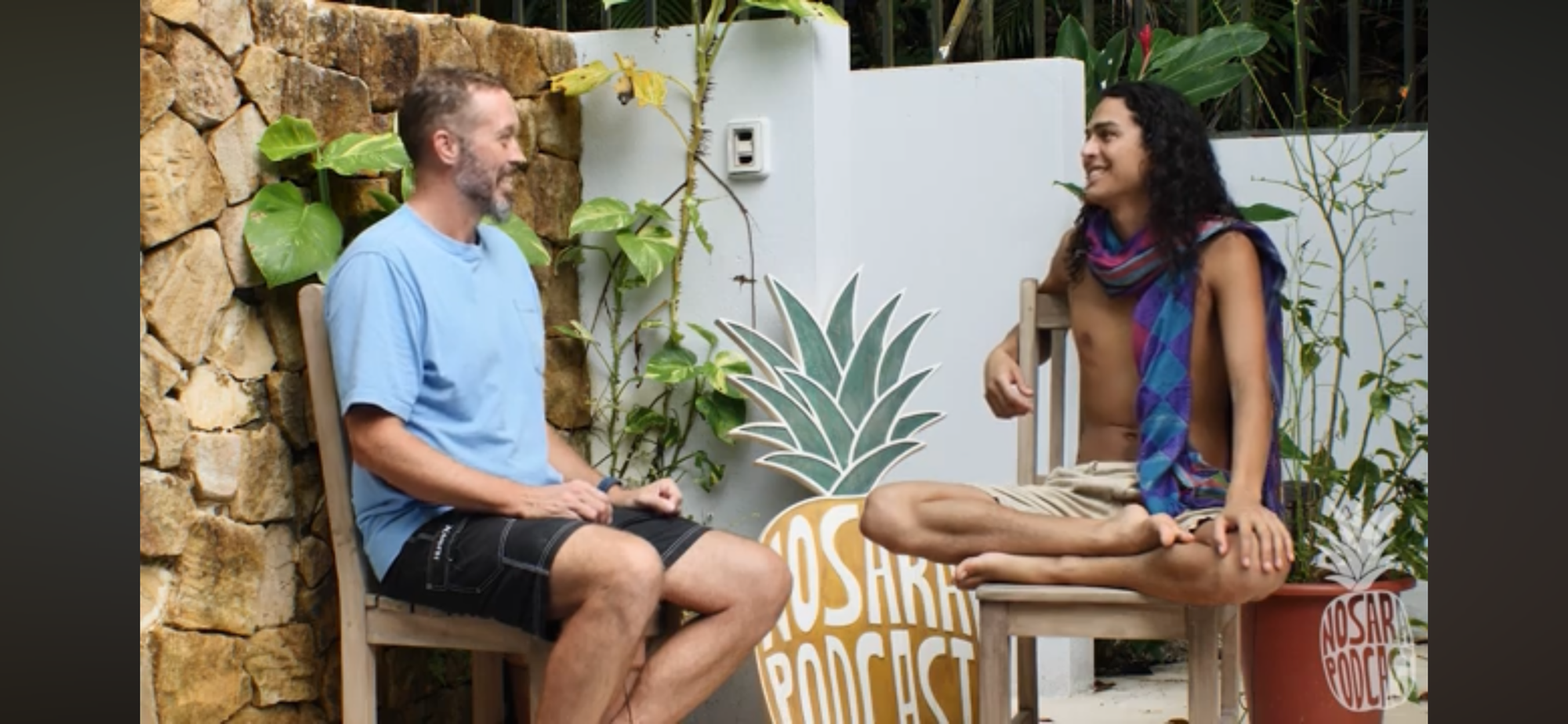
I sat down with Daniel Mora, a Costa Rican musician and sound healer who walked away from a conventional corporate track to spend the last seven years building a life of music in Nosara. We dive straight into his personal transformation from a structured background in San José to a full-time sound healer, his ongoing mission to revive ancestral Costa Rican instruments and local Bribri traditions, and how sound therapy serves as a practical, therapeutic tool for deep neurological healing.
What We Dive Into:
Bribri Indigenous Traditions: Exploring the healing songs and musical lineages of Costa Rica’s largest indigenous community.
Ancestral Instrument Revival: Recreating ancient clay ocarinas and flutes discovered across five local archaeological excavation sites.
Neurological Sound Therapy: How specific sound frequencies and singing bowls directly treat brain trauma, severe head injuries, and chronic tinnitus.
The Harmonics of the Quijongo: Utilizing the traditional single-string folk bow to generate therapeutic vocal harmonics.
Secret Orchestra Vision: Building a collaborative musical network in Nosara that blends global world music with ancient spiritual practices.
The Power of Structural Silence: Why intentional silence serves as the ultimate diagnostic and therapeutic endpoint in sound healing.
Episode Transcript
00:00 – Introduction to Sound Healing and Personal Origins
Rich Burnam (Rich): Welcome to the podcast.
Daniel Mora (Daniel): Gracias. Thanks for inviting me.
Rich: Please introduce yourself and tell me what you are doing. Why are we talking today? What are you all about?
Daniel: My name is Daniel Mora. I am from Costa Rica and moved here to Nosara about seven years ago. I am a musician and a sound healer.
Rich: To survive in Nosara, you have to pay your bills. I don’t know how to make a good enough living to pay Nosara-type bills being a sound healer, so my mind instantly goes there. That being said, I had a head injury, had a lot of stuff happen, and the solfeggio frequencies literally changed my life. It is through these frequencies at different tones. When I get really stressed or I’m having problems with my brain, I go listen. I even have one track that goes through the different sounds and clears my mind out. I don’t know how to explain it. It’s very hippie; I think I’m turning sort of hippie because now I like to play music. I tune my guitar sometimes, and now I’m playing sound bowls and trying to make music out of it. I think that’s why we’re talking today. It is interesting because it is like a shift in the world. No one talked about sound healing twenty years ago. It is a recent concept for modern times, but it has been around for ages. What’s that all about?
Daniel: That is a hundred percent the case.
Rich: Twenty years ago, if you told me you were a sound healer, I would say I don’t have time for this. Now if you say it, I’m like, “Oh, are you playing 432 Hz? What are you doing?” As you get older, you never know what’s going to happen, so try not to say never very often.
Daniel: For me, I wanted to live from music. Becoming a rock star playing stadiums felt like I wasn’t sure if that was my path. It somehow presented itself. I was doing sound healing in San José because I was born there. People were surprised because I have a green business background. My family went through economic challenges. My mom and dad have very formal jobs; my mom is a judge and my dad is an engineer.
Rich: You almost had a formal job.
Daniel: Almost. I did have one. I chose the truth. I wasn’t feeling honest in the way I was living. I was feeling like there has to be something more to life than just working for money and making a house.
Rich: It sounds like by saying the words “idea of life,” you’re talking about more than just an artist’s lifestyle.
04:15 – Moving to Nosara and the Retreat Industry Ecosystem
Daniel: It is a mysterious path. The reason I came to move and live in Nosara was because a guy was looking for sound healers for his new retreat center. There were no sound healers back then in Costa Rica. He offered us a job to come here with my ex. Many people you would never expect show up. It is for some people, but when it hits, it hits. It’s very addictive. More people pour out, come here, and they come back. That’s the interesting thing I’ve learned through my job. Those people don’t know they are being hippies. It seems like it’s just happening at every level, from your business person who is just trying to get relaxation, to someone who is willing to go full-time in Nosara. It’s just sticky.
Rich: What instruments do you play?
06:40 – Reviving Ancestral Costa Rican Instruments and Bribri Music
Daniel: I am interested in the local music. I don’t know if you know anything about the indigenous history of this country.
Rich: I’ve seen a lot of interesting stuff, but I’ve never heard about local indigenous instruments.
Daniel: Many of these artifacts are clay ocarinas and flutes. There have been five excavation sites where instruments from this area were found, which are now in the museum. In this journey of getting to know those instruments and remaking them, I realized there is a lack of exposure to Costa Rican art. A lot of people come here for a week and miss it completely.
Rich: What happened to the instruments from here? That’s actually a fun album title. It’s cool you’re bringing them back to life. That’s really freaking cool.
Daniel: I was just recording a sound library of Costa Rican instruments. We recorded over thousands of local instruments. For me, I felt some sort of calling. I used to play guitar and drums, but we have thousands of indigenous instruments out there. What are the other sounds? Especially because the world of sound healing has become pretty elitist with crystal bowls and gongs. If you want to be a sound healer, you have to pay all this money for fancy, shiny instruments. I was curious about how the ancestors did it. There’s a very interesting tradition in the Bribri tribe, which is the biggest indigenous community. They had a specific clan of musicians. They have a spiritual doctor of those traditions who used to heal directly with songs.
Rich: Why aren’t we exposed to that?
Daniel: It is due to this mixture of culture. Costa Rica became a bridge for so many traditions and cultures, but with the indigenous situation, there has been a lot of historical discrimination. When colonization came, the language and practices were taken away. Basically, there have been people making efforts to bring it back. They realized that there were specific songs for healing specific illnesses, but there are few people left who know them. It has been a whole journey for me looking for teachers to learn this music and learn how to play them because there is not much information out there. There are few books here and there.
Rich: There’s not a YouTube video that shows you how to bring it all back.
Daniel: Exactly. That is why I am super happy doing this.
11:15 – Neurological Trauma, Tinnitus, and Frequency Stabilization
Rich: It’s interesting that we are meeting because this all came from a big head injury I had years back. I constantly have ringing in my head all the time. I lost most of my hearing and I can’t turn it off. Then I went to medical practitioners who found the specific frequency of the ringing. If I play this exact frequency a couple of times a day, it helps calm down the noise. I came across a 432 Hz frequency when I was in agony late at night, sweating profusely. No one was around; it was just me in a remote house. That sound anchored me. Somehow I started telling family and friends, and they asked what I was talking about. If I put this frequency right here, my brain adjusts. That’s my story, so I’m right with you. If you told me a long time ago I’m going to have a dialogue with a sound healer who gave up his conventional jobs to do this, doesn’t wear a shirt, uses a scarf, and that I’m going to love it—I would have never believed it.
Daniel: That’s how life teaches you.
Rich: Take us to the instruments again. It sounds like you are literally trying to go into the past, bring it to life by recreating the instruments, and learning to play them.
14:30 – The Quijongo Bow and Harmonics
Daniel: Yes, it is a whole journey. This area of Guanacaste is the heart of Costa Rican folk culture. A lot of our musical culture comes from here, but it is very Spanish-based and European. What we commonly call folk is from old traditions, but there are deeper things. For example, we’ve been using the quijongo, which is an ancestral musical bow. It creates distinct harmonics. Harmonics are the foundation of sound healing in general. It is basically the same vocal technique you find in Mongolian throat singing. Somehow the past was bonded by sounds. For me, it almost feels un-Costa Rican sometimes because the modern culture is so expansive with English. A part of me feels like a guardian of the ancestral traditions, but it’s not even my choice. Some force is taking me on that journey. What I do now is host music ceremonies to bring these sounds in. How do we use our collective power now? I’ve been feeling a call for collaboration. The beauty of this movement is the diversity of music. We can mix these ancient ocarinas with the guitar and singing bowls. I have been dreaming of a sacred orchestra, bringing world music into spiritual practice.
Rich: “Sacred Orchestra” is a great band name, by the way. Remember that.
Daniel: Everyone is a sound healer nowadays. Back at the beginning, I was just the crazy kid who didn’t even understand what I was doing, but now it’s super popular alongside yoga and surfing. If you asked people fifty years ago what happened to Nosara, the National Commission of Indigenous People came to the area and it was going to be declared indigenous land. Look at where Nosara is fifty years later.
Rich: Bringing it back realistically is part of it.
Daniel: It makes me super happy. We have somewhere to connect. The challenge of these times is how to bridge different cultures, languages, and traditions. Music seems to be the middle point, and that is why I am so deep in music. It saved my life, not necessarily because of specific frequencies or instruments, but because of the feeling of purpose. Our minds are limited. Even though we try to explain what we are doing, words limit communication, whereas with sounds, I can play music in a band with people and feel like we are communicating deeply without words.
Rich: Inside of that sound creation, you can feel it, and that means something.
19:45 – Overcoming Intellectual Addictions and Capitalistic Judgment
Daniel: It brings us back to feeling. I used to be so much in my head; I was addicted to trying to make sense of everything and explain it. Here, everyone is a yogi or meditating to quiet the mind. You have tried that, right?
Rich: Good luck. It’s like a racetrack in there.
Daniel: It is so hard. But when I play music, I am not thinking. My brain finally takes a breath and pauses. I didn’t realize how healthy that was for me.
Rich: Everyone who goes deep into the spiritual side reports the exact same thing. You don’t have to be into Hinduism to understand the scientific benefits. It is therapeutic; we now know that. There are people coming from all around the world to Nosara. You can convert the negative into good because you can reach someone from any country right here.
Daniel: Unity gives power. Nosara is a very blessed, magnetic place. We have a chance to bring these places together.
Rich: This podcast operates on that inspiration. We need information to flow. We are not going to save this place without connecting people, and music is the one thing that does it.
Daniel: Music can be political because politics is about power, and through music, we can get our power back. I agree a lot with getting into connection. The thing is making these spaces. I am grateful for you creating this space and inviting so many different people to talk. We come from different backgrounds, but we have a lot in common. Just playing music on the same ground is enough to create a relationship.
Rich: You don’t need an office building for your services.
Daniel: I want to create musical masterpieces right now. That’s one of the reasons why I am here; Nosara has the resources and high-level studio talent to make that possible. A part of me feels I need to empower myself to be the orchestrator of all this. Music is really my prayer. The focus right now is how to make space for all of us to make music together. Beyond that, I believe the purpose of life is love, and music is the channel for that. When we play together, we see something deeper than just external traits like skin or eye color. We see who we truly are.
Rich: You figured out how to get away from the corporate track.
Daniel: Being a full-time musician over this seven-year period in Costa Rica makes me feel like I am on top of the world.
Rich: Let’s celebrate that for a second. Congratulations, man.
Daniel: Thanks. I feel a big responsibility. I don’t need much right now in my life. I don’t have a beachfront home or a new car; I live in a basic home and drive a basic car, but I have time. I want to create a space for people to be aware of the blessings we have around us.
Rich: The internet is what got this information to me. That’s why I’m interested in seeing you get this information disseminated, because that’s how it started to reach me. I love to play music, and now that I can make something that actually makes me feel better, it’s the biggest gift from God ever. For me, nothing has been faster at shifting my vibration than sound healing. I felt it, so I don’t need the words. You can’t take that away from me. That’s what you’re tapping into. How does your family feel about it when they introduce you to people? Is it like, “Wow, this one’s off in the jungle without a shirt on, riding a bike and playing music,” or have they accepted it?
Daniel: I love honesty and clarity. I felt very judged in the process. My name, Daniel, means “only God can judge me,” which felt heavy for me at some point because the capitalistic system is not made for people like me. If you take the unknown path, it challenges your security, identity, relationships, and trust.
Rich: You’re playing with iron.
Daniel: Exactly. I felt like there was nothing I could do that felt healthy to me other than following my passion. I heard a question that a friend asks every time she wakes up: “What can I do for you, Great Mystery?” She wakes up every day with that question. I am truly trusting this path. I risk everything; if I die in the process, I am right with it because I trust this path so much. It is not logical at all and defies all conventional concepts of how I should live, but it brings miracles. I am here because a guy from the States came and gave me a piece of land. I am getting to record in amazing studios because people from the States have the resources to make it possible for me to compose art now. Life always gives me a little taste to say, “Don’t worry, we got you.”
Rich: Is it getting easier?
Daniel: Things are getting better, definitely. Before, I was constantly asking myself if I was doing the right thing. Right now, I realize I’ve made it so far. I’ve always had a home, food, and friends. I have everything I need, so I have nothing to fear.
Rich: Your journey isn’t just self-component sounds; you’re describing pure faith.
27:10 – Historical Perspective and Timeless Messaging
Daniel: I definitely have faith in love and in music. That’s where I felt spirituality, which is wild because I used to be very stuck in my head, questioning the hippie movement and the retreat culture. I live life not believing anything until I experience it firsthand. If you saw me seven years ago talking about miracles and prayers, I would have said, “What are you talking about, bro?” But nowadays, I feel I live in a prayer. It is a wild shift.
Rich: What would you say to yourself seven years ago right now if you could go back in time?
Daniel: I would say: listen beyond the words. Beyond the message, listen to what is really being communicated. I was a very judgmental person, especially when I was hearing things outside of my belief system. Open up to why this information is showing up. Maybe there’s a message between the lines.
Rich: “Intention” is the word that keeps coming to my brain. You’re talking about being less judgmental in communication. This is the most judgmental I think the planet has ever been, exemplified by the political divisions. Relationships fracture over it. I think sounds can fix that.
Daniel: I was researching what the most powerful sound is, and it was clearly silence. Silence is what makes sounds valuable. To be a great musician, you have to be a great listener. We are doing sound healing right now because we are really listening and making silence for a message to come through. There is a lot of compassion in silence.
Rich: You nailed it. You have to get so good at your sound therapy that you get to silence. Your destination is the silence, which ironically dissolves everything. All these other things are tools.
Daniel: I think silence is a representation of death somehow. After all this chatting and expressing our feelings, we go back home and let these things settle.
31:40 – Local Recommendations and Closing Project Notes
Rich: What are your three favorite restaurants? Do you even eat food anymore, or do you just use sound?
Daniel: I wish, but no. I have some neighbors that cook. There is a lady, Celia, who makes one-dollar empanadas. Gracias, Celia. I also like Mala Crianza’s pizzas.
Rich: You’re the second person to say Mala Crianza today. Is there anything else you wanted to get off your chest, any funny jokes, or anything you want to use this platform for?
Daniel: I am recording music for my project called Canto Flecha. You guys can listen to it.