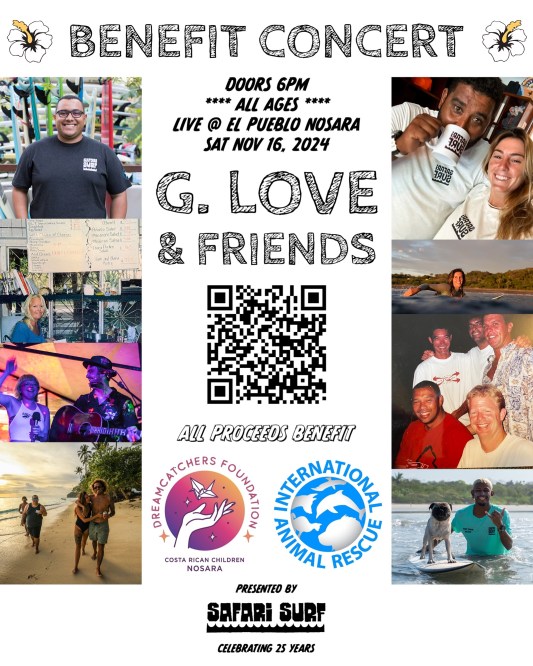
In this Nosara Podcast episode, Tim Marsh from Safari Surf School shares stories from mid 1990’s PLUS announces benefit concert with G Love & Friends happening November 16th to celebrate Safari Surf School’s 25th year anniversary.
Tim recounts how his Nosara journey started mid 1990’s in Playa Garza (small town just south of Playa Guiones), with a little super market & deli type of shop, right as you roll into town along Ruta 160 smack in front of where Soda Garza sits today. That building is still sitting there & most people are unaware about Tim’s family entry portal to Nosara.
Many of us may remember Casa Tucan, where Safari operated for many years until ultimately being bought out by the Johnson family as they expanded the Harmony Hotel’s services & presence into what is today is Al Chile & Sunset Shack. Tim jokes about karaoke night being the end of their successful run too close to a nice hotel 🙂
The G Love show proceeds are set to benefit Dreamcatcher’s Foundation CR and the International Animal Rescue (IAR ).
Anyways, hope you enjoy this episode with Tim & the good news he provides for us all both in & celebratory service to the community. Reserve tickets for the show November 16th &/or the private dinner auction November 15th with G Love Friday night at Tierra Magnifica.
Safari is looking for donations from businesses, homeowners, artists, etc so hit them up if you want to contribute in any manner.
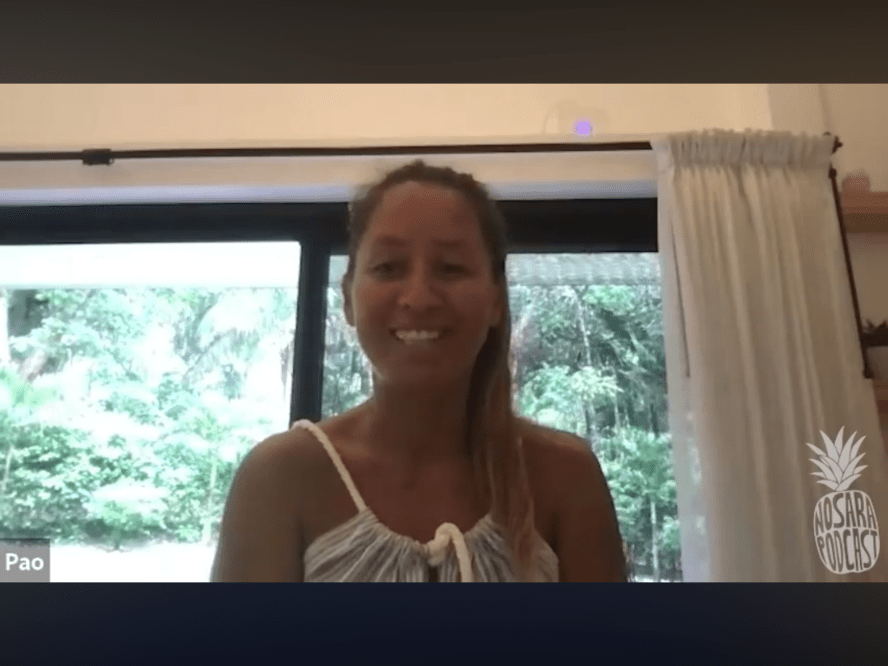
Long time friend Pao Barrera dropped in for her first Nosara Podcast episode to explain the purpose & intentions for Triple Crown of Surf Nosara contests plus explain how & why the Asociacion de Surf Nosara is asking for support from the local community & visitors.
Pao is pleasure to be around, and it is fun to see her growing family evolve while she continues to be a pillar in the community.
She serves as vice president for the Asociacion de Surf Nosara & their main objective is to unite people through surfing to make a difference in the community for a greater good.
They are paying prize $ to winners plus they are getting local children involved in the festivities. They are asking for people to come join in on the fun plus consider anything and everything from financial to gift donations which may help serve as prizes & or benefit local kids. Some local leaders of the surf community are assisting Dreamcatchers Foundation on a regular basis & overall the Asociacion is committed to uniting the community through surfing.
*There’s several ‘Rich rants’ in this episode pertaining to community items; especially about empowering the local Tico populace with the education and skill set systems to acquire higher end jobs and own their own successful businesses and become the future.
Personally I am growing quite tired of people directing anger & frustration about Nosara’s challenges without being part of a solution. Being upset or angry is OK, but direct it to the right direction… The Asociacion de Surf Nosara is doing this & it has my attention a great deal.
The Asociacion de Surf Nosara is happy for anyone & everyone to help any number of ways ranging from financial assistance to used surfboards, games for kids, and even just some ideas &/or helping local kids learn to surf are super appreciated as Pao explains in this episode.
Per usual, I ask 3 favorite restaurants question of Pao plus a bunch more.
If you’re in town get to the contest to participate or just cheer on the folks involved. Shout out to all sponsors and everyone involved looking to help for a greater good.
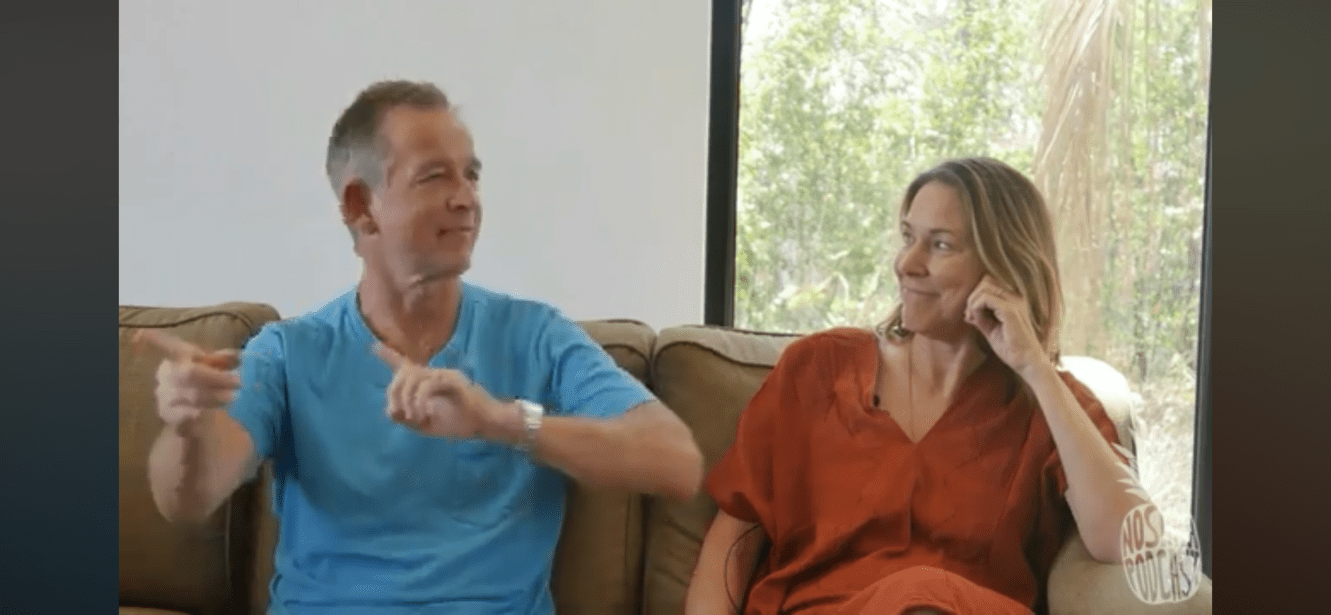
In this Nosara Podcast episode, John and Susan (Short) Johnson openly discuss a myriad of subjects plus share their purposes & intentions behind their actions for themselves & the Nosara community as a whole.
It’s a wide ranging episode, which bounces around in all kinds of directions towards addressing the heavy hitting subjects surrounding our town (John also gets in a couple of good jokes along the way, which I’m grateful for) as well as just simple topics & personal opinions and memories of Nosara’s yesterday & perhaps what tomorrow will prove to be.
Rather than spend much time reciting the same things as the litany of articles and such that are readily available on the internet about the Johnson family, I decided to take a different approach, which hopefully proves significantly more beneficial to the community as well as the entertainment level of this episode & achieve it’s purpose of getting to know the ‘real’ version of them.
We begin with a curveball of a question & discussion with me asking their opinion about wave pools. What started as conversation starter turned into solid points from the obvious about water issues and the ocean being preferential, then into pros/cons and my wild idea about prior to any money being sent for wars… Make everyone put their guns down and have a surf (I was more serious than kidding). From there the conversation goes on a loooong ride down many lanes and avenues and I hope you enjoy it.
My goal with this episode is to provide an opportunity for people to get to know the ‘real’ version of this famous, but not so famous, duo. Reason being, this fiercely private family is constantly brought up in conversations with all kinds of things being suggested ranging from being multi billionaires with unlimited resources plotting to take over majestic Nosara all the way to extreme other end of the spectrum as kind hearted people who truly are trying to protect this town through their acquisitions and projects focused on keeping Nosara away from being engulfed by chain hotels and mega developments.
For anyone unaware: John & Susan (Short) Johnson are the owners of Nosara’s Harmony Hotel & Healing Center, Sunset Shack, El Campo (formerly Harbor Reef Hotel), new development project El Bosque, and behind many community initiatives via Harmony Projects & quietly behind the scenes of many other ones.
This is NOT a standard ‘fluff’ piece like so many others out there. Both John & Susan willingly address some of the most challenging parts of the community while providing an interesting take on things from their vantage points.
My relationship with both John & Susan started as surfing friends in the water at Playa Guiones. In recent years, I’ve spent time in water surfing with Susan & playing music with John. Turns out both John & I enjoy playing same styles of music together and I count myself fortunate to have a music friend who enjoys folk, gospel, bluegrass & from time to time we hope to play at our ‘gospel Sundays’ which is basically he & I squeezing a couple moments into our already incredibly busy schedules. He’s the only friend who has ever given me a Banjuitar (banjo strung like a guitar) & in the same conversation went over our longboard rail preferences, then bounced to meditation techniques and affirmations followed up with a recap of Nosara stuff.
Although this episode is focusing on Nosara… The Johnson’s have been featured in The Wall Street Journal, Conde Nast, and so many other publications due to their exposure to the public from the Johnson & Johnson name itself in addition to their many personal accolades.
For example, John is well known for Eyebeam, being cofounder of Buzzfeed, Harmony labs, but started out as a successful filmmaker who has written, produced and directed multiple films. Susan is deeply committed and concerned about the environment… So much so she started Deep Green Living and through this & her Nosara efforts and projects wants people to live in line with their environmental values (as you will hear in this episode).
I hope this episode & this synopsis help you have more insight directly to John & Susan!
Episode Transcript
Rich Burnam (Rich): John Johnson (John): Susan Johnson (Susan):
Wave Pools, Skate Parks, and the Equalizer Effect
Rich: John, Susan, welcome to the podcast.
John: Thank you, Rich.
Rich: Long time coming. I’m happy to have you in. I’m excited. Let’s start off with the hard-hitting stuff. What do you think about wave pools?
John: Oh. Well.
Rich: We were talking earlier, and I got to thinking about some of the stuff you were saying. We were talking about Florida and chasing swells. Then we were talking about the Netherlands surf, then your Danish friends, and I started thinking about wave pools. I’ll start with my thoughts. I think, okay, well, same thing I’m thinking about. The secret’s out. So the idea of hiding it, that’s so far gone. How do we deal with it, in my opinion, is we steer into it. And you guys have done the same in many facets too. So I started thinking about waves. It’s crowded. I’m from Florida. There’s no waves in Florida. It’s a lot of backed-up energy. Then I started thinking about just the planet everywhere, everywhere there’s conflict. If there was a surfer around, I think the world would be better. And I’m not saying it replaces the ocean thing. I actually think it would help at this point. So the idea of not having them because it’s not cool, that’s not helping anything. There’s a lot of people like me and you who just wanted to surf. So on a lighthearted note, but I actually am interested in it. What do you think about wave pools?
John: Yeah, I am. I hear that and I love the idea of people getting a water experience. I would just hope two things. One, people getting that water surfing experience and democratizing that, I love the idea of that. That’s cool. The only thing I would hope is that they’re also finding a way to get a real nature experience because we’ve been at Slater’s Wave Pool on the West Coast, friend of a friend kind of thing. And it was really kind of orthogonal to everything that was around there in a way where it was like, wow, this is like Area 51 or something. It’s so different from everything around it. And it was both cool and also kind of like, huh. But here’s the second thing for me that I think wave pools could be really good for is learning technique. When you’re learning, someone like Josh Waitzkin will tell you that you want to isolate all the crazy variables if you’re trying to learn something and just work on that one thing. And you can do that in a wave pool.
Rich: That is what Waitzkin would say first off. He would measure it and quantify it in some manner. So shout out to him. But that made sense. I’m seeing what the skate park is doing for this community. So shout out to everyone in every way. Huge. But what if that was everywhere in every city? Like it’s the great equalizer. It takes away race, creed, nationality, socioeconomic status. I can’t poke a hole in it. Let’s add that. Okay. So while we’re at it, let’s add, you know how we have these green areas that NCA is protecting now that were originally golf course greens in the original plan. Let’s combine the skate park and the wave pool. And I think everybody globally just mellows out and co-regulates together a little better. Okay. Susan, are we off on a crazy tangent here?
Susan: Well, we are of course, but that’s okay. I like to start in a happy place. I’m just going to push back a little bit. I don’t want to be rigid or such a purist that I can’t be open. And definitely the idea of a wave park is not all bad to me. It’s sort of like a climbing gym for climbers. However, I do think it’s important where they are.
Rich: Talk me through that, because I want to go to every war zone, where people are really mad, and build the best wave pool. Everyone leaves their guns at the door because they can’t bring them in the water anyway. And honest to goodness, I don’t see what’s wrong with it if we’re going to send so much money everywhere all around the world and fight about it all the time.
Susan: Yeah, I guess I think about water. That’s a fair point. Water is important, energy is important. It plays a role. And you’re putting in—I mean, I don’t know enough about wave pools. Only ones I’ve seen are very, very, very big. And so that’s where I question, would I want a wave pool right here? And I personally would still want to be in the ocean. It’s just so beautiful. It’s so available here. I do definitely get the idea that we could work on our skill level, but here it’s so dry. I would feel that it wasn’t the right place.
Rich: If someone’s going thirsty because there’s a wave pool, yeah, that’s an issue. Or if toilets can’t flush.
Shifting From Scarcity to the Slider Analogy
Rich: We can segue into water in the area right now. We’re peak dry season. We’re having water shortages, access issues, because we don’t have the pumping capacity to refill it. So again, shout out to ASADA, everyone who works on all this stuff. Very, very challenging situation. And there’s not an easy answer to any of this because you’re not going to stop development. You can’t pause things. You temper it as best you can, but people are coming. So we don’t have the pumping capacity. We don’t have the electrical grid. We’ve got a lot of issues. I mean, if you go on and on, we also need to fight like holy heck to keep the green areas because that’s what saves us from becoming Jacó, Tamarindo, everything else. So I guess just fast forward.
Your journey here is already out there all over the internet. People can check all that stuff. You’ve had real actual journalists do all that. I’d rather just be real and kind of shoot from the heart as far as Nosara goes. Talk us through, how do we deal with becoming popular and high-end at the same time? How do we accept the inevitable and roll with it as best we can? Where’s the path? How do we navigate these next eight to 10 years? Because my opinion is the past 12 years or so and the next eight are the sweet spot for me of this place. We have just enough doctors, just enough pavement now—shout out Kai Modelo. We have just enough stuff to actually be like, wait, it’s kind of safe to be here, it’s a little more comfortable, so it’s not all bad. But at the same time, water’s being shut down and people can’t flush their toilets. You see what I’m saying?
John: Totally. Two things right off the bat. First thing is equanimity. That’s the first thing you’ve got to have because if you don’t have equanimity, if you start looking through a scarcity frame, your limbic system gets activated. That’s when people make their worst decisions, where they feel separate, and it becomes a zero-sum game. That’s where humanity tends to go down the toilet.
Rich: It’s easy to go there.
John: It’s easy to go there, but it’s easy also to not go there, especially if you’re in Nosara. This is a place where you can’t swing a cat without hitting a meditation class.
Rich: Hey, you’re going to catch some flak for saying swing a cat.
John: Yeah, I may. Sorry. It’s left over from my 12-year-old self. I have a lot of colloquialisms like that. Then the second thing I think is making sure we’re doing it together and that no one’s getting left behind. And that means inevitably people making sacrifices, and that’s okay. Accept that going in, knowing that bringing everyone along—finding the solutions that raise all boats—is where we want to be. That’s where we have to be. And that’s where I think Costa Rica needs us to be.
Rich: Do you feel like we’re becoming that model that the world needs us to be? Because with the podcast, word on the street, and just my day job, I hear the negatives nonstop. Sometimes it gets taxing. And then I have to remember like, wait, it’s not all bad. We’re actually doing good. This could be a model. The hope’s not all gone by being mad about yesterday not being the same today. There’s now a house at a spot that there didn’t used to be. That’s hard to digest. We lived for 15 years in the jungle back in Selvamar. And then within the next thing you know, there’s 12 people all around. It’s completely changed, surrounded by houses. It was taxing, and I’m in the machine. I’m part of it, so I admit that.
I’m trying to steer into the wind. When I do a surf report now, I’m not doing it saying, “Please come learn about Nosara.” They’re already here. Everyone already knows. It’s more of, “Hey, do you see the trees that are here? They got here by people paying attention to it.” So I kind of feel, from the reserves to everything, it’s more like what you’re saying: find a way to lift all the boats. I don’t know how to lift the boats though, because we’re always fighting. And that’s why you guys doing things like this can be inopportune, because somebody can use it from the wrong angle or the wrong way. You know what I’m saying? So how do you guys balance your life here? Because you are deeply involved. You guys basically met and formalized your relationship here. Your heart is in this.
Susan: We met in the water here.
Rich: And then you met again.
Susan: We met surfing, but I would like to say, being a Florida girl and coming from Miami where there were so many guys in the water for years, I wouldn’t admit that we met surfing because it was all business in the water. No flirting in the water.
Rich: Oh, I got it. It was focus time.
Susan: Yeah. I learned to surf in Miami with Lee Bailey, who you might know was one of my best friends. There were four of us women and hundreds of guys. So that’s why I had that attitude.
Rich: Fast forward to now, the water is filled with women.
Susan: Yeah, it’s so cool. It’s filled with women and I’m really enjoying it, to be honest. I enjoy the whole vibe here and it’s always been a good vibe here.
John: So just riffing off what you’re saying, the lineup is crowded. And so what you do is you adapt. For me, what’s that look like? That means I wake up early. Sometimes I wake up at 4:30 if I’m surfing and I go out. I’ve also fallen back in love with body surfing. Getting out in Ostional in head-high barrel body surfing is currently my greatest water joy right now.
Rich: Are you wearing fins?
John: Oh, you have to, to be able to get in those waves.
Rich: Do you use hand planes?
John: I’m scared of hand planes in heavy surf when it’s thumping. If it’s a really fast wave you want a hand plane because then you can get your upper body a little bit out, speed up, and get down the line.
Rich: You and Herbert are out there practicing, figuring this thing out, aren’t you?
John: He never uses a hand plane. The fins—you need to have the fins. He taught me a great technique. We were getting all these barrels and I was like, “Herbert, I’m running out of air. These rides are so long, I’m having to kick out.” And he’s like, “Hey, no problem. Just roll on your back and breathe in the barrel.” And I did it. He’s taught me so much. I came in thinking I knew a lot, and then he really helped me recalibrate that.
Rich: Such an amazing waterman.
John: Yeah.
Environmental Grief and the Genesis of the Harmony Hotel
Rich: So you guys met in the water here. You’re adapting to the crowds through different stuff. What do you guys do in the area? What can you speak about?
Susan: Can I actually go back to something you guys were just talking about? You were talking about getting attached to what was yesterday. I try to just think about what we’re doing right now and how we want to live. The other thing you brought up was, are we succeeding or are we failing? I think that can be really distracting because I’ve been an environmentalist for a very long time and I sometimes have felt very defeated and fearful.
Rich: I bet the majority of the time it’s easy to feel that way. I’m just thinking of all the people watching this because they see us. They see what I do, what you do, who we are—these visible people. So a lot of people are already at that spot of tension. I would like for people to know where the intentions are coming from and how raising all ships truly is a unified thing. People actually really do care in this community.
Susan: They do. Care is so important. I think that’s the kind of thing to put your energy into instead of feeling like, are we failing or are we not. Sometimes we have to mourn. We do have to grieve when a chapter is closed or when something beautiful has stopped being appreciated and been removed. I think sometimes we have to grieve, but I also think that in general, just doing your best to live the way you think you ought to is the most important thing.
John: And as soon as we use a frame of succeed or fail, now we’re in a zero-sum game. One of the first things to do is switch from the on-off framing to a slider: how well are we doing? That just takes some of the pressure off, which helps that limbic system relax. Now our decision-making capacity goes way up. We’re just able to make better decisions.
Rich: Agreed. To clarify, I wasn’t saying succeed or fail in black or white terms, but that slider analogy you so aptly put fits perfectly because it’s not this or that. The point I’m conveying is there’s already a lot of built-up resentment, and I see it in my day-to-day life all the time. So when your names are brought up, it brings a lot of what I feel is inaccurate energy. That’s also why I’m so happy to have you on the podcast, because I’ve gotten to know you personally and I hear it. Nosara is like high school. Let’s not hide from it. It is small town, big hell, and I think I’ve heard every rumor that can basically be said about you guys. I just watch it and it’s like, that’s not accurate.
John: I’ve had people tell me the rumors before when they don’t know who I am. It’s pretty funny. I’m like, oh.
Rich: So you get my point. I’m thrilled to have you here for that reason. And again, that’s back to, are we doing so bad? Because I honestly don’t think we are. I think the slider is actually showing we have a real beautiful thing here. That’s why I’m trying to say I think it’s not over by any means. We still have some juice left in the squeeze of the early nostalgia, as long as we keep the green areas in place.
John: And I think we can keep replenishing the juice if we make good decisions. The squeeze will go on forever if we can make some good decisions.
Rich: It seems like in recent years, we’ve had a nice focus shift over to the people from here. Again, shout out to the Biblioteca and people who have been doing it forever, but Edunámica and other things are coming. That gives me hope because the people coming into the community actually want to hire people from here. I don’t know of people who are like, “I’m coming here for imperialism, here’s my flag.” People are trying to get away from that. They want a touch of this. We are in it together. And then how do we go about it? Normally, what we all do is we get on our islands, stay in our safe tents, and hang out with the same people. But we can’t raise all ships if we stay there. So again, part of the purpose of this podcast is how do we get information flowing. Almost everyone seems to say you guys pretty much agree. One of the studies shows like 90-something percent of you guys agree, you just don’t communicate. Between your community organizations, government organizations, and key leaders, there’s a lot of water in between. You guys need to get the boat to rise and flow information. You can be competitors, but you can still get information to flow.
John: Yeah, I think there’s some interesting solutions there. Maybe some public-private partnerships. I think Calle Modelo, while not perfect, is a great start to figuring out how to all come together to solve an issue.
Rich: That name is perfect because it’s a model. I feel Nosara should aim to, like you said, mourn the things that we can mourn. That’s a good point, it’s healthy. A good example would be when the Richmond Phipps dispute happened on the northern boundary of the G section—our largest section in the nature reserve. A lot of people thought that was permanently nature reserve, so when all that happened, it was a big hit.
John: That’s right.
Rich: So that stuff happens, but it’s not over. Now we have a skate park, now we have Calle Modelo. We might be able to keep adding to this, so that’s good to hear. You’re hopeful. I personally am loving that skate park so much. I skateboarded as a kid and I’ve gone back at 57, 58, whatever. Trying not to embarrass my kids, but literally getting back in there trying to pull some turns and pump. The joy I was feeling made me realize that’s another way I’ve adapted. Are you going to come skateboarding soon?
Susan: I am, but I’m kind of terrified of breaking my leg or something. I’ll be the one who has pillows tied around me, every single piece of gear to protect myself.
John: That’s an invention. Somebody should come up with a crash suit. I would buy it.
Susan: Seriously, I would too. No, I really want to learn how to skate. I think it would be another one of those things, like you’re talking about wave pools opening up surfing. I feel like that would allow me, when I’m not in this wonderful place, to have something I would really enjoy.
John: There’s some joy you can touch doing that. It’s like a frozen wave.
Susan: Yeah.
John: I did three months in the States seeing my parents. Thank goodness they’re still alive, but they’re out on a farm, not near any surf. I needed to move, so we put down some pavement and a little quarter pipe. It gave me a way to bond with my son right as the skate park was being done here. I got one of those wiggly boards, like the Carvers, and that changed everything for me. I would just go do figure eights over and over, and it gave me that pumping motion of surfing. So when I got back to town after visiting my parents, I did a floater on a wave and stayed at the top a lot longer than I normally would have because I was used to that feeling. They’re related. This is great. So I’m exactly where you’re at. I’m trying not to embarrass my son, trying not to get hurt, but it’s adding value to my life. Now when it’s raining, there’s something else to do. Or in the middle of the day if I’m stressed out, I can break away to that skate park, get in a quick workout, a nice release, and then be like, all right, Nosara is okay.
Rich: And it’s a nice little social scene down there.
John: Yes, it is.
The Strategy Behind the Scales of Development
Rich: Can you give a description of what you guys are up to and where your focus is between your business initiatives and what you guys are doing?
John: Absolutely. One of the things that happened to us with the Harmony was we had a lot of guests say, “Hey, we fell in love with your hotel, and because of your hotel, we fell in love with Nosara. We’ve been looking around for a home and we’ve been scared to run construction remotely from where we live. We haven’t found anything yet that we could picture ourselves in terms of a home, but if you guys ever do something, please let us know.”
Rich: That started more than 10 years ago. It’s probably been going on a minute, huh?
John: It has been, but I just never thought we would do anything like that.
Rich: Really?
Susan: Yeah, I just wanted to have a simple, good life. I think “developer” was a dirty word to me. I never pictured myself doing that. But we got into it because there was someone who was in the process of developing this land, and he came to us and said, “I’ve got this project going and you’ve got community, why don’t we get together?” I was kind of like, “I’m going surfing, bye.” But John got together with him, talked with them, walked through it, and explored it, as John is good at doing. And then he came and got me and said, “You have to see this.” Then I got the hooks in my heart.
Rich: So you felt it. It went from “I’m scared of that” to “Hold on, let me look at it,” and then you felt it. This is symbolic of our conversation from earlier. That’s what we need everybody to do. If you’re scared about something in the area, go explore it, look into it, fall into it, and check it out. That’s a great example.
Susan: When you were talking about fear, I don’t know if you know how we got into the hotel, but it is so much a part of how to look at where we’re at right now. I had a lot of fear about Nosara growing because I’m from Miami originally. My mom was born and raised there, and Miami was a small town when she was a kid. Dirt roads. She lived in what you would consider the heart of Miami now, but she had chickens and horses and went into town once a week for dinner. It can happen fast, and I’m well aware of that. Like all of us, I fell in love with this place early on, and I could see things starting to change and I was really fretting about it. I kept talking to John about it in the early days here. He would say this thing to me that I couldn’t quite understand at first, which was, “It’s probably going to grow. It’s going to change because that’s the nature of things. The question is, how does it change? How does it grow?” That took a little while to sink in. This was a conversation we had over probably two weeks. I eventually got to the point where I accepted that. He was right. It is going to change because everything does. So, how do we influence how it changes? John said there’s probably a handful of properties here that whatever happens on them is going to disproportionately influence what’s going to happen here. So the logical next question was, what are those properties? The first one he mentioned was the Nosara Yoga Institute, which was already bringing yogis—now Bodhi Tree. It’s still a yoga, health, and wellness draw, which is such an important influence. He brought up the Gilded Iguana in the heart of North Guiones. And right at that moment, Rick Walker came running into the restaurant we were in and was like, “Oh my gosh, guys, the Villa Taipei is for sale. You guys should buy it.” And John said, “Yeah, I would say that’s probably the third biggie right there.” That’s how we got into the hospitality business. It was not like either one of us went to hospitality school. It was a really big decision that came out of our love for Nosara.
John: There’s a cool Chinese saying: “If you want to change the course of a mighty river, you have to walk far enough upstream and you can put your hand in.” So we had to take a moment because that’s a big deal. We were a new marriage, and you hear about couples divorcing over the paint color of their house.
Susan: It ended up being a fantastic experience for our marriage, it brought us closer together. We talk about the whole Reese’s Peanut Butter Cup model—you got your chocolate on my peanut butter, you got your peanut butter on my chocolate. That was how we got through that and realized, oh, this is actually pretty good together. Part of the reason I’m telling that story right now is I’m thinking about what we do right now in Nosara. How do we think? My husband is very good at rising up, taking the long view, and being strategic from that place, which is the hand-in-the-river analogy. What he did for me at that moment was get me out of that tight, fearful framework of “How can I keep it from changing?” which is impossible, to thinking about how we can influence things in the right direction. Way back when with the hotel, we were asking ourselves what kind of hotel we would want to stay in. We had the management company in, and we said, “How about really good Wi-Fi, but no TVs and no sodas?” And they were like, “You guys are crazy.” And then I said, “And no advertising.” They said, “Okay, remember when we said you were crazy before? Can you make that squared?” But it was really important to us. That hotel books up over the holidays sometimes three years in advance, and that is built on friendships. It spread by word of mouth, and there are people who come back year after year and see each other. That is the community of the hotel. We have this incredible repeat guest base. It was a bit of a hit in the beginning, definitely a nail-biter, but what a wonderful payoff.
Rich: Did this start around 2004 or 2005? I’m interested to know how long it took for the snowball to gather before everybody was relieved and you realized this was good.
Susan: He doesn’t bite his nails. I bite my nails a little bit, but I actually did have a lot of faith. Like you were saying before, I don’t need to tell people to come to Nosara. When I moved here, it had not caught on. I just wanted to find a way to get by.
Rich: Exactly. You guys wanted to find a way to help protect the place and keep enjoying it, right?
Susan: Yes.
John: We always had faith that it would work out, or we wouldn’t have made that call. A point that I remember is when we first started out, we weren’t advertising. Our friends knew what was there and they would come, and maybe they would tell friends. I remember someone coming up to me saying, “I love this place and I’m going to tell all my friends.” And I said, “Don’t. Just tell your best friend.”
Rich: That’s a good line. Just tell your best friend.
John: Yeah, and it’s true. I think it still holds. A longtime guest told us at his 50th birthday party that of the eight people at his dinner who traveled to see him, six of them were people he had met at the hotel.
Rich: What a testimony. Definitely a good friend maker there.
John: Once you have no TVs and no sodas, then the stream of people coming to your hotel is going to self-select. Some people are going to be like, “Oh no, I’ve got to have my daily Diet Coke or my rum and Coke,” and they’re going to go someplace else. The folks who are like, “Sweet, I don’t have to have this battle with my kid over TV or over a Coke,” gravitate here. There’s that little bit of clumping, and that helps create new friendships because there’s some commonality.
The Evolution of Family Demographics and Bosque Design
Rich: It seems like in the start itself, there was a forced social interaction in a way. Once you were here, you were here, so you’re going to interact and bounce off people. The place is sticky. I’m not a super experienced traveler like you guys. Is there any other place that’s as sticky as this? My ticket in was when Surf Nosara was starting a vacation rental business. That was my entry. One demographic back then was guys saying, “It’s not nice enough to bring my wife out, I don’t have a spot to put her.” This was just as you guys were getting up. And when you guys got going, you were always booked. We didn’t have the vacation rental houses quite yet at the time, and that’s where I got the idea that everyone is selling the same old construction, there are not that many hotels, we need houses. So we sold lots to build houses.
When people could bring their families back, that was about the time the local private schools had gotten going. Huge advantage—shout out to Omar for leading the way, and others since then. For me, when I realized it was going to catch was when people started coming back with their families year after year, people who normally went all over the world. They were like, “You know what, let’s take a year off from other places. I need a spot where my kids will be okay.” That’s when I saw us break away from the Santa Teresa or Malpaís area. We went more family-oriented. Around 2012 or 2013 was when I felt this might happen, then by 2014 or 2015 it solidified. When I paddled up to you in the water, I told you that you’ve got to buy Harbor Reef before this other company does, because somebody was going to buy it and create a carnival of stuff. Much testament to you guys, you truly do act. You don’t say many public words, but your actions behind the scenes are actually there.
John: Thank you, Rich.
Rich: Don’t thank me. I’m thrilled to have you here because people finally get to hear a voice in the story, your emotions, and where your intentions are coming from. I base everything off intentions. If someone wrongs me but they meant well or were aiming at something good, I can deal with that. It’s when someone’s intentions are off that I really struggle. Most of the people who dislike you and me without knowing us just like the idea of the fear. I want to eradicate that. That’s a big part of the podcast, having people on constantly so people can hear a voice. If people ever really have something negative to say, at least base it off facts.
John: Sure. Just going back for a sec to what you asked us before on what we’re working on now. We ended up having this transition where the hotel was going pretty well, and then this developer comes to us and asks us to be partners over here at the Bosque. When I went into it, I saw this incredible swath of forest left right by the ocean, even some hills. It blew my mind. That was another really big decision for us that we did not take lightly.
Rich: It’s neat for people to hear what you’re saying right now because prior to ever doing this, various people thought you guys had developments planned everywhere. But the actual truth is you didn’t plan to buy a hotel.
John: I don’t know what spacey surfers we really are. It’s a lot to take on something like this. I’m not saying I won’t eventually do another thing after this, but I’ve always just been like, can we just go surfing?
Susan: I’m going to say something else about it. When John got me to go look at the land and the trees—because like I said, I wasn’t even interested in having the conversation initially—it really touched something in me that I think you might relate to since you’ve been here a long time. When I first came to Nosara, I stayed in the North Guiones area. I didn’t have a bike or a car, and I would walk everywhere. I would sometimes walk all the way to Café Paris from North Guiones via the back roads. So much of it was forest. When I say I get having to mourn and grieve, I had moments where spots went and it hurt. I’ve often thought about writing a book. You know how there’s that famous book People I’ve Known? Mine would be Beautiful Trees I’ve Known.
Rich: Oh jeez. That would be a sad cemetery book from here in recent years. But we also have to, like you said, squeeze the juice back in.
Susan: Yeah. And so when I saw this beautiful property right up against K section, I knew what might happen here if we didn’t step in. It’s kind of a weird thing to say like, “Oh, we kind of have to do this,” but that’s how I felt.
Rich: This place has a weird way of forcing you guys to do the exact opposite of what you were thinking, but you keep doing it and it keeps working.
John: The Godfather—they keep pulling you back in. One of the great things is we started off doing this as a partnership or else I don’t think I would have had the guts to get into it.
Rich: Give us the update as we record this, peak high season 2024. It is very visible, people are out there. I’ve already started talking about it on the little “This Week in Nosara” videos I do. Give us the synopsis.
John: One of the great things about it is it comes with a horizontal condominium zoning, which is just a way of saying you can create guidelines here. That means we can make agreements about how we’re going to live.
Rich: What are some of the more interesting ones that would catch people’s attention that you guys have put in there?
John: An agreement that we’re going to preserve the forest. You’re basically buying a home site in the forest.
Rich: You’re going back in time to North Guiones back in the day and recreating what you can from it right now to keep it that way for the next generation. You’re basically proving through your actions the exact opposite of what negative rumors might say—that you guys are just here to take over. Obviously you’re not, because you already could have a million times over and you haven’t. Now that you had the opportunity to do something, you’re actually doing it as a protective measure. And it’s also not an easy sale from a guy in the industry. It’s not for everyone, it’s special. I use this platform to cover some of the heavy-hitter items because I think it’s worthy of note. You guys could make this far more profitable.
John: We wanted it to be something that, just like with the Harmony, answers the question: what’s the neighborhood we’d want to live in?
Rich: I’m trying to get you to describe some of your interior regulations. Let’s start with the vehicles, for example. Talk us through that type of stuff.
John: Part of this land opens into K section, and the other part touches the 160 in Esperanza. On that side, that road is loud and fast. But there’s this ridge that runs parallel to that towards the front of the property. On one side of the ridge, it is noticeably quieter. That’s something we appreciated when walking the land, and it inspired us to keep it quiet. I love to walk, so we asked how we can keep this super serene. We are keeping the cars on the loud side of the hill.
Rich: So the cars, people are parking on the loud side of the hill.
John: Yeah, people park on the loud side of the hill. Then you get on an electric golf cart, a bike, or you walk to come into where everyone is living. You can flow right out of there down to the beach via the back entrance, which I have a feeling is going to be the front entrance before we know it because that’s the way in and out people are going use. Basically, it’s EV living. If you need to go to Nicoya or want to do an early surf in Ostional, you can hop into your car and go do that, but everything else you do within the property is with an EV. It’s quiet. We were imagining kids being able to run and bike around safely. That’s the kind of neighborhood feel we’re looking for.
Rich: Can I take a shot at a 30-second version of it? All right. So in Bosque, we have a walking, biking, nature-oriented layout with easy access to the beach without the traffic, where your kids can go around safely. You can enjoy yourself. You do have access to your car, but you’re going to take an electric vehicle of some sort to it. You can still go wherever you want, but the reality is once you’re here, most of life is right over there and the beach is that way.
John: Do you have experience in media and communications? Because that’s it, right? Sounds pretty good. And restaurants—it’s amazing what all you can do pretty close without having to travel very far.
Holistic Aquifer Protection and the Edgeworth Campaign
Rich: Let’s talk about restaurants for a second since you brought it up. There’s a bunch, we have a lot of options here.
Susan: Great restaurants. The other day I was outside of Boca Garza looking at their bulletin boards, and I was blown away by all the healing modalities and offerings tacked up there. It’s really amazing and a very special time here. There was even a bondage workshop. I was picturing a friend of ours saying, “Hello, this is the bondage workshop, we need somebody here right away.”
Rich: Hey, do you go to ecstatic dance before or after the bondage workshop? What a cool town. I’m a fan of ecstatic dance. I started off being like, “What is this?” and now I’m totally into it.
Susan: Maybe we’ll do that for the next podcast episode, but no filming me doing ecstatic dance. This place has an effect on you, it changes you. It’s sticky. If there was any place stickier, I think we’d be there.
Rich: I did one of my Rich rants earlier describing the timing as I saw it. By 2012 or 2013, it caught on, then by 2015 I knew everything completely changed. Google was out, everyone knew where everything was, surfing was all over the place, information was flying, and social media had ignited. I realized I saw the end of the old era there, and it became a question of how we go about it. My gospel is let’s keep the lineup calm. It’s a soft wave, a lot of people are learning. Let’s keep the lineup calm because my first entry to the town was Playa Negra, Marbella, and Avellanas. It got much thicker and more intense there. I’m from Florida. As soon as we get waves, we’re freaking out. Especially when I lived in South Florida, that was the snippiest place.
John: Freaking out is right.
Rich: Those are pretty places, I’m not trying to dog them out, but they’re not here. I want to keep it calm here. If I can’t keep people away, which isn’t going to happen anyway, we need a certain attitude right in the lineup.
John: We need to have that attitude. A lot of it is how we think and what we value. We all have our moments of having death-defying moments while trying to surf and someone launches themselves right at you in your critical moment. I do think a calm, constructive response is always the best long-term investment.
Rich: You’re so right. The locals here have been so good. Hands down, the locals from here—I don’t even know how to describe it, I’ve never seen it anywhere. Not a single spot on the East Coast, West Coast, Florida, California, Carolinas, Virginia, Europe, Hawaii, the Caribbean, or Mexico matches it. There’s no place like here. I’ve seen Nelson go out at Guiones and tell people to settle down or get out of here. So instead of it going the other way, it means the world to me. I’m getting chill bumps as you say that.
John: I couldn’t agree with you more.
Rich: I don’t know how it happened, but it did. My only current prescription for it is putting wave pools everywhere because the lineups get intense. Surfing is popular, it’s not getting less popular or less fun.
Susan: The other thing is a lot of people come here now who aren’t surfers. A little bit of the yogi community started it out, but now that’s flourished. There are a lot of people who come here for yoga or all those healing modalities. It’s like a Mecca for that.
Rich: I can fill you in from the business side. The people coming in and making purchases right now, most of them are not diehard surfers or diehard yogis. It used to be that way during the mid-nineties wave. Then the Yoga Institute got started. Let’s give a shout-out to the Yoga Institute. Good gosh, they had a beautiful system of how they got people to come back. You came down to get your training and certification, you came back the next year, and you kept the journey going. People brought people, and it was a multimodal, beautiful system of flowing the people they wanted in. By having a goal to shoot for, they’d come back the next year. Over the years, some of the surf schools did that, like Surf Simply, and now look at some of the local schools starting to employ it. It’s brilliant and gives people something to shoot for.
Susan: That’s so interesting, because I wonder if they were even thinking of it as trying to get people to come back or if they were just generously offering.
Rich: I learned that was the case through so many clients because they’d come back every year and bring their friends. People would go back and grow their practices. Yoga went from being this scary thing in the States for us religious types to something everyone got into. It wasn’t just the Harmony; all these places grew through these friendships and people connecting to this place. You meet interesting people. I’m a nature lover and a surfer; those are the two initial things that got me here. I remember thinking if you were neither of those things, why would you come here? If you’re into yoga, I get it. But it has grown into a healing Mecca. I was talking to this woman recently who doesn’t surf, is not an ocean person, not that much of a nature person, and is not into yoga. I asked her why she was here, and she said, “It just feels really sane to me. It feels like the pace I want my life to be at.”
Rich: Did she say sane, S-A-N-E, or safe, S-A-F-E? I want to know.
Susan: S-A-N-E. Really sane. And sort of safe. I hope she feels safe too, though these days it depends on where you’re at in town.
Rich: Goodness gracious. So she does none of those things. I talk to that person almost daily now, whereas they didn’t used to be here.
Susan: They didn’t used to be here. I was pretty interested in that whole thing. Something you love brought you here, and now we have to really be thoughtful about how to preserve it.
Rich: I’ve never seen a place where more people care. Most of the negative stuff, even against anyone visible or influential, is generally well-intended.
Susan: Yeah, I think we just need to keep finding ways to strengthen the community and the connectedness of everybody.
Rich: Elaborate on that a bit, like what’s going through your head as you say that?
Susan: That’s the thing that people would go to the Harmony Hotel for. They weren’t just going to a hotel at a sweet surf break; they were going because when they landed and walked in, it felt like family. There’s that connection. Like you were saying earlier, those of us living here for a while can get in our donkey trails and miss making new connections. I have my routine—we have three kids—but finding new ways to strengthen those connections with everyone is key. In a way, Calle Modelo helped that because those were public-private partnerships strengthening connections. We’re just going to keep looking for new ways to do this. There’s a project—I can’t say a ton about it right now because it’s early days—involving public transportation. Let’s have great public transportation and figure out a way to do it right, where it helps people who live in Nosara Pueblo and are coming in for jobs in Guiones, or live in Garza and come in for jobs. It reaches them and is powered financially by tourists.
Rich: You think that will turn into more of a walking setup because the pathways are getting better? When I got here, they were fighting and things were locked up. Now I rode a bike from the office over to Pelada and it was like eight minutes. It was great. It was amazing. I didn’t mean to get sidetracked on my biking story, but it goes back to how we strengthen community. To go back to the Bosque for a second, that relates to something you normally say that I love.
Susan: I know what you’re going to say. When you go to a place like this, you’re usually out in nature but missing community and engagement with the world of ideas. Or you have to choose to live way out in the boonies and come into town to see your friends or go to a restaurant. What we were trying to do there is provide community out your front door and nature out your back door. We were trying to put these two things together where you usually have to choose. We are making a setup where you have that easy bump-into-your-neighbor community, but you get your quiet nature moment out the back door looking into the woods. When I said you’re buying a home site more than a lot, 75% of that property is to be kept as woods. It’s a really community-focused thing, and I think that’s what we could benefit a lot from over Nosara generally. We figured out a way to do it there with the built environment in terms of situating homes, but there are all kinds of other ways we can do it, like with these public-private partnerships and public transportation that’s going to bring us together. The last thing is there are all kinds of other small towns confronting these challenges that are finding really cool solutions, so looking out there and seeing where other people have had real successes or innovated something is something we can do.
Rich: Are there any models you can think of that you could recommend to help unify the cultures? I call it “behind the trees.” The real Nosara is kind of back over there, and most of our guests stay over here. If we don’t have education systems, transportation, and a way for the people from here to succeed and get jobs at the higher-end institutions, we face a major divide. Do you have any models you’ve seen that you recommend?
John: I just kind of live here and talk to everyone from here. I don’t know what else is going on out in the world that maybe we could point to, unless you have a few things, Susan.
Susan: There’s the whole new urbanism movement which you probably know.
Rich: No, please explain it.
Susan: The new urbanism movement is about living closer together to preserve more land around us and making it easy to walk. One of the things that is very pleasantly surprising to me is to find out how highly valued walkability is. I love walking and don’t enjoy getting in my car, though I do to drive into town. Everything we can do to support that walking flow, I think we should. You’ve been giving a lot of shout-outs to the people who stewarded the trail system; I’m grateful to them wherever they are. I’m almost afraid to say their names because I know I’d be leaving people out, but Peter Kelly was big in that. I also know my niece, Malone Madsen, really helped me. She’s the one who suggested making it no cars in that part of the Bosque.
Rich: So she’s the no-soda lady of the new project.
Susan: She got me to go to a walkability workshop. She ended up getting her graduate degree at Harvard, which we’re all very proud of. She got me to go to a walkability symposium program, and that’s how I know what new urbanism is. Walkability is valuable. I always thought I was just a weirdo who valued it. Growing up in Miami, I thought I valued things that no one else valued. But this is a community for people like that, where you realize you’re not the only one who values things like walkability.
John: For people whose first thoughts go to their pocketbook, it also increases the value of real estate. How valuable is it for you to feel like you could let your children out the door and not be afraid for them?
Rich: I always regretted not getting something in Guiones Beach Club in the early days. I just didn’t have the money. In Guiones, traffic really got tense. Right now, look at the trucks. Sometimes if they don’t want to use Calle Modelo, they go over to K, and then we have issues over there. We’re always going to have these challenges, right? So that’s where Bosque comes in, because that car-free format is just not available elsewhere. Where we’re at right now, we’re at the top of the hill of Pelada, but we’re on the edge. That’s all nature reserve. This is a really cool little spot, but finding that little nook is harder and harder. You guys picked up the last big chunk of land where you could do exactly what you’re saying. Now I’m understanding new urbanism, a lot of this stuff is making sense to me. I’m from Florida and I’ve seen a lot of developments. Most of them are heartbreaking because I love Florida, it’s beautiful, and it’s heartbreaking what has happened in many places there.
Susan: Sanibel Island is an example of being thoughtful about how they’re going to live. I don’t know if they allowed chains in there; signs are very discreet. I would love it if we could adopt more of that here in Nosara. We’ve got so many signs along the main road, I question how helpful they are. I love just looking at the landscape here.
Rich: Listen, you’re breaking rule number one of living in Nosara, Susan, which for me is: don’t make sense. You’ve got to settle down with that. Some things we’re not going to win, and some things we are. If we’re going to win on those flavor-oriented, non-soda, electric car initiatives, you’ve got to find other like-minded people who fall into that. You guys were able to do that with the Harmony, and you’re about to attempt it with Bosque. How do we do that with people who come from a completely different setup? How do we still get all boats to float across different backgrounds and camps? For me, I think it’s education and building the skill sets of the locals. Otherwise, you guys had to hire outside management initially.
John: We hired them, and they were great. They are super committed to hiring local.
Rich: That has spawned a new generation of local leaders like Yamira and Cookie, people who are going on to do amazing things out there. I see that as something we need to keep going.
John: I think there are great ideas and initiatives in the community trying to look for how we can share opportunity so all the boats go up. One element that is very special about Costa Rica in general is how strong the family unit is. Let’s grow and create opportunity, especially for the local kids. It’s great that so many local kids are going off to college now, because that wasn’t really the case 15 years ago.
Rich: No, literacy used to sit around a sixth-grade level for females, and they couldn’t get past it. It’s still an issue, but it’s a lot better.
John: Now there’s a high school, continuing education beyond that here, and kids going off to school in Liberia or San José. That is so great. Let’s give those kids a future here because we get to keep the families together. It’s such a strong part of the fabric here. Shout out to Cresce and Andrés Fernández, they’re doing exactly that. We’ve been trying to help them and I would like to help them more.
Rich: Amen. Cressy from the ASADAs has been coming on. We have a couple of episodes in editing right now with him. When painted into a corner and asked what his number one priority of everything is, he says we need a census more than anything. We can’t get the proper funding from governmental institutions without it. Let’s use the Red Cross or the ambulance, for example. I’ve had accidents before where we called 911 and they just never came. I don’t think it’s because anyone is trying to be mean, it’s just because they couldn’t. If we’re ever going to get the Bomberos completely funded, we have to pay for that. You guys pay for that. It’s amazing, but we pay for it out of pocket. If we’re ever going to get governmental support, they have to have an accurate count of the people in the area. If they have that, we can get monies directed this way.
There’s no way Nosara is going to become its own canton without having the accurate numbers. We have that bridge between us and Nicoya, which as the crow flies isn’t short, but as the car drives is unpleasant. He says the census is the number one thing to reset the foundation of the area, and then we can get tax monies that we currently can’t get access to. That takes a lot of the load off the individuals carrying the community and our 50-plus NGOs. He’s boldly walking into this. He’s a very soft-spoken man, but he notes that if we get this, a lot of the money we’re paying willingly for basic services can be redirected into other things the community needs. I have a lot of respect for him.
John: That sounds like a really wise step. You’ve talked a lot about the stages of what it’s been like here, and I appreciate your ability to pull dates out—that is not something either of us can do. This community is evolving and changing, going through these different stages. Right now, we’re in a stage of asking: how are we going to come together in a better way? There was a certain amount of having to do it on your own at one point; if you didn’t just start doing it, it wasn’t going to get done. Things have changed, and that’s a good thing overall. Let’s meet that.
The next step is figuring out how to come together, because if we really come together, we can think more holistically. With growth, there are always going to be new challenges. To address them, we need to raise up and take the long view, and the long view goes with holistic thinking.
Rich: Can you talk me through the holistic thinking part so I understand?
John: You were talking earlier about water shortages, which many people will say is an infrastructure problem. Where people talk about water quality issues in the ocean, both of these are two parts of a very important, overall whole system. We need to care for it from the very beginning to the very end, which is really a circle. That means taking care of our aquifer. If you don’t have water, you have nothing. We’ve got to care for the aquifer. It’s not just a question of whether we can make our infrastructure stronger to extract water from it to get to houses, but how our infrastructure can help us replenish it.
Rich: Yes, the systems engineers on the podcast talk about that a lot. Shout out to Dr. Edgeworth, who comes on and fusses at everybody. He just launched the “No Shit Nosara” campaign that you’ll see flying around. He’s that guy, he’s not messing around.
John: Nice, I have to learn more.
Rich: He’s been on here five or six times. He says all the stuff that nobody else is willing to say, and he does not hold back; he lets it fly. One of the things he goes through is very humbling for all of us. We were trying to block resorts, big hotels, and widespread development—that has always been the thing everyone unified on. His point—which surprised him too as a scientist—was that we kind of got it wrong. What happened was the hotels that came in are doing better with wastewater management than anyone else. When Gilded Iguana launched, everyone said Nosara was gone, but they put in a better water treatment system than we’ve seen in a long time. When Bodhi Tree built theirs, they did a better system. Even Selina in Nosara and Esperanza that you guys drive by, which everyone was so mad about—they have a massive water treatment system. Where we messed up was we have so many tight lots with multi-unit structures using standard septic systems meant for a single family of three or four. Then we stacked them with Airbnb rentals up into the hills. We’re using old septic systems and pegging them to maximum capacity. The laws in Costa Rica just dictate baseline rules, but at Nosara, if we really want “No Shit Nosara,” we have to pay attention to this.
He’s pounding that drum. He is now saying everyone who stays in a rental should rate it as one star if they haven’t upgraded their processing system, because he feels it’s unethical to run a high-occupancy business on a standard residential septic tank. Agree or disagree, it’s nice to see someone speaking their mind and taking a stand.
John: That sounds really smart.
Rich: His thing is, if you make money from a rental and you haven’t upgraded your system, he’s calling you out.
John: How can we come together? It comes back to that. At the hotel, we are able to have our whole cyclical water treatment situation, and we can do that at the Bosque because we’re going to have dedicated infrastructure.
Rich: That’s another example. People drive by right now and look at that big development, but the reality is its footprint infrastructure is going to be cleaner than what is currently around here. The baseline laws we do have are very hard to enforce because the municipality doesn’t have the capacity to come out here regularly. Obviously we need an updated regulatory zoning plan, but that’s a whole other subject.
John: I get it that people just make assumptions that it’s going to be terrible because, sadly, development is done wrong so often in the world. I’ve seen it done wrong in Florida.
Rich: Also North Guiones. Your walk from North Guiones across town is entirely different now. So the mourning is real and well-intended. I didn’t see it coming the way Edgeworth explains it. He notes that while we were looking over there trying to block major projects, the high-density residential issues snuck in right under us. He pulls up the Airbnb data every couple of months on the podcast to give us updates. Much like the Bomberos take care of us—they’re the ones who showed up when I had my recent head injury and coordinated everything alongside the private ambulance from Paradise Medical to get me to San José. We fund that ourselves. It would be interesting if somebody put together a lending body to lend to these individual homeowners to redo their septic systems.
John: Financing for upgrading the septic systems—I’ve never had that thought. That is something that could work. Here’s another thought: what if there was an even better deal you could get if you teamed up with your neighbors? Because if you create a shared micro-system, there is a certain economy of scale that definitely brings costs down.
Rich: The issue becomes long-term ownership structure and future property sales. If you sell a cooperative plot, it gets tricky, though you guys can execute that easily within a master-planned horizontal condo layout like Bosque.
John: We are doing exactly that there. It’s harder to get unassociated individuals to cooperate, so you incentivize them financially. Maybe that’s where the lending institution comes in with a subsidy: we reward people who pool their properties for a shared treatment system. Wouldn’t it be great if banks in Costa Rica actually were loaning to people at better rates who were doing the right thing environmentally?
Rich: You’re breaking rule number one again, John. You keep making sense.
John: That would be awesome. You say it’s rule number one, but being curious and asking why we don’t do it that way is how things change.
Rich: For the bank, it would require external capital structures that function under specific ESG mandates, because standard retail banks answer strictly to baseline profitability. It would have to be an ancillary side project.
John: There’s no reason that can’t happen if you look at Costa Rica’s role and what it stands for in the world. When people think Costa Rica, they think biodiversity. They see a GDP that has risen on the exact same arc as land preservation and reforestation. On a systemic level, the financial institutions should support that winning formula more here.
Rich: Unifying people’s financial incentives makes sense. Normally, the answer always comes back that there’s no short-term profit in it. You guys are two people who are executing your Nosara-based actions not necessarily based off maximizing profit, from the beginning to today.
Susan: Yes, and I’m going to send this graph to you because I know you like to put images in that show what I’m talking about regarding forest cover and GDP growth, because it’s a very curious phenomenon.
Rich: You’re 100% right on. Some people watching this podcast are thinking, “Yeah, that guy works in real estate, and those people have a hotel and are developers,” maintaining that negative frame. I’m just trying to get the community to open up to hear people out for goodness sake, before we can get everyone to share septics. There are a lot of levels to this whole thing.
Susan: I would love to talk to him and figure out what is the ideal unit size for a shared septic system in Guiones. Is it four homes? Is it six homes? Where’s the sweet spot, and what’s the amount of capital needed to incentivize homeowners to make that switch? We should figure that out.
Rich: It’s an interesting conversation. When people ask why the whole town doesn’t have a single central municipal treatment system, his point is that mathematically, a massive centralized sewage network costs an astronomical amount of money to execute over a disparate area. We’ve never openly discussed doing it by micro-sections instead.
Susan: I like that layout better anyway because in terms of resiliency and security, it’s better to have distributed networks versus one single central vulnerability point.
Rich: Some people think that because you guys are affiliated with the NCA, whenever a treatment system is brought up, it implies a massive corporate infrastructure project, and they argue against it. What you guys are saying is let’s explore decentralized solutions by small sections.
Susan: To be clear, I’m a total novice about this specific engineering issue. I’m just starting to think of what a potential solution looks like, and I’m sure somebody has already analyzed it. In fact, I think we’re about to get to hear about a solution like that soon. I did go to a far-out dream about the banks, as I am wont to do.
Rich: You’ve got to say it and put it out there so people realize it’s a possibility. It ceases to be a possibility if you don’t keep vocalizing it. We’ve had several times where—rest in peace—Kevin Walker noted to me, “Look, I pay $75,000 to help with these roads or infrastructure, I just don’t want to be the only one doing it.” He caught my attention with that before he passed. He said the way we solve this stuff is by getting enough people who truly are in it to step up together so they don’t feel isolated. And then he referenced you, John, saying the issue with you is you often have to stay behind the scenes because you get hit with constant public criticism the moment you stick your neck out. You guys can’t take a step anywhere without someone assuming you can solve every local problem single-handedly if you just felt like it.
John: I wish we could. I wanted to address that because there are a couple of times where even you have assigned things to us where I thought, I don’t think we have that capacity. We have really tried hard to be thoughtful, strategic, and do what we could to influence things. But if we had as much control as some people assign to us, this place would be absolute paradise on earth. It’s close to it without intervention, but I would love to solve every single problem.
Rich: I believe you. I was going to make a big joke about a rumor I heard before I even knew you guys. Somebody said you guys were plotting to take over Garza Point and turn it into a private territorial compound.
John: There was a what? I’m curious.
Rich: Oh, the rumors are off the charts. Another one was a secret commercial development layout between Pelada and Guiones.
John: Secret? Which secret?
Rich: Exactly, it never existed. But initially, that rumor was attached to you guys before it transferred to someone else later. Small town, big hell. That’s the power of a podcast long-form conversation. You guys have touched on so many different things completely authentically. Now people have a chance to know you, so next time somebody wants to start some silly rumor, hopefully they can start their critiques at a higher level of facts.
John: They’ll look at it and realize, “There’s no way those guys are organized enough to pull that off.”
Rich: That’s the truth right there. No conspiracies are possible with space cadets.
John: Exactly. Between being too spacey and Susan being too much of a blabbermouth, I don’t think we could pull off a true conspiracy.
Strategic Focus Areas and the Multi-Generational View
Rich: Well, we just debunked a big one right now: you guys aren’t organized enough to pull off all your rumored conspiracies.
Susan: I want to keep going back to something, because I really appreciate the questions you’re asking about the community and what needs strategic attention. On the note of holistic thinking—not just focusing on how we get water to homes or keep the ocean clean—I think about the early days when John pointed out those three key properties that would shape the town. The new version of that thought hitting me right now is: what are the key focus areas today that, if targeted, fundamentally stabilize the entire ecosystem? By ecosystem, I mean the social system as well as the natural environment. If we focus on care for the entire aquifer, we are naturally forced to deal with gray water and black water responsibly. We are forced to think about what we are planting in our landscapes so we aren’t overusing water, which inherently supports biodiversity. We have to think about maintaining porous surfaces for aquifer replenishment, like we are doing in the Bosque by setting houses on stilts so we don’t excavate the land, keeping the roads porous so the entire development acts as a water replenishment sink. If you care for the whole aquifer, you solve all those derivative problems.
Another major focus area is supporting women. I mean this across the board, but especially regarding the long-term local community here. If women are supported and able to care for their families the way they want to, the community thrives. Women tend to be highly collaborative.
Rich: They tend to be smarter and better at things. I said that, not you. Just generally better than men at most things involving long-term consideration.
Susan: I think about the women who are the grandmothers, who hold the multi-generational view and act as the unifiers holding the social fabric together. I’m a big believer in listening to grandmothers—may I be one day, I hope—and ensuring women feel safe.
Rich: How do we execute that here? I like it. Take your pause. John brought up a good idea earlier about treatment plants by section, and I’ll ask Robert to get that conversation happening on his end. I love what you’re saying, Susan. When I first came in, I noticed a lot of the local surf instructors and workers back behind the trees had families, but sometimes things shifted, people moved on, or families were left isolated back there. That was the early driver for the Mercy Homes initiatives we did in the area, because there were mothers with multiple kids who didn’t have stable places to live if the fathers left. That caught my attention early on, seeing how the grandparents often stepped in to hold the glue together. That structural reality is very real here.
John: Adding to the list of things regarding structural dynamics, it’s pretty well established globally in development data that women repay micro-loans at significantly higher rates than men do. That’s the essence of effective micro-finance and small business loans. I think about organizations like Cresce—those guys are smart, lending to the people who are statistically most reliable to build local enterprises. They are playing a major role in addressing that core issue.
Rich: They are. There is also Nosara Sano, Cynthia from the James Initiative, and programs in Esperanza providing psychological support and safety resources for women. If they can all coordinate efficiently, it gets better and better.
Susan: Just having the cultural attitude that it is valuable and worthwhile to help women feel safe and thrive establishes long-term community solidity.
Rich: It establishes that confidence and identity early. I’m thinking of Dreamcatchers as we’re talking.
Susan: I’m not explicitly familiar with that organization.
Rich: They’ve come on the scene in recent years and I’m a massive fan. They figure out exactly how and where to allocate resources directly to the youth without letting it get bogged down in internal politics. Dreamcatchers digs deep, finding ways to deliver arts, dance, music, educational supplies, and clothing straight to the kids back in the Pueblo who need it most. Along with the Biblioteca, those folks are doing real work. That’s why I say when people get down on the town, we actually have more positive momentum and structural community support than we’ve ever had. It’s okay to mourn what we’ve lost, but don’t give up. Hiding from the growth didn’t do me any good, so I may as well steer into the wind and do the best we can with what we have. I don’t think our ship is going down; I think Nosara has a genuine chance to be a model community for the world, and I like to think that’s where you guys are operating from.
John: Oh, definitely.
Susan: Absolutely. In the old days of snowboarding—when I learned in the late eighties—they would tell you: “Don’t look at the tree, look at the path where you want to go.” Because if you look at the tree, your eyes turn, your head turns, your spine turns, your hips turn, and sure enough, you ride straight into the tree. It doesn’t mean ignore the obstacles, but your primary focus must be where you want to drop in. When I was learning to surf, I remember those moments of looking straight down at the drop and wiping out. You’ve got to look where you want to go while maintaining situational awareness.
Rich: We need more success stories documented so people have hope and see that things are working. Social media is rife with fast, addictive images designed for quick dopamine hits, but we need to inject structural success and hope into the information cycle so that everyone—regardless of socioeconomic status—sees a viable path forward. That’s what I felt was missing in high school for me, and that’s how I feel about the narrative of this town right now.
Susan: Let’s talk about that for a minute. You were missing hope in high school; I can relate to that. We have young teens here who go through their intense ups and downs. When you’re young, you don’t have the long-term context to understand that this is just a temporary, difficult chapter of life. High school and junior high involve massive physical and social changes, where a single week feels like an entire year to a kid. Sometimes kids adopt defensive strategies like playing the mean girl or the tough guy, trying on identities that aren’t truly who they are. Surely you know people from high school who treated you poorly then but are completely different, mature people now.
Rich: I knew one guy who went from a hardcore reggae Rastafarian to a straight cowboy. That was an interesting transition.
Susan: People move to this town and rename themselves after trees and flowers all the time. But I know people who were genuinely mean back then who are completely softened now.
Rich: This place softens people. One of my musician friends came in from the Northeast built entirely to protect himself defensively because he had to be like that where he grew up, but he completely softened up here over time. You can let that guard go here. I know we’re running short on time and I have to ask you a couple more basic questions to wind things up.
Susan: I was going to ask if we were your longest interview ever.
Rich: We can go on and on about ideas, but I have a Biblioteca call to jump on in a couple of minutes. Are you volunteering with them?
Rich: I’m on the advisory board. It’s the only board I stayed on; I dropped the others to put my energy entirely into this podcast. The advisory board is very strategic, trying to look at what the town structurally needs. Doing this was also therapeutic for me because when I was helping lead the church group years ago, people called me Pastor Rich. The last thing in the world I am is a traditional pastor, but I knew how to organize resources through those networks, and that’s how we got Mercy Homes moving initially before Máximo, Danny, and others took it over.
Then I jumped over to focus on security because working in the vacation rental business, property theft was a horrendous issue that ruined people’s lives on vacation. I wanted to fix it, so that’s where the localized security monitoring coordination came from. But then every conversation I had in town revolved strictly around security, or real estate, or specific community battles. My wife won’t even go out to dinner with me in town anymore because somebody always stops our table to talk about a local issue, and I’m bad at establishing hard boundaries so I’ll just sit there and solve problems all night.
John: We all know when Rich is out with his wife, we need to give them their moment. Absolutely. If you can get her back out to dinner, that would be great.
Rich: It was all well-intended, but I found myself stuck in the same operational ruts. A lot of the well-meaning people on local boards only live here part-time, so you make solid progress for a few months only to reset the conversation back to baseline every year. Then social media flamed up, and people are typing the exact same complaints today that they were typing a decade ago. Nothing structural was changing textually. I couldn’t take the repetitive noise anymore, so I realized we need a central depository of long-form information where people can actually hear a person out completely. Now when people approach me in town, I don’t mind it, because we’re no longer having the base-level conversation; we’re starting from a place of shared information.
Susan: Rich, it’s not just information. Going back to your question of how we build community, you are actively doing it with this podcast because we are getting to know each other as actual human beings rather than flat public profiles. Thank you for that.
Rich: I’m trying. I am actively going after the toxic cycles of social media. I’m tired of the repetitive dopamine-driven outrages. John mentioned the limbic system, and that’s exactly what social media exploits. A plane flies over right now, and if I post a clip of that, it will generate hundreds of argumentative comments instantly, whereas putting up an hour-and-a-half conversation with a doctorate holder who has analyzed our watershed doesn’t get that immediate viral traction because most people don’t want to stop and listen deeply. But the long-form video clips get the core message to the people who need to hear it. I want the people from this town to hear where you’re coming from directly, clear the air of rumors, and start the conversation there. If we do this systematically over hundreds of episodes, it shifts the local narrative standard. I haven’t taken any sponsors yet, though I might have to eventually to keep the lights shoes on since the real estate market cycles down, but I’m going to keep swinging. I respect that you guys are too. Let’s finish with some basic restaurant rapid-fire. What are your favorite spots in town and what do you get?
John: The chocolate cake at Malacrianza and the fish of the day. We are both partial to a clean fish of the day, and we love what they’ve created structurally at Malacrianza. We don’t eat out enough because we’re homebodies, but it’s exceptional.
Rich: I’m hearing about that cake more often.
John: Our real family routine is a Friday night movie night with the kids, which is usually a two-stop pizza run. We go to Mama Guí for pasta and pizza, and then we go to Basilico because the kids love it. I’ve been eating at Basilico long enough that it feels like home nostalgia.
Rich: I remember watching the kids play with the dough and Channy hooking them up when they were tiny. I still think about that. Anything else?
Susan: Clearly I eat at the Harmony Hotel and the juice bar a lot. I also still love a traditional casado, and there are many local sodas that do it perfectly. I really appreciate that Rosie’s is still right in the heart of things, now over in Pelada. I was psyched to see that. I also love to go to Chivas both for their music scene and because it attracts a very specific, diverse cross-section of Nosara that reminds me a lot of the early days here.
Rich: Shout out to Matt and Joel for keeping Chivas going, because that’s where the working staff, surfers, and everyday residents congregate after work. Let’s talk about Pelada for just a second. There are new local businesses coming in there now and I’m thrilled. Yesterday on the internet, someone yelled at me for posting a video of Pelada bay because they wanted to keep it a secret. I told them our most popular beachfront restaurant sits right there; it’s not a secret. I want the local businesses to be supported.
Susan: To me, the secret is long gone.
Rich: That’s my point. Get Hooked just opened up there, there’s a cupcake store, a new art gallery, and Secret Spot is expanding. I want them to succeed commercially. Since development is an inevitable reality, the incoming people need to be integrated as part of the structural solution rather than just extracting funding from the same small group of older residents. How many times do you guys get approached for funding by NGOs? It’s nonstop.
Susan: It goes back to holistic thinking and identifying overlooked potential right in front of you. The sheer volume of new residents represents major civic potential. Another massive potential is learning Spanish. I say this humbly because languages don’t come easily to me; I can get by in a pretty embarrassing way, but I keep trying and I’m genuinely enjoying the process. It’s something we all should actively attempt.
Rich: It makes me think of the Biblioteca’s bilingual programs, because exchange goes both ways. You can go volunteer to teach English even if you don’t know fluent Spanish, and you end up picking up so much Spanish from the interaction while building real friendships.
Susan: That’s beautiful, because it breaks down the intimidation barrier. When I first got here, I was insecure about making mistakes, so I stayed within my linguistic comfort zone for years because I didn’t want to expose that vulnerability.
Rich: I try to explain to my local friends now that when a tourist or new resident seems aloof, they aren’t ignoring you; they’re often just terrified of speaking broken Spanish and looking foolish. If we normalize struggling through the language barrier together, the social integration happens much faster.
Susan: Absolutely. I jokingly tell people I speak Spanish “with a machete” because I’m just hacking my way through the grammar, but it’s about making the effort.
Rich: Two years from now, you guys come back and we’ll do an entire episode fully in Spanish.
Susan: That would be really cool. That’s a solid goal to aspire to.
Rich: Any final manifestations or thoughts you want to put out there while you have the floor?
Susan: One thing that solidified for me during this conversation regarding our personal work at Bosque is a real excitement about our architectural choices. We aren’t doing heavy excavation; we are building homes elevated on stilts to let the natural drainage systems slow the water down and sink it directly back into the ground. A lot of times, people think of nature as something separate “out there,” but in Nosara we still have the rare opportunity to live directly within nature. The trend of losing massive swathes of contiguous forest to clear-cutting is deeply concerning, but what we are structurally proving at Bosque is that you can build human community while maintaining full community with the existing forest.
Rich: You have Calle Modelo, and now you have Bosque as a model layout.
Susan: That’s how we think about it. We want to execute something the community can be genuinely proud of and inspired by.
Rich: We’re about to find out. You guys covered a massive amount of ground today. The time you invested here is going to clarify your intentions to this community over a long period of time. Thank you for making space in your lives to come in today.
Nitzan Solan shares a great about water, septic, dengue, mold, bridging cultural gaps & is launching campaign for a community meeting about septic & water issues later this year. Please contact her to discuss any & all ideas.
Christophe Jean Charles has been roaming the waters in Playa Guiones seeking the biggest and best set waves for decades. He is one of the fastest paddling surfers in most any lineup and although not huge in size, he is huge in personality, opinions and aggression taking on a big set wave.
In this Nosara Podcast episode, we learn how Christophe figured out how to base his life around surfing since he was very young and up into this present day as he nears 60 years old. He shares ideas of segmenting beaches to help alleviate crowds, a good bit about what life in Nosara was like back in the day compared to now, discusses how not everything is bad, life has a way of balancing things out and although uncomfortable there is a way. At the same time the good old, opinionated Christophe shares a bunch of opinions and fusses at Rich about a couple things. Is a fun conversation and I’m grateful to Christophe for coming in.
Here’s recap of our conversation: Intro: Rich thanks Christophe for always surfing on big days when weather bad & complains about C paddles fast. 1: Started surfing at 9 didn’t want to do office. Invented life around surfing 2: Pulled it off! Rich asks day job C says did & does all kinds of things from body therapy & is naturopath, being a builder he is on 7th house in Nosara. 3: Rich asks what’s life in Arenales 20 years ago to today. C references panthers, animals, & construction happening and not going to stop 4: R asks how C wrestling with the pros cons of development. C says road being paved is good 5: C says #1 thing is life getting better for the Tico populace and for him that is number 1 6: R asks about crowds & says Guiones been crowded with residents since 09.. Today though many new people don’t surf. 7: C says understand’s R position & how a realstater needs to find a way to bring people in (this is super incorrect by the way, Nosara super popular) 8: C upset tax $ not coming back from Nicoya. Why doesn’t government reinvest for the young people in Nosara? 9: Rich explains needs census to solve issue because on public records Nosara is much smaller than it really is. So we need to prove our size 10: R explains expat community able to take care of itself but Emmanuel from Desarrollo de Alianza says if we get census we can start the plebiscite process of breaking away from Nicoya. 11: C would like to get lights at the airport. He explains French version of US is imperialist trash type version. C says living in Nosara was first time he saw organization of trash & R is often helping community. 12: R agrees Nosara is special in this regard. When times get bad people come together. Surf talk: C says when waves are too small the good surfers should get out & let beginners have at it. Then C says we should have sections for different levels at different spots. Surf Schools, beginners, intermediates and advances. C says crowds are dangerous and how he got hit in the ribs by a longboardiing beginner. 14: R asks how the flag system worked in France? C says 6 flags 15: C says we have to separate beginners from the advanced we don’t need surf instructors pushing people into crowds. R asks how this system would work… C shares ideas about how to implement 16: R asks C favorite waves to surf. C definitely one of his favorites. Rich remembers losing a surf contest to C at Ostional in 2010. 17: R asks about secrecy of Ostional because back in day it was a secret. R says no more secrets everyone knows about Ostional, but what about other spots? 18: C says it’s good someone from Surfing Nosara is asking this question because him Surfing Nosara symbolized the beginning of the end for Nosara’s glory years. 18: C says surfers not the smartest people and surfing individualistic and ego filled. C says he has lots of ego and if you know about a wave somewhere just don’t share it. Don’t talk about it. 19: Surfing bigger than it’s ever been. C says 20 years ago there was still room in the water. He’s saying it’s over we have to adapt. 20: R says likes C’s proactive thought about crowds but strongly disagrees about people forgetting a spot or just staying quiet is a strong solution. R says plant trees help locals and develop in a nice way. 21: C says that’s American way and paternalist and instead of getting involved with Ostional people just leave them alone. They are doing great and town is the same now as has been for many decades. 22: R respects C’s opinion & good for yesterday and today, but strongly disagrees for the future because people are coming. R references Beverly Kitson’s quote about development and R is concerned the local kids don’t have education and skill sets to work at the higher level jobs and it isn’t fair 23: C points out San Juanillo growing & people electing to live there. 24: C says leave Ostional alone a bit more but acknowledges future inevitable. 25: R asks for septic solutions and also points out supply demand situation. C says doesn’t have all the solutions 26: C says construction should be revised by the authorities for quality, the water situation should be addressed. R asks what areas are going to be the best in 10 years?
27: C explains the outer areas about 15 to 20 minutes away from everything is how he feels the future will be for the best.
28: R explains supply and demand curve has adjusted and he can’t afford to live or invest in prime area of Pelada or Guiones, even though his day job is selling real estate in the highest end locations. R says thinks about every day how if he’s struggling then how about the local kids who are trying to find a way to make it here?
29: C Reminds R things change and its good for the Tico. C says the more development the cheaper things will be for Ticos. He give bread example from 10 years ago and sees balance. R struggles with the positivity from C.
30: C says human beings by nature will share and cooperate but it takes times for things to balance out. R is happy to listen to C’s thoughts and celebrates the value of long form conversation and hearing people out.
31: R falls back into losing hope about surfing crowds. Surfing only more popular, internet changed everything. C says there will be something, it is a question of time, patience and working together.
32: R says he feels water crowded since arrival in 2009 & it was shocking to him how same people there every day. R compares former life in FL to Nosara and after getting to know everyone the surprise and frustration transitioned into liking the vibe, people, seeing C split a peak (inside joke).
33: R complains about paddling out & new people taking off. Outside of this the people who live here are pretty cool and things are good. C says now young Ticos, tourists, everyone can surf and it’s not like it used to be where only a couple people could surf.
34: New generation of people are combined with the older folks and rules and regulations of lineup. C says R arrived a bit older into an atmosphere of people with more experience… Wheras today that is gone. There’s young locals and tourists.
35: C says we have to find balance. Maybe it’s time for next generation to step up. But stay in shape, paddle hard and show these young kids you still have it so don’t miss your wave.
36: R asks C why is he getting nicer and stuff? C says he’s getting beat up by the ocean and can’t take it as much anymore. R says Nosara too small and weak for his ability and thought went to Bali for that reason.
37: C trying to lower expectations into what’s coming and realizes he’s on the downturn in age and physical abilities
38: R asks what 3 favorite restaurants are in the area. C explains his favorites at Bistrot, Celajes, Malacrianza
39: R asks if anything wasn’t to share while has the platform: C answers saying he wants to apologize to anyone he’s yelled at in lineup, but that’s it
The Steve Jacobus story is a fun one & we hope you enjoy hearing it! This is a fun conversation between long time friends about their journeys to, & experiences in, Nosara, Costa Rica. Steve shares some good tales with Rich & provides all kinds of upfront info in this candid, and interesting conversation.
Episode Transcript
00:00 – Arrival in Nosara and Leaving the US Logistics Sector
Rich Burnam (Rich): Steve, welcome to the podcast.
Steve: Thank you. I’ve been really excited about this and kind of wishing I could have been on it earlier.
Rich: Well, your story is interesting and you fought hard to make all this happen. And now as we’re sitting at Tierra Magnifica, now you can rattle off awards and all the stuff that you win and all the, all the stuff. And it just seemed like it was so easy, but I knew you a long time ago.
Steve: Yeah. So, 20 years ago.
Rich: Yeah. So congratulations on 20.
Steve: Thank you.
Rich: And let’s just get right into your story. Talk us through arriving here, setting it up, and then while you’re talking, we’re going to play some photos of before and after of, of the whole thing. So just—
Steve: That sounds like fun. Let’s get going. In 2004, I came down here with my family and we were on vacation and I was in the process of selling the companies in the United States. I had a group of companies involved in logistics and warehousing and trucking. It was based in Wisconsin, but we had operations in California and I think like 28 states.
Rich: You’re clearing it out.
01:30 – The Beach Encounter with Chickie and Purchasing Henny’s House
Steve: And so, I’m on the beach. We’re on vacation, 2004. I run into Chickie on the beach. And I said, “Chickie, I’m kind of, you know, we’re here checking this out to see if this is a good spot to move with my kids for a little while.” Chickie, of course, right away, you know, you know Chickie, and he brings me up here to Henny’s house and introduces me to Pauline, who’s, you know, a real estate broker at the time and representing Henny’s house, and he’s selling it, and I bought it.
Rich: You’re hitting some heavy names in a cool story just right off the bat, man.
Steve: Yeah, yeah, so that’s how it started. So I decided, what the hell, I bought it. And I put money down in 2004 and we moved here 2005.
02:45 – The September 2005 Rainy Season Arrival and Casa Toucan
Steve: And being as brilliant and planning organized as I am, we moved here in the middle of September and couldn’t even get to the house. So the first two nights we slept at Casa Toucan in their rooms there. It was a disaster, but it was fun. It was an adventure. And then that whole September, October, you know, I sold my companies. I had some cash. I was thinking about getting involved in real estate and everything else. You couldn’t do a damn thing because it rained so hard. I literally would have to put my laptop in the refrigerator just so I could get the humidity out to start it up.
Rich: Man, you’re bringing back some memories for me now too.
03:30 – Dial-Up Internet Constraints and the 2000s Paradise Tax
Steve: Yeah, and the internet was the dial up. That was it. It would take you 45 minutes to get one little email out to your family to let them know you’re okay.
Rich: The pram let me do that. You say we have internet now. It’s like 2002 or something.
Steve: Yeah. And I sat there. It was like 10 to 15 minutes, and it’s yeah, that’s the paradise tax. But it also was cool because if you need to see someone or talk to someone about something, you didn’t have the cell phone network yet either. So you drive down to the main entrance and you stroll down it and you run into typically the person you want to see and then about four other people that you have a conversation with, and that’s, that’s how the community was back then.
04:15 – The 2008 Real Estate Crash and San Juan Hill Developments
Rich: All right, so how did you take it from then to where it is now? Talk us through that journey of like through 2010 and 12 and 15 all the way to the pandemic to now. Cause as you sit here now, you have a marvelous restaurant. You just had this awesome expansion thing. Like, it seems like, like if I was just walking in here, it’s like, oh, this guy’s always had it made. Like, you know what I mean? That’s, and there is money here now. So people don’t always know. Some of us like fought hard to make it happen and it was work and it was an adventure and it was worth it, but it wasn’t easy.
Steve: No, you know, and obviously a lot of good fortune and good luck and blessings have come my way along, along the line too. But so I bought this house 2006. I bought a much larger piece of property in the hills up in San Juan. So I had some investment here. And I started creating a development up there. 2008 hit and everything dropped through the floor and real estate in particular. It was only supposed to be a two year stay with my kids. And then I was going to go back and start a new company in the States. And I bought this piece of property, which was two and a half hectares. And I figured, well, I could probably do something with that too. Subdivided or something like that. Real estate tanked and I couldn’t go anywhere because I was underwater here in real estate.
Rich: So you locked yourself in?
Steve: Locked myself in. Yeah. And then, kids were here for, well, the kids lived in Costa Rica for a total of six years and three were here. And then we rented a house in Escazu and enrolled them in Lincoln and then three years at Lincoln. And then they went back to the States, but I couldn’t go. I had too much tied up here.
Rich: So you painted yourself in a corner, and you had to find a way to make it. Mm hmm. So, hospitality industry it is?
06:00 – Transitioning from Trucking to a Santa Marta Bed & Breakfast
Steve: Yeah, and I knew nothing about it. So I come from a trucking and warehousing background, but I know what I enjoy in hospitality, and I did well enough in my career before that I could stay in nice places, and I knew what I liked. So, post 2008, I figured, well, I better start an income stream here, because money’s not going to last forever, and I started playing around with bed and breakfast kind of thing and in fact rented a house next door to the Santa Marta school because my kids went to Santa Marta for four months, learned Spanish, made their friends with the local kids, and we had so much fun in that house that I lived in that house, and we just used this as a rental, and then we added a couple rooms, we added a yoga shala, we built on a little more, built on a little more, and just kept going.
Rich: So a true, what was that movie? Was it Field of Dreams? If you build it, they’ll come. Am I getting that right?
Steve: Yeah, you’re actually kind of a cross between Field of Dreams and the Mosquito Coast, you know, too, because I don’t want people to think I was Harrison Ford losing it. But my family back home sure thought it was, so they might not have been all that wrong.
Rich: Yeah.
07:30 – Operational Partnership with Erica and Business Scaling in 2010
Steve: So, the real game changer came when my wife, Erica, had helped me start a travel company also in 2006. And she was in San Jose and she’s been in hospitality now for over 40 years in hotel management and so forth. And so our relationship shifted to a personal relationship in 2010. And by the end of that year, I said, “Would you be interested in joining me in really building something really special? Because I think we’ve got something, we’ve got a really special property in a very special community.” And that’s why I came in the first place, the protected beach, a safe place for my kids to hop on a bicycle and take off and come back at dark and really good community that included truly local, Nosara folks that own businesses, like Roosevelt. So that’s what I love about this.
Rich: So it kind of caught your heart and set up before your mind, your initiative got you into this mess. Then Erica was the brains to help connect between your initiative and drive and vision and belief and feeling her operation skills. That’s how we got to, well, your restaurant’s full now every night.
Steve: Yeah. Yeah.
09:00 – Leveraging COVID-19 Closures for Structural Footprint Building
Rich: But you’re also in a spot where there’s not restaurants normally, and people don’t even know to come here. So the quality must be there. So. What you’re doing has been working, but these early years are interesting because you didn’t have enough space to really cash flow a ton, right? You have eight rooms for a while, I believe.
Steve: Yeah, we never, because I always wanted a very high level of guest experience, whether it’s a restaurant or the rooms. So we never made money. We lost money every year. It was a labor of love and a little bit of financial hardship.
Rich: But people liked it.
Steve: Yeah, people loved it. And we got great reviews. We’re still, we have the highest five bubble rating in Costa Rica. But so, you know, every year we would make some money during high season and then we’d kind of give it all back in low season and we maybe would break even or make a little bit, but not much. So, Erica and I just decided we would add what we could. So every year we would build what we could accomplish in three or four months. You know, so we’re sitting on top of two rooms. We built these in four months where, over there we built that and the room over there we built in three months. So that’s how we operated.
Steve: But the real opportunity for us was, you know, a big hardship for a lot of people, but a silver lining for us was COVID. So COVID hit, we were having a record year with advanced reservations. We had to give all that money back, closed in March. And I said to Erica, I said, “This is our opportunity. Now we can build that one building that’s going to take more than four months to build. And not disrupt our reputation, not disrupt our guest experience.” So we closed and we, I already had the design. We broke ground in June on that building and we delivered it in December, six new suites. That was the financial game changer.
11:15 – Chef Valerios and Post-Pandemic Menu Architecture
Steve: And then we were able to build this restaurant. So we doubled the size of the restaurant and we consistently, the quality of the restaurant kept going up and up and up. But then post COVID we had the opportunity to meet our chef, Valerios. And he had gone through financial hardship in San Jose. He lost his restaurants and he’s a talented guy. And so we flew him out here. We interviewed him and we said, “Well, if you could go from doing smoked meat and things like that to delicate foods and learning delicate foods, let’s give it a try.” And he’s been a phenomenal partner and he’s the architect behind the menus. We always do the tastings together. We always agree on that. I do the wine list. And the mixology has been outstanding.
Rich: So you’re still having fun, but now it’s evolved to fine dining. And finally, you have capacity to actually make some money.
Steve: Yeah. So now we’re making money, which is fun. All right. That’s really fun. It’s supporting our lifestyle.
Rich: It only took 20 years to really get it dialed in.
Steve: It did. It did.
12:00 – Employee Development Stories: Karina’s Mixology and Danny’s English Transition
Steve: You know, and, but the thing that I’m really proud of, too, is our head bartender, mixologist, Karina, born and raised here in Nosara.
Rich: Oh, beautiful.
Steve: And on the other side of the river. And when we close every October, she went to—Erica signed her up with a mixology class in San Jose. Karina, in one weekend, accomplished these firsts that terrified her. She flew on a plane on Sansa. She had to take an Uber for the first time. She checked into an Airbnb in a high rise tower. She was on an elevator for the first time.
Rich: Jeez, man, you poured it on her.
Steve: I know, right? Everything in one weekend. And she was so funny. And she kept texting Erica like, “Oh my god, oh my god, I can’t believe I’m doing this, I’m doing that. These are all the things I always was afraid of.” But she’s killing it. She’s doing great stuff. So it’s fun, you know, and then, like, Danny, we hired Danny as a dishwasher. And this guy had the attitude, like, in Ted Lasso, you know, Danny Rojas? He loved his job and he had such a positive attitude. We made him a runner. And then we said, “If you learn English, you can become a waiter.” He didn’t tell anybody, and in six months, he had command of English well enough to become a waiter. Now he’s the backup bartender. He’s taking mixology classes. Born and raised, you know, and so—
13:30 – The Realities of Educational System Deficiencies for Local Staff
Rich: How beautiful is initiative? Like, I think as a business owner here, there’s not much better than seeing someone truly progress their lives and get a shot. Because making it in Nosara is not easy. It’s expensive, it’s hard, it’s competitive. There’s people from all around the world wanting to come into this place. And the people from here generally don’t have the educational systems and the support to get the skill sets to get the top tier jobs, because if you’re going to run a business here at a high end, it’s not easy. There’s not supply stores all around. There’s not a Home Depot right down the corner. So it’s really cool to hear stories from inside your organization of people busting through and making it and getting positioned well.
Steve: Yeah, it is. We have employees that have been with us for a long time. Every year we have very few people that we’re replacing. And then the management team, the upper level folks stay with us, you know, but we also continue to educate them and give them opportunity to learn and grow. We send them to courses, and in October when we close, the chef picks wherever he wants to go in the world. We buy him a plane ticket and an Airbnb and he goes in and studies cuisine. This coming year he’s going to go to Italy. Last year he was in Argentina, Lima before, and Oaxaca, Mexico before.
Rich: Wow, you’ve been doing that for a long time. Where’d you get that from? I remember way back in the event Caesar. That was really impressive that you send your people to improve in the rain season. They get to experience something new. And then also—
15:00 – Off-Season Global Training Internships (Milwaukee to Soda Mari)
Steve: Yeah, we sent Cesar to the top elegant old, historic old hotel in Milwaukee, Wisconsin. And I know the owner and he gave Cesar an opportunity to be, for a month, he worked every department in that hotel.
Rich: And changed his life. He’s a phenomenal, phenomenal representative. So many different skill sets now from that exposure.
Steve: Yeah, you know that you touch on another thing being here as long as we have. Juan Carlos of Howlers started out here, Cesar came from here, you know, we’ve got a lot of folks in the community that I’m really proud of that learned, grew and moved on. Marianne owns an organic Vivero and next to, and she has Soda Mari. She was a waitress here and we started teaching the families of our staff how to grow organic groceries, prep products. And if you did, we would buy them from you versus creating your own garden. Hers got so big that she left here. That’s what she’s doing.
Rich: Beautiful.
Steve: Yeah, it’s fun. Those are good stories. And those are things I’m really proud of. And the development of our team is what gives me great joy. In my past companies, it’s always been the development of the team. Not necessarily the customer, but this is the first time that I really, I also really love our customers too.
16:30 – Defining the Adult Sanctuary and Gilded Iguana Beach Club Alliance
Rich: So tell us about that. Who’s your clientele who should stay here? Because all the buzz is down by the beach, right?
Steve: Yeah.
Rich: You have something different. It’s, I mean, outside of Lagarta, which is big and on the other side. It’s about the only, like, business that’s a true, like, hotel restaurant setup up in the hills. So, I’m trying to say, who should leave the popular beach areas and come up here and give this a go?
Steve: First of all, we have a minimum age of 15 in the restaurant and the hotel. So we create an environment that’s really perfect, very conducive for couples on romantic getaways or a date night dinner, solo travelers doing a wellness vacation or working remotely, and families with adult or older children who appreciate this very quiet environment and our culinary offerings. And it’s peaceful up here. And it’s, we got a breeze, and it’s not dusty, and it’s not hot, and we’ve got 14 beautiful rooms. We’re small enough that my staff knows everybody’s name, and uses their name, and greets them when they come back from a tour and asks them about the tour. So it’s a very personalized hospitality experience.
Steve: We have a huge wellness program with over 45 different modalities that we offer. So it’s geared towards people that are looking for a rejuvenating or quiet or reconnecting kind of experience. And we’re surrounded with nature. I mean, there’s monkeys everywhere. So it’s the peace and quiet. And then we have a relationship with the Gilded Iguana. So all of our hotel guests have complimentary use of the Gilded Iguana Beach Club. They get towels, lockers. So they got their beach space. And then they can retreat back up. And that’s how it works. Probably 70 percent of our guests dine in and then go out one or two times during their stay. But the food’s really good here. The service is great. So, you know, and it’s convenient. And all of our hotel guests always have a table. A lot of our dinner guests thank me that they have a date night spot. You know, it’s fun to go to La Luna and all these other spots with your family and be at the beach and have the kids run around. And I raised, I’ve got four of them. So it was a lot of fun. But now there’s a little sanctuary for adults to get away. And that’s good for a family’s health too.
Rich: Congratulations on this is awesome. This is, this is, this is really cool. It’s interesting to be sitting here as we record this High Season 24. A lot’s changed, a lot’s changed, but the place is still the same in a way, you know what I mean?
Steve: Yeah. I’m happy with the way it’s evolving. I’m happy with the fact that we don’t have any big, large landowners building resorts or big hotels or big condominium projects and things like that. And it’s still, to me, retains its very local boutique feel. Just, I was walking down the street on Tuesday during the farmer’s market, you know, and you’re bumping into everybody and it’s fun. It’s kind of like how it always has been. So it’s just more people and more expensive homes.
19:45 – The Evolution Beyond the Core Surf-Yoga Persona
Rich: Did you ever expect Nosara to catch like this? Because I definitely did not by 2013, 14, 15. I realized it had something. The crowds weren’t going away, but I didn’t expect it to catch with the upper echelon, the higher end at the level that it has. I really didn’t see that coming. I always thought it was going to stay a little more low key surf yoga based town. But the reality is most of the people come in here now, they’re not diehard surfers, they’re not diehard yogis. They like the idea of it. They like being around it. And that’s a pull, but it’s not the original folks that set up, which were pretty committed surf yogi, it was kind of that or nothing, you know what I mean?
Steve: It’s true. The folks that came in the eighties, you know, and it was hard getting here. They came by boat because it was a great wave.
Rich: Also the eighties even brings in, well, the people who in Vietnam, this is back, shout out to Chickie. Rest in peace, Chickie. We miss you. Chickie used to tell me about how the Nosara hotel people who were on the offshoots of the Iran-Contra whole thing. And then the Nicaragua setup was their getaway.
Steve: Yeah. I’ve heard some of those stories too.
Rich: So then, and then you had the early pioneers and then through the nineties, I guess it was the mid nineties when surf caught. Endless Summer 2 came out. If you remember that movie, and that was a big old thing for surfers. Cause from the moment I first saw that movie in 95 or 96, I watched it every night until I moved here. 2009, early 2009. And before that, but literally I watched it every night. Just: how am I getting to Costa Rica? I want to get to Costa Rica. I want to surf that wave. I want to be there. I want to be there so bad. But it was exotic back then. It was crazy. Now it’s found, now your grandma’s here, but then it was something.
Steve: Yeah.
21:15 – Geographic Scaling: North Guiones Boom and Pelada’s Covid Launch
Rich: So I didn’t expect it to ever leave that core surf yoga thing, especially cause it really was that—it was the yoga Institute. Yeah. And the north side of Guiones was like, that’s where we sent the backpacker renters or the people who wanted to party. You had Blue Dogs and you had Gilded and eventually Kayasol. And this wasn’t even that long ago. Now look at North Guiones. It’s exploded. There’s not an inch.
Steve: It’s bustling.
Rich: Uh, and now Pelada caught up through COVID’s explosion. Pelada launched. It’s not, “Oh, Pelada, that’s way over there.” And then Guiones Beach Club, which you see from here, that used to be way over there. Now the town’s really gotten a lot smaller, people are on golf carts, the walking paths reignited to connect everywhere, so that’s been a real big blessing.
Steve: I’m living on the other side of Santa Marta, and back then it was like, way out of town.
Rich: Isn’t that funny? Yeah. The road’s paved.
Steve: But you know, you’re right, and it goes back to about 2016, when it really started to ramp up again. And I think what the appeal was is, it first starts with somebody from Boulder that discovers this and then they start telling their friends, or from LA or from San Diego and they start telling their friends and they come down here and it’s such a laid back escape and it is a good consistent wave and there is holistic activities going on all around. It’s a healthy environment to live in. It’s not overrun with tourist t-shirt shops and things like that. So it has this authenticity that a lot of people, people with a lot of money and people who’ve made a lot of money are attracted to it.
Rich: Is that why it’s so sticky? That people go home feeling better. Like when they think about it as a memory, it’s like, “Hey, that felt good.” Yeah. Cause you are a little bit more healthy here. You are eating something a little different. The fruit tastes differently. And then Nosara’s vibe is very, very different. No offense to every other town, but as far as kind of its own country within a country in my opinion because if you look at any other spot there’s nothing like it.
Steve: No there isn’t. We started a travel company in 2006 so we have people traveling all over Costa Rica. Nosara is its own unique destination. It’s not like any other beach town. It has its own personality and DNA that’s unique and different and that’s what’s attracting these people and it’s going to continue to attract people because of its uniqueness. And people are starting to move up into the hills now. You know, San Juan, the real estate I bought in San Juan is back on now. And that area is becoming popular as a nice quiet respite from the beach town.
23:40 – The Machine of Real Estate and the Post-Crash Grind
Rich: It’s interesting to watch a town evolve. I, yeah, it’s been a fun run. I could be wrong in this. I’m just making this up, but this is how I feel. I think like the past 10, 12 years in the next 8 to 10 are the prime of this place for me. Because now there’s medical services. And I didn’t use to feel this way. I used to think the luster was gone. I’ve changed my mind on that from talking to people who’ve been here a long time, like Beverly Kitson and Alice Olson and a lot of these other folks, cause I was expecting them to be angry and they were like, “Wait, I liked it. There’s a doctor. I liked it. I can move around more freely. I liked that the nature reserves are still blocking big widespread development, but it’s not all bad.” And it’s very easy to look at the bad. Cause I think lack of crowds and pricing.
Rich: And in my day job, I can’t afford to buy the very properties that I sell and believe in the most and I think have the least amount of risk. So I get bitter daily because I can’t afford to participate in the machine that I’m part of. Um, but at the same time, being here is worth it.
Steve: But you’re here. You are part of it and you’re established.
Rich: Yeah, but it’s a machine. It’s hard. Like, I don’t want to keep selling properties every day until I die. I’ve sold the same properties eight times. I’m tired of—I don’t even want to hear my own voice. It’s not like I wake up saying, “Real estate!” It’s just the only way I know how to make it in this town and I want to live here that bad. Like, I mean, it meant the world to me to raise our kids here. And I’m so grateful for that, as are you. I wouldn’t change it, but just like you, I didn’t come into this with money. The crash came. I was in real estate and mortgages back in the states of financial services. So when the crash came, I lost it all. So I was sitting there like, I was this close. I’d dedicated my twenties and my thirties to working 80 hours a week. And I kept telling my wife and kids, it’s like, “we’re going to get to Costa Rica.” So I thought I lost it all. Then the phone rang and it was Eric saying, “I’m launching a rental division. Job’s yours. You got to take it or die.” And I remember I went numb. I was like, I don’t have any reason to say no at this point.
Rich: So just like you, when you bought this place and the peak of the rainy season, then you locked yourself in and then 2008 happened and you couldn’t go back and start the other companies. You had to find a way to make it work. Instead of going around the circle this way, you went around it that way. I did too. And a lot of us who’ve made it here, that’s kind of the story. It was a big old chance. You just jumped all the way in and here we are.
Steve: Maybe there’s another start to a new chapter in your life. You don’t know. You know, I didn’t ever think I was going to be a hotelier or in the hospitality industry, I’m a truck driver, you know, and a warehouse operator. I knew how to operate forklifts and trucks and now I’m in the hotel business and we’re doing well with it, but never expected it. There’s something that’s out there for you. You just haven’t seen it yet. And it’s probably gonna be different than selling real estate, but there is something.
26:15 – Access to Capital Constraints for Local Business Operations
Rich: It’s access to capital. Cause here as a business owner, there’s not the bank to borrow from in the same capacity. It’s not like, “Hey, here’s my business. Here’s what I know. I have this knowledge.” I kind of feel like I have this—my analogy is a weapon. I think I have like one of the best weapons in the world at my hand. I just don’t have a bullet to put in it, but the people coming through have the ammunition. So I haven’t figured out how to—I’m doing okay, but I haven’t figured out how to do what you did as far as homogenize it. Like you expanded.
27:00 – Quarantined Cocktail Social Media Classes and Keeping Staff Salaries Intact
Rich: Let’s talk about COVID. Like when COVID came, I was freaking out. Cause I’ve always said whenever a plane stops flying, that’s when I’m worried. Let’s talk about your version of COVID because when COVID came, you did the expansion. Talk about what happened for your employees because business owners were going to have to trim and it was a mess. You found a way through it that I found pretty interesting.
Steve: You know, there’s nothing we can do about it. So we resigned ourselves to it. We had to return money. It was actually kind of fun in the very beginning because we had this really sweet older couple from Norway who couldn’t get out. And so they lived with us for a week and a half. And so, well, there’s no kitchen service, there’s no housekeeping, you know, but I’m not going to ask you to leave until a plane can take you. And we had our mixologist at the time from Sevilla, Spain living with us. So it was my wife and I, my daughter, her boyfriend, a mixologist, and then this one couple for a couple weeks. So, you know, we didn’t know what to do. And so we just started—we had a full kitchen of food and a full bar. So we just started making dinners and having cooking competitions and making new cocktails. And the bartender and I created an every Saturday quarantine cocktail class on social media that all kinds of people were signing up and watching it and they’d have all their ingredients prepared and we do two different cocktails. And so we’re having some fun.
Steve: But at the same time, we also decided we can’t reopen in June or whatever. We knew why, because we’ll lose money. So let’s stay closed until December. Nobody’s going to fault us for that. And we’ll build this new building and we’ll build this restaurant addition and we’ll completely renovate the spa and the yoga shala. And then that gave us the opportunity to offer to our employees, our team, anybody who wanted to keep their salary intact: you got it. You know, you just might be pushing a wheelbarrow or sanding or whatever it is. Men and women. Two thirds took us up on that. A third, you know, hunkered down and went home with their families. But two thirds showed up and did whatever they needed to do. They were on one side of a yellow tape and we were on the other side and it was crazy time. But you know, you can’t sit and do nothing. I’ve never been one to really sit in fear. Figure, well, okay, where’s the opportunity here? Let’s figure it out. And it was a little risky because we didn’t know, but it’s paid off for us. Those rooms made all the difference in the world and it allowed us in expanding. This allowed us to elevate our hospitality offerings. So it’s worked out really well.
Rich: And the COVID break and the energy that came from it of people wanting to get out and see stuff was the perfect time to launch your whole new thing. And it gave you time to build it. It worked out well. Just fantastic.
Steve: It did, it did indeed. So it didn’t seem like that in the beginning though.
Rich: No, no.
Steve: But you know, I’ve had several instances in my life where you didn’t see something coming and it did, and you just pivoted. Y2K time, you know, I had a few companies that were very heavily involved in software and logistics and so forth, and that worked out. You just gotta roll with it. Figure out where’s the silver lining or where’s the opportunity out of it.
29:30 – Infrastructure Fragility: The Electrical Grid, Internet, and Nicoya Tax Drain
Rich: Alright, Steve, I want to know your negatives with Nosara in general, like what are your dislikes?
Steve: The dislikes? Well, the one frustrating thing is that I don’t think the electrical grid infrastructure is getting improved. And as more people are moving in here, the service quality is going down sharply. As is internet, so that’s a little, that’s frustrating because that shouldn’t be the case. There’s a lot of money being generated by this town, but not a lot of it is going into the town. That’s frustrating to me. I have a lot of concern about the local Nosara residents who—those were our friends when I first moved here—getting pushed further and further out and their kids not getting a decent education. Those things worry me. Water quality, that worries me. And those are the, I don’t know if I call them dislikes, but those are the things that concern me about Nosara.
Rich: What message would you have for people who are looking at entering the community? Like, if you were coming in now and you were giving yourself advice, what would you say?
Steve: Well, first of all, when people do ask me that question, I say, well, definitely rent, don’t buy something, don’t do what I did. But rent and get a sense of it, get a feel for our community, where you’d like to be, and so forth. Be sure that you’re in a place where you know you can protect your home and yourself. There are some areas that aren’t as safe. So, and take some time and get to know it and get used to it.
31:00 – The Economics of Town Survival vs. The Perception of a Great Living
Steve: The one thing that I do tell people is it’s not an easy place to make a living. It’s a very difficult place to make a living. And a lot of people have this perception that they can come down here, offer their services, and they’re going to make a killing, or make a great living. It’s expensive in this era. It’s very expensive. So, unless you’re going to adapt to a true Costa Rican diet—rice and beans and the basics that are available here—you’re going to spend a lot more money here than you will in the States on the foods that you like to eat, the drinks you like to have, wine you’d like to drink, you’re gonna spend a lot more money here. So it’s more expensive. And it’s more difficult to actually make a living from this community. Now we have folks here that are working remotely and able to make a living and do well, but making a living from this community, it’s hard.
Rich: The town changes once you have to extract money from it for your survival. Everything changes. The curtains all come back and the challenges of it surface.
Steve: Yep. And it’s, I feel for the folks that come down here with a great idea for a restaurant and they’re a talented chef and they struggle because it’s hard and there’s a lot of competition. That’s the kind of advice I give people is, how are you going to sustain yourself? You know, what are the things you want to do? There are some folks that are down here that are really geared towards trying to make a difference in the community. Um, you touched on that before. I wish—we’re trying to work with a couple of organizations too. Try to get other ones to fold into it or participate together or collaborate together so that we can harness all these folks that want to do good things here and their contributions into a mainstream targeted direction. That would be huge. And that’s, yeah, that’s a struggle.
32:45 – Squeezing the NGO Funding Turnip and the High Season Census Problem
Rich: That’s—boy, that’s it. That one’s, it’s close to home podcast. We were recording just before this, we were talking about that and there’s no shortage of NGOs. Like we currently have over 50.
Steve: I know.
Rich: Most of them are competing for money from the same place. So people do move here from wherever they’re from with a great idea, whether it’s opening a business or doing good for the community. They’re like, “Let’s do this,” and then they get here and then it’s a whole different ballgame. So, well, you touched on it earlier that we don’t have the governmental funding and most of our tax money goes to Nicoya and basically see, we need a census. I’m going to start saying that a lot more on podcasts. We need a census so that we accurately know how many people are here. Cause I think they currently have us registered as like 5,000 to 8,000 people. So we get the funding for just that. We’re way bigger than that at this point.
Steve: I’ve heard that during high season, we swell to 22,000, 23,000 people, right?
Rich: Right? So that’s why our ambulances aren’t funded, right? That’s why the Bomberos are taking on so much additional stuff is because it doesn’t exist without them, but they’re all privately funded. So Nosara has kind of become its own funding machine with 50 plus places. We’re squeezing blood from the same turnip. So what we need to do is tap into the new people who are arriving, the people who have means, and a lot of the people, those of us who have been here a long time. It’s very easy to get bitter, but the reality is that we’re closer to a solution, in my opinion, to most of our problems than we’ve ever been. You and I never thought that road was going to be paved like it is. Cayamodello just happened. You actually have drainage, Animal Crossing Pass, like a fine example of how things can be.
Steve: Well, you guys came up our road, and that’s the whole Las Huacas community pitched in.
Rich: That’s right.
Steve: I never thought that we would achieve raising that much money in this community, just in this community, Las Huacas. It’s a great community. People are stepping up.
Rich: We have examples of it actually happening right now. And that extends, we just got to get to the local populace. Like you said, if we can get the organizations and people to get to the local populace, then the local people from here can get jobs at places like this and it can work.
34:15 – Proposing a Dedicated Hospitality and Trade School Blueprint
Steve: Well, one of the things that we’re—I’ve got a few folks that have been around for a long time in business that we’re talking about building a trade school, hospitality trades. But a hospitality trade school goes beyond teaching chefs, you know, cooks and housekeepers, things like that. It’s mechanics, electricians, it’s landscape management. It’s so many things. And I think that would be phenomenal is to give some of these kids that just—university’s not in their horizon at all, or you give them an opportunity to find a skillset.
Rich: A skillset to make it. You’re spot on. I hope people listening to this will consider getting involved in this type of stuff, and I appreciate you bringing it up.
35:00 – Steve’s Local Restaurant Picks (Howler’s, Mama Gee, Harmony, La Luna, Coyol, La Brasa)
Rich: I’m gonna ask you a weird question now. What are your three favorite restaurants in the area that you’d like to go to? And you, outside of this fantastic restaurant here, which by the way, we’re getting a lot of people bringing up Las Huacas. I asked this question to everybody and this one’s coming up a bunch, but you’re not allowed to say here.
Steve: Okay, I won’t say Huacas is my favorite, but I eat here more than anywhere else. No, I would say my favorites are—I mean, I love Carpaccio at Howler’s in the afternoon. My wife and I, we go down there quite a bit. I’m enjoying Mama Gee. Like I think they’re putting together a really nice offering. And so I’m enjoying that one. We go to Harmony frequently. Okay, I’ll give you a couple more. For me, my daughter and I have our kind of date afternoons. We frequently go to La Luna for around two o’clock on a Sunday and have our little chat. That’s priceless to me. That’s the environment of La Luna. And I enjoy the environment of Coyol, too. Going up there, again, for like a late afternoon lunch. I enjoy that a lot, too. So, those are, I’d say those are probably my top picks. Oh, I do, I’m sorry, I also do enjoy La Brasa. We have so many options.
Rich: We got a lot of options.
Steve: There’s a lot of good restaurants. Great restaurants in town and great lunch spots and dinner spots and, again, that’s—the people that are moving into this community are supporting those businesses and a lot of them are succeeding.
36:30 – Secret Beaches and Quad Exploration Eras in San Juanillo
Rich: We have a lot of beaches up and down this coast. If you had to name two or three that those were your beaches you’re visiting for the rest of your days, what would be your top two or three?
Steve: Well, Guiones would definitely be my first choice. I like Pelada too. I love Garza, you know, so I like to fish and I like to go out on Kaia’s sailboat. And so I enjoy that one too. We even, for my son’s 25th birthday, we brought down water skis and they hired a fishing boat. We went water skiing in the bay. It was fun and really hard. It’s hard to water ski on an ocean.
Steve: But apart from those, every once in a while, I like to go up with Erica and we do a little picnic with our family on that little beach in San Juanillo, not the public one, that one that you gotta walk down the path on. I love that beach.
Rich: It’s a special spot.
Steve: Yeah, it is a special spot. When I first came here, my son Ryan, he was 12, he got a quad, I got a quad, we put the other two boys on the back of it and we went north. Didn’t know where we were going. Made a left-hand turn in San Juanillo, I found that beach, we pitched a tent and camped there for a night. Had a blast. Then we went to Marbella, we camped there. You know, remember the Argentinian camping spot? We camped with those guys, these little kids. Then we went up to Junquillal, we camped there on the beach. It was just exploring. Never been up that road.
37:45 – Building in Junquillal in 2006 to Overcoming Local Stigmas
Rich: Man, I didn’t camp, but I did the same thing. Tamarindo was thundering so far south and so strong. I got at least his 2002, 2004 range. And Nosara between 2002 and 2004 had basically tripled. And I was like, “I’ve missed that. I’m going to get in between and enjoy the ride.” So my first purchase, because I missed Nosara, was in Junquillal.
Steve: Was it?
Rich: It was in Junquillal. That’s where we built our first house there in 2006. Second kid was born down here in 07. And then by early 09, I moved full time all the time. But my plan wasn’t to get here in that way. My plan was to make enough money to live on my own terms because I thought, I thought making a living down here would be very challenging. And boy, was that accurate.
Steve: Yeah, it’s true.
Rich: Uh, but that being said, I’m glad I did it. I hope it’s an example for, for kids and also for other people. Like, that’s another reason for the podcast. It was to get to know someone’s story. Because some people, if you just say, “Steve at Tierra Magnifica,” people just think, “Oh, he doesn’t have any financial problems. He can’t relate to me. That guy’s up there on the hill with all this money,” if they didn’t get to know you. So thanks for coming on this platform, and sharing that with me too. I want kids to know you can make it here. All you gotta do is bust your ass for a long period of time consistently, and you can make it.
Steve: Look at, you know, my kids’ friends, you know, they went to Santa Marta, so a lot of their friends are now the kids that have their own surf school, or they’re surf instructors, or they’re guides, or they’re, you know, Adrian. I got to know Adrian from Agua Tibia because he was working at his family’s, at La Roca, in the restaurant, and his English was pretty good. And I said, “You know, you ought to come to Nosara and check it out. There’s opportunities there in tourism.” He worked hard and made it. A lot. I love those. I love those stories. I’m celebrating it. So I just, I hope people can understand the positive. You can still make it here. It’s just, it’s just not easy. But that, that’s life.
Rich: I hope the kids can get that message as opposed to just thinking people from somewhere come with a bunch of means. And there are people doing that. Those are my clients and your clients now, but I hope that the kids from here and the families from here can have hope that they can make it. And I hope that the people who are coming in will help get to them because we have so many talented people from around here. You know what I mean? We just need to get the cultures to, to continue to merge. And you try to get organizations to cooperate. Well, now we’re starting to break rule number one. My rule number one to live in here is don’t make sense. So, I do hope we can make sense of the education stuff. You’re onto something like with the technical—what was the term that you used?
Steve: It’d be a hospitality trade school, right? And it teaches the various trades that get incorporated into hospitality. And it gives some—some people just are not good learning in a school environment or books and things like that. Versus working hands-on, being an apprentice, and a lot of kids are successful that way. And if you really do learn how to become an electrician, or a plumber, or AC repair, you can make a living and survive here in Nosara.
Rich: It’s always relevant.
Steve: Yeah. It’s always needed.
Rich: You definitely can.
Steve: So, there’s always possibilities. But, I feel particularly because I’ve been here for so long, it’s our responsibility to help expose those possibilities and bring more of the community into there.
Rich: I appreciate your time. And you coming on this year. I do. I do. Any parting jokes, messages, ideas, thoughts, anything you want to get out there while you have the platform?
Steve: No, no, it’s just good to see you again, Rich. Love having you up here. You need to bring your wife up here. She’ll enjoy it. Nobody’s going to want to talk your ear off. Everybody’s left alone here and you’ll have a really nice dinner.
Rich: Hey, when you first launched, she did, and she does love it. Yeah. You’re on the short list. Like, you have good stuff happening.
41:15 – Tour of the Canopy Jungle Lounge and Custom Local Furniture
Steve: Now I’m feeling really, really honored. That’s great. So this is super exciting. We just opened this in December, beginning of December. It was an idea that I had in 2019, but, you know, COVID hit and we built the other buildings. So now we built it this year and we built it around four trees. So we maintain the canopy above the roof. The monkeys still have their trail and we call this the jungle lounge. It’s a pool table and dartboard. And it’s a place for our hotel guests to lounge. It’s a place where the community can come and hang out. We’ve got, you know, these wonderful—all of this is custom made, our furniture, the bar. We have a kitchen that we’re preparing a menu for that we’re going to start offering on weekends. It’ll be pizzas and kind of, you know, casual finger food while you’re just hanging out here.
Steve: Built a conference room so people can flip on the A.C. if they want, close it up and have a Zoom meeting, and our guests and the community are reserving that every day. So that’s been a cool addition. And then we built over here our jungle nests. And these are awesome. And people are coming here and hanging out. I came up here one day and this guy was asleep for an hour in that one over there. And so these have been really fun. And it’s fun to watch people try to get into them. Some people get a little nervous because you can see through it. But these have been fun. We engineered these and designed them ourselves. On weekends, we’re playing sporting events. The Super Bowl, we were packed. We probably had 200, 200 plus people in this room.
Rich: So the public can come on up and hang out in this area?
Steve: It’s for the public, yeah.
Rich: Alright.
Steve: Yeah, you know, so before, with the restaurant being kind of fine dining, we wanted to create a casual spot so that people felt comfortable coming in and hanging out, shooting a game of pool, throwing some darts, having a couple of beers or a glass of wine and an appetizer.
Rich: Yeah. Yeah, this is, what a cool add-on. Darts, pool, pizza, healthy Blue Zone style food.
Steve: Yeah, yeah, the chef on Wednesdays is doing a Blue Zone tasting menu and demonstration up there in his Nicoya kitchen.
Rich: Uh-huh.
Steve: Um, so we’re having a lot of fun with it. We’re coming up with new ways to utilize it. It’s also available for people to rent privately. So, we have a big birthday party in a couple of weeks where they have this place. It’s private, just for them. We’ll have it staffed. We can move all the lounge furniture out and bring in tables so we can do a sit-down dinner for about 80 um, or have a combination of tables and, and lounge furniture.
Rich: This is rad.
Steve: Yeah, isn’t it fun?
Rich: Yeah.
Steve: And it literally is in the forest and, you know, the monkeys in the afternoon will be right there on that tree. They’ll be on this tree right here. You know, so the people hanging out here, even the local residents are like, “Wow, I’m not seeing these monkeys down by my house.” So it’s, it’s really pretty special.
Rich: Well, you did it. You have fine dining, fancy. You can look elegant and be all exquisite over there. Then you come over here and play pool or throw a dart.
Steve: Well, my wife gets a ton of credit. She’s the general manager here. The quality of the service belongs to her because she’s, you know, they’re her employees. We collaborate, we worked well together and, you know, I, we have the visions for these kinds of things. And fortunately we’ve been able to execute them.
Rich: Apparently so.
Steve: Hmm. Yeah, so you have to come on back up and we’ll shoot a game of pool or throw some darts together.
Patrick is a multi talented man with high-level of skills in many arenas. He is a music producer, songwriter, performer, life coach, hosts a podcast (BEING with Patrick Cooke), father, and overall just a pleasant human being.
In this episode, Patrick shares his journey to Nosara, how facing trials and tribulations in recent years is proving extremely beneficial to him. We discuss how & why his life transformed into his current growth as a human and what he’s learned & he’s sharing it with others.
I thoroughly enjoyed speaking with Patrick and hearing his guidance about all kinds of different things pertaining to Nosara and just life in general. Please check out his podcast and take a deeper look into Patrick.
If you’re not interested in the mental health side of Patrick, just get down to El Chivo and listen to he and his new band The Quebrada’s rocking out! They’re super fun to listen to and a blast of fresh energy.
Luis López Alfaro es propietario y opera Transportes Guiones y es un hombre popular y querido que es un buen ejemplo del que pueden aprender los niños. Tiene muchas habilidades y continúa evolucionando. Comenzó a trabajar en la construcción, luego aprendió a ser mecánico… En el camino adquirió la pasión por andar en motocicleta y surfear. Luis explica su trayectoria desde él hasta convertirse en un emprendedor exitoso y cómo sigue su lema de “Trabaja duro y juega más duro” en su vida diaria. ¡Esperamos que disfrutes conociendo a Luis!
**Nuestros subtítulos están bastante desviados y nos disculpamos por ello. ¡No hay suficiente tiempo en el día para hacer todo! Estamos muy respaldados con los episodios y buscamos voluntarios que nos ayuden con los episodios.
Luis Lopez Alfaro owns and operates Guiones Transports & is a popular, well liked man who is a good example for children to learn from. He is a many of many skills and continues to evolve. He started working in construction, then learned how to be mechanic… Along the way he picked up a passion for riding motorcycles & surfing. Luis explains his journey to a successful entrepreneur and how he follows his motto of “Work hard & play harder” in his daily life. We hope you enjoy getting to know Luis!
**Our subtitles are off a good bit & we apologize for this. There’s not enough time in the day to get everything done! We are super backed up on episodes and looking for volunteers to help us with the episodes.