
Hope you enjoy the 80th episode of This Week in Nosara! The music and scenery in this episode of fantastic and we appreciate you checking it out.
Tag: real estate in nosara
-
This Week In Nosara #40 Late September 2024: Surf, Water Moratorium Updates, Old Honolei, Happy Birthday Brian!!!
This Week In Nosara #40 is late September 2024…Here’s basic outline of this episode:
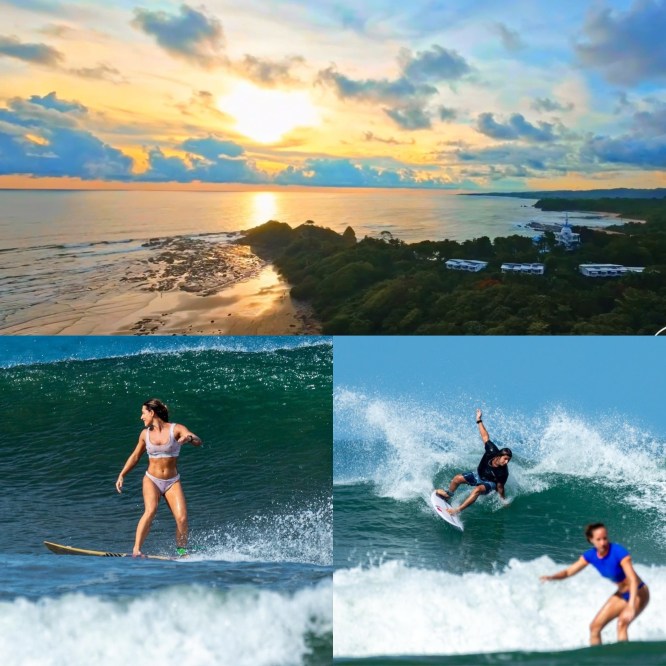
- Some quality surf photos & a couple videos from Kaiya at Surfing Nosara.
- Take a look from the air Playa Guiones overlooking Las Huacas, Pelada, North Guiones, Main Street Calle Modelo, J & K sections, South Guiones, Punta Garza, Esperanza & South Las Huacas
- Updates from the Playas de Nosara ASADA available to everyone on their Facebook page. They are providing updates about water outages, updates to the system, which areas are to be affected, community updates & answering questions.
- The biggest update is water moratorium in place for new water approval letters. The ASADA can not say when this will change because we need to provide 20 year in advance coverage so need new wells & legal processing all to take place
- Rich predicts existing construction & properties with water meters like K45 & ones with approved water letters like R6 will become highly sought after. However, there are not many properties with water letters in place
- K45 is going on the market for sale (3000m2 with ocean view in K section & a water meter). It is the old Honolei Restaurant & house Brian & Kyle Bombard used to live in. Rich had birthday party there 15 years ago photo with a young Brian in the background & ironically today is Brian’s birthday! Didn’t know about that till after this was done.
- Surf footage from Guiones thanks to Kaiya
- Nosara Civic Association reminds us to celebrate 203 years of Independence!
- NOCA leader Michel came on the Nosara Podcast; he’s an awesome guy check it out when you want to feel good
- WCA water updates & need volunteers
- MoviemientoGuardianes is doing awesome things!!
- Stop by La Roca next time driving into or out of Nosara… Terrific views & great experience
-
This Week In Nosara #34: Improving surf for July, Alligators in river, Community updates & more
Check out our YouTube channel for more
-
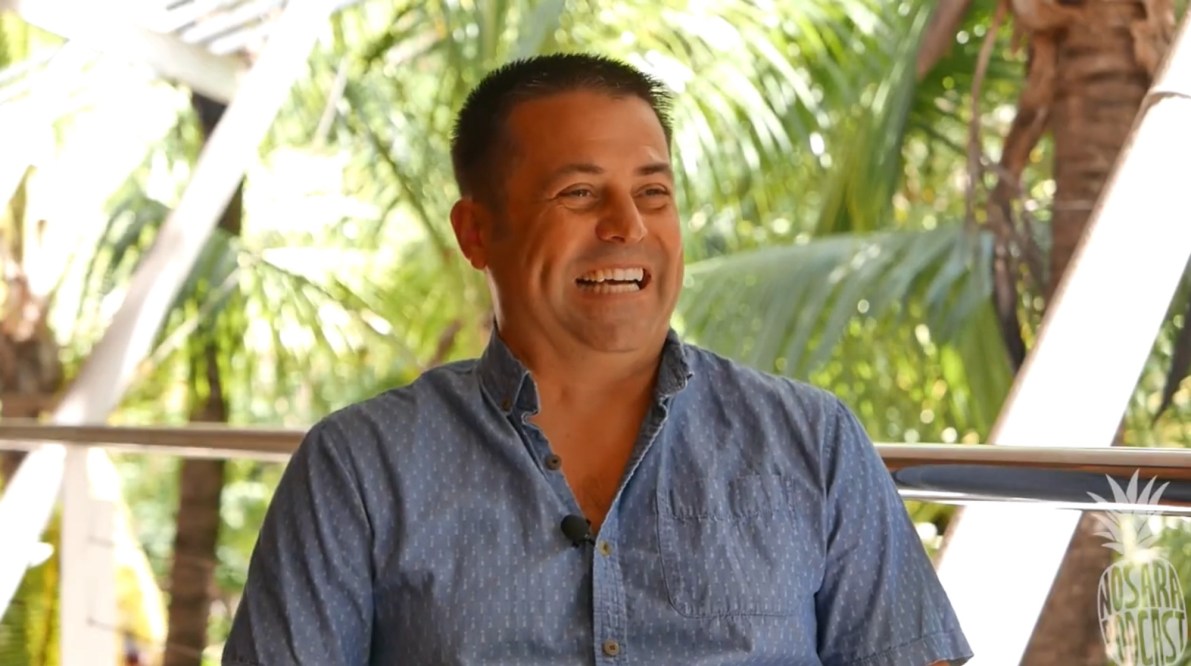
The Brian Bombard Episode: A Legendary Nosara Tale, Which Continues To Unfold.
Brian has been, still is, & will probably always continue to be many things to me. Above all else, he is a HUGE ball of fun, a great friend & business partner, occasionally an innovative source of stress, and much, much more… Did I mention how much fun he is?
In this episode with B’s (this is what I’ve called him for over a decade now), we explore his past, his present, and his vision for Nosara’s future.
This is a candid conversation, and I grill him pretty hard about being a real estate agent plus ask him how his family could be so wildly involved in saving sooo many animals lives, yet he works in the most vilified industry around here.
His answers will surprise many. I am pleased to share B’s episode & proud to call him a friend. This one is long overdue & I hope you enjoy it!
Some of the topics discussed in this podcast:
- Introduction:
- Many might know Brian Bombard as a seasoned real estate agent in Nosara. Recently he has been getting increasingly visible with his marketing too. However, there is much more to Brian than many might know;
- Background and Connection to Nosara:
- Brian is originally from Catalina Island, California, & relocated to Nosara in 2004.
- His family established the legendary Harbor Reef Hotel (formerly a fishing camp) ; which served as the initial landing spot for so many Nosara visitors, plus served as the initial spot to help injured animals later converting to Refuge for wildlife (Now IAR)
- Nosara as Brian’s Home:
- Nosara became Brian’s permanent home after his work for the US coastguard.
- We discuss Brian’s early days, including anecdotes about living in a developing coastal town.
- Transformation from a carefree, single man adventurer to an experienced professional and dedicated family man.
- Balancing Real Estate and Conservation:
- We discuss the delicate balance between real estate development and conservation efforts in Nosara.
- Brian expresses his understanding of the challenges faced by real estate agents and emphasis on guiding responsible development.
- Addressing the apparent contradiction between Brian’s involvement in real estate and his family’s commitment to wildlife conservation.
- Insights into how real estate funded the family’s venture into creating a wildlife refuge. Thank God!!!
- Challenges of Nosara’s Growth:
- Discussion of the challenges posed by Nosara’s growth.
- The need for building regulations in Nosara to manage development.
- Exploration of the alignment and common ground in previously imposed regulations.
- Emphasis on the importance of communication for practical solutions in managing growth.
- Reflections on Sustainable Development:
- Brian reflects on the fine line between embracing development and preserving the town’s natural allure.
- Insights into the need for sustainable building practices.
- Nuanced perspective on navigating the challenges and opportunities in a rapidly evolving coastal town.
- Commitment to Nosara’s Unique Charm:
- Brian’s commitment to preserving the unique charm of Nosara.
- Facilitating responsible growth while preserving the environment.
- Dedication to both community and environment in the context of real estate, conservation, and community development.
- Introduction:
-
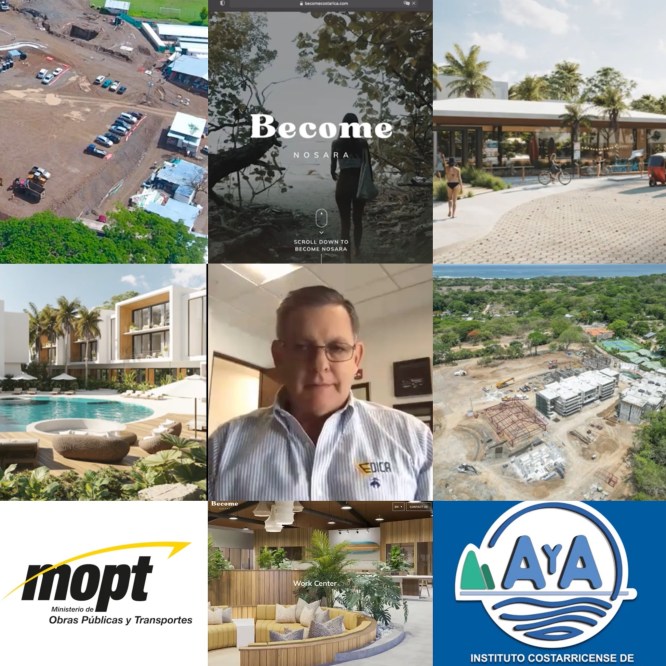
NP #176: Become Nosara’s developer Karl Lachner answers internet comments and explains his development


Episode Transcript
Rich Burnam / Karl Lachner
Opening — Addressing the Community Fear Head-On
[0:00]
Rich: Karl, thanks for coming on the podcast. I really appreciate it.
Karl: Thank you for inviting me and letting me show people what we are doing.
Rich: Let’s just get right into it. You’re the developer for Become Nosara, and Become Nosara is a pretty big project. It’s right at the entrance as you come into town, so everyone sees it. And quite frankly, Karl, everyone’s scared and nervous. Nosara has had a wild streak of growth and development. People are concerned we’re gonna lose the charm of the area. Anytime there’s construction of that magnitude, it’s alarming. I’m not trying to start on a negative note — I just want to address what’s going on right away. So thank you for coming on and being willing to do that. That means something to me. People respect that you’re communicating and you want to get involved. Let’s get on with it if that’s okay.
Karl: Thank you. First of all, I’m Costa Rican. I’m a civil engineer. I own a construction company. I would like people to know that my grandfather had a ranch in Sámara since 1950, so I’ve been going there before everybody. There were no roads. My father owned a Cessna plane and we used to land on the beach. So I know the area. I know what it means. I’m in love with all that part of the peninsula — from Montezuma and Santa Teresa all the way up to Guiones. It is my favorite part of the country. I know it very well, and I’m not intending to destroy anything. In fact, I’m trying to do everything to look great and not disturb the natural magic of Nosara.
Reading the Community Comments Out Loud
[~2:00]
Rich: With that being said — I’m going to read a couple of things that people have said. People I’m friends with, people I know. This might sting a little bit. Here’s what’s being said:
“That project came to destroy Nosara.”
“The road construction exemplifies how little they care about the community.”
“They illegally took away the asada’s well and there’s no water for the school.”
“Only 60 luxury condos. All real estate developers care about is money.”
“They have destroyed land and water rights, nature, roads, creating dangerous conditions.”
“I’ve never hated a building so much.”
“The lights are a total hazard.”
“They have the balls to call this Become Nosara — just sick, sick, sick. More like Destroy Nosara.”
I wanted to invite you on this platform to give you a chance to address this yourself and speak from your heart. This is your episode.
What the Land Actually Was — and the Permitting Process
[~5:00]
Karl: That was a lot of information. Let’s see where to start.
First of all — I bought that piece of land. It used to be a cattle farm. Somebody cut all the trees and had cattle on that land. So when I got it, the majority of the trees were guácimos, which are the trees that grow on cow manure. There was nothing of value on that land.
There were two hills I needed to terrace to build the buildings. We went through a lot of permitting and studies. I had to do an archaeological study to see if there were any indigenous burial sites. I did a hydrogeological study to see how runoff water would exit the project. I needed to discharge that water into the river right in front, so I had to do a hydraulic study of the river to confirm I wouldn’t cause any construction impact downstream.
I also hired a forest engineer who got me the permits to cut those guácimos. In exchange, we’re planting about 200 trees along that property. We’re reforesting the area.
The project is not right on the street — it’s about a hundred-and-something meters back on the property. Even though there are three three-story buildings with 54 units, they’re retired from the road. They’re not going to invade the view when you come in.
In the front of the property, we’re working on another project. It’s all Nosara-style — ranches, palm trees, trees everywhere. It’s going to be really, really nice. A destination place.
The Well — Setting the Record Straight
[~9:00]
Karl: The entire property — the owner drilled a well, maybe 10 or 12 years ago. He went through the hassle to get permits. I went through the hassle to get the concession to use that water for the property.
I didn’t take any well from any asada.
The well in front of the property was donated by the prior owner to the asada. The asada didn’t do anything with that well. It collapsed — it’s gone — because they didn’t use it and didn’t get the permits.
When I found out about that, I started working with the board of directors of the asada. They already have another well and it’s been about a year and a half getting the permit from AyA to connect it. Now they have the permit, but they didn’t yet complete the permitting from MINAE to get their concession. So I’m working with them — helping them get that well connected to the asada, because being Costa Rican and having worked in this for 33 years, I know how to navigate the permitting. These guys maybe weren’t well-guided on how to do it, so I’m helping them.
Rich: So it’s safe to say you’re not stealing from any schools or from the community. Those accusations are completely false — is that what you’re saying?
Karl: Yes. The well that was donated to the asada was lost because they didn’t use it. I’m using a separate well that was drilled with proper permitting, and I have the concession from MINAE.
Septic Tanks — Or Not
[~12:00]
Karl: I’m also being told — you didn’t say it, but I’m being told — that I’m building 300 septic tanks there.
Rich: Talk us through that. That was going to be one of my next questions anyway.
Karl: I’m not doing septic tanks. This is a serious project. I’m doing a wastewater treatment plant. The water discharged from there is going to be used to irrigate those 200 trees we’re planting. So we’re giving the water back to the soil.
We also have roads, gutters, sidewalks, and a stormwater system — something that doesn’t exist anywhere in Nosara. When you go there in the rainy season, you’re passing through huge pools of water to get from one side of town to the other. Now we have a stormwater system. It’s not going to flood. It’s going to have parking. I’m improving everything and planting trees back on the land.
I invite everybody to come, and I’ll be there to answer whatever questions you have.
Open Door Policy — With One Condition
[~15:00]
Rich: So you’re open to people contacting you directly? We can put your email up. You’ll address their questions one-to-one rather than through online banter?
Karl: Yes — under one condition: respect. I’ve been told a lot of things that I’m not. I can talk with anybody who will listen, understand, and communicate with respect.
Rich: That’s a fair condition. And quite frankly, that’s what this town needs to do. That’s a big impetus for this podcast — for years I’ve watched so much misinformation fly around, and I want to give people a chance to speak for themselves and go directly to the source. And again, thank you for doing this. The people who are saying those things — they just care about Nosara. We’re all scared.
Karl: I do care about Nosara. I love the place. And this is not just a real estate project — it’s something different.
The Pandemic Origin Story — and the Name
[~18:00]
Rich: Explain that. Please.
Karl: Become is a project that was my idea during the pandemic. I was reading what was going to happen with people after the pandemic — how they were going to work. I teamed up with my two daughters. My oldest daughter is an expert in branding and she lives in Garza in a container. My youngest daughter is an architect. We worked together for a year and a half designing a project where you can enjoy and have the experience of living in Nosara and Costa Rica, but at the same time have a place to work.
There’s a work center in the project that’s not only for the owners of the apartments — it’s open to the public for a day fee.
This was designed for people who wanted to change their way of living. Before the pandemic, I thought you had to be 70 years old before you could go live at the beach. But now you can go and learn to surf, do yoga in the morning, work all day in the work center, then have a beer and watch the sunset. It brings balance — surf, yoga, sand, beach, sun, and also work and responsibility.
Rich: I heard “family project” in there too. It sounds like this is a project where you get to interact with your daughters and they take a leadership role. Is that accurate?
Karl: My oldest is 26, my youngest is 24. We teamed up and worked for a year and a half. And that’s where the name came from.
Rich: Explain the name. Where did “Become Nosara” come from?
Karl: Vivian, my daughter, came up with the name. It means: start doing, start being something else. Start moving in your life. Become somebody else. Become a better person, a healthier person. Start living. Have the opportunity to live in Costa Rica.
My dream is that this becomes the first. Someday I build Become Santa Teresa, and the people who buy in Become Nosara have the chance to swap their experience for another location I build.
Who’s Buying — and What the Rental Rules Are
[~24:00]
Rich: Who is buying? Is it just foreigners, ticos — is there a particular demographic you’re targeting?
Karl: I’m not permitting daily rentals. The minimum rent is one week. I want people to stay and enjoy and have the experience of living in Nosara.
Rich: So weekly rentals are the minimum from a vacation rental perspective. And long-term rentals are allowed too?
Karl: I don’t want people just filling the project for a weekend. I like people to stay and enjoy the place. About 90% of the people who have bought are Americans and Canadians who have been to the area multiple times and have come to the project and talked to me directly.
There’s a Canadian couple who said, “I like the project a lot, but I don’t like the way you treat your workers.” I asked why. They’d heard the workers were living in bad conditions. I said, let me take you to the campsite. She went in and saw how I set everything up — clean facilities, good food, healthy conditions. She bought the apartment. I invite anybody to come see how we treat our workers.
Last week we had a party because there were no accidents. We care about safety a lot. We have recycling programs, and—
Construction Practices, Recycling, and Plastic-to-Pavers
[~30:00]
Rich: I think people want to hear this — the comments say so much is illegal and workers are mistreated. I appreciate you addressing it.
Karl: My company, EDICA, is carbon neutral and ISO 14001 certified, which is the environmental management standard. That means we’re responsible for all our waste disposal. When you’re building something, you generate a lot of trash. We separate it — wood, steel, plastics, hazardous materials — and we dispose of them properly.
[Fact-check: Karl said “ISO 14000” in the interview — the correct standard is ISO 14001:2015, confirmed on EDICA’s website.]
On plastics, we’re doing something new. I’ve sent crews to the beach to collect plastics. We take all of that construction plastic and the beach-collected plastic to a company called Pedregal. They build pavers, and they have a special machine that shreds plastic and adds a percentage of it into the pavers and concrete blocks. So we’re disposing of plastics by embedding them into construction materials.
The challenge in Costa Rica is that you can’t move trash across provinces freely. I have to go to the municipality first. It takes a long time. What they don’t accept locally, I can take to San José and process into the concrete pavers.
Rich: So you’re collecting plastic from the beach, and it ends up in building materials. That’s pretty cool.
The Road Cuts and the Lights — What Actually Happened
[~36:00]
Karl: I wanted to say something I forgot earlier. There’s a gutter that crosses the road into the river. I wanted to use that one so I didn’t have to cut the road. But the Ministry of Transportation didn’t want me to do that. They wanted me to cut the road and run the drainage down to the river. I fought with these people for a long time and there was no way, so I had to cut the road. It’s already fixed. I think we did a fair job fixing it.
Rich: So one of the quotes that came in was that the road construction shows how little they care for the community. And what you’re saying is that wasn’t your decision at all — you tried something different and were ordered to do it?
Karl: I hate when they pave a road and then cut it. There’s a gutter going through the road — the Ministry of Transportation didn’t want me to use it. There’s no reasoning with these people, so I had to do it.
Rich: And the lights in the area — temporary?
Karl: I took off the lights. When you have the road in bad condition, you have to put lights — even if they’re blinding — because of safety. You have to slow people down. If you go to any Guanacaste construction site, you’ll see those lights on the road. Now that we fixed the road, the lights are gone.
Rich: So you were taking heat for the road — and you’re saying that wasn’t your decision. And the lights were for safety during the road work you didn’t even want to do. Is that correct?
Karl: Yes. Correct.
Protected Area, Trees, and the 40-Meter Radius
[~42:00]
Rich: People are so concerned they assume it’s all destruction. Can you talk about the protected area on the property?
Karl: The well is on the back side of the property. Forty meters around it, I cannot touch or build anything. So there’s a protected area — all trees and green space. Just outside those 40 meters I might build a couple of pickleball courts. We’re also building stairs in the back connecting to the 506 Tennis Center next door, for those who want to use the courts there.
That protected area is around 4,000 to 5,000 square meters. That’s where I’m planting a lot of the trees. I’m also going to pump the effluent from the wastewater treatment plant into that area to irrigate those trees.
I don’t want a Miami-style project. I want a very local project. I’m not planting palm trees — I’m planting local, indigenous species. I’m being helped by a forest engineer and a landscape specialist who is helping me rebuild all the landscaping with trees and green areas.
Even though it’s a large project, we’ve taken care of a lot of things. The back of the property was previously destroyed — someone illegally extracted the soil to use for road fill material. You couldn’t see it from the front, but the back of the property was severely impacted. So I could say right now that we’re improving the land. Even accounting for the buildings, we’re doing improvements on what was left there.
Community Outreach — Soccer Field and the School
[~50:00]
Rich: Anything else you want to get out there while you have this platform?
Karl: We are really serious about responsible development and social responsibility. I waited two and a half years before starting construction — a year and a half in design and another year getting permits — to be totally legal and do everything right.
I’m also trying to contact the Esperanza Association — Asociación de Desarrollo de Esperanza — because I want to help that soccer field next to us. I want to fix the bleachers, the restrooms, the locker rooms, paint everything, fix the roof, fix the roads around it. I’ve sent emails but haven’t had luck yet.
We’re also beginning to get involved with the school right in front of us. We may help with materials the children need — I heard something about music instruments that we might help with.
The Project Overview — Size, Units, and Amenities
[~54:00]
Rich: Tell us the description of the project itself — size, units, the general overview.
Karl: Three buildings, three stories each, 18 units in each — 54 total. There’s a large swimming pool, a large work center, and a couple of meeting rooms available for anyone who needs a place to meet. There’s also a back-of-house building for maintenance and housekeeping, so owners who want to rent can do full unit turnarounds easily.
I own a house in Carrillo and that’s the model I follow — I leave, I leave a note about what needs fixing, and when I come back it’s done. That’s the experience I want to provide here.
I’m also thinking about building two pickleball courts in the common areas, in the green zone around the well.
The Front Commercial Zone
[~59:00]
Rich: You mentioned the front of the property. Tell us about that.
Karl: I’m designing a destination place at the front. A place with small restaurants, boutiques, maybe a bank or real estate office. Built Nosara-style — real wood, palm roofs, wood shingles. We’re putting wood shingles on the Ritz-Carlton in Papagayo right now and they look incredible.
It’s not going to be a place you stop and go. It’s going to be a place you want to go — a couple of rooftop bars where you can watch people come and go, an open patio with trees and lights. Something like the plaza in front of La Luna. I think it’s going to be great. The buildings will be far back so you won’t feel like they’re invading from the road.
[Fact-check: La Luna is a well-known Mediterranean beachfront restaurant on Playa Pelada, Nosara — confirmed.]
Background, Resume, and the Scale of EDICA
[~63:00]
Rich: As far as quality of construction — you’ve been doing this 33 years. What’s your background and education?
Karl: I went to Purdue University in Indiana. Two degrees — civil engineering and construction management. I worked in Atlanta for about a year, then came back to Costa Rica.
Rich: 33 years of experience, two degrees, and you’re saying this project should leave the land better off once the unavoidable impact is done. Did I hear that right?
[Fact-check: EDICA was founded in 1957 — Karl’s personal 33-year tenure tracks. The Ritz-Carlton project Karl references is Nekajui, a Ritz-Carlton Reserve at Peninsula Papagayo, which opened February 2025. Karl cites 37 residences and $108M; public records show 36 residences and $130M in construction financing — minor live-interview discrepancy.]
Karl: Somebody cut all the trees and put in a cattle farm. Then somebody invaded the property and extracted the soil illegally with no permits. Right now, even though we cut those trees and flattened the land, we’re planting back native trees that should be there — the ones that were there before the 1950s.
Rich: On your first trip — when the plane landed on the beach — you’re bringing it back to that?
Karl: Yeah. There was no power, no water, no nothing back then.
Rich: And for the people saying the construction quality is bad — you’re also currently building the Ritz-Carlton at Papagayo?
Karl: Yes. We’re building Nekajui, a Ritz-Carlton Reserve, plus 37 residences. It’s a $108 million project.
Rich: I think the quality argument is almost laughable at this point.
Karl: There are a lot of professionals involved in this project — structural engineers, mechanical engineers, electrical engineers, architects, interior designers, pool designers. I didn’t do this alone. I always surround myself with people better than me. Everything is solid concrete — no blocks. Mat foundations. Seismic-proofed structural design. First-class mechanical and electrical.
Also — my father was my boss. He passed away nine years ago. He built some of the most important buildings in San José, including the children’s hospital, the San José airport, convention centers, factories, and hotels. You can go to EDICA’s website and see who we are.
[Fact-check: EDICA’s first major project in 1962 was the Hospital de Niños Dr. Carlos Sáenz Herrera — confirmed.]
Closing — An Invitation and a Walk-Through Planned for November
[~70:00]
Rich: I’ve learned a lot through this conversation. I hope other people do too. I’m still scared — everyone is, and that means they care. But you don’t sound as scary after hearing you as you did before we started. There’s definitely going to be people who benefit from speaking with you directly.
Nosara is one of the few spots where tourism actually brought nature back. Everything used to be cattle fields — just like this land. Now what we’re all worried about is that it’s getting so filled in that those days are over. It’s very easy to be negative and very hard to do the extra step of getting to know people. So again, thank you for doing this. I hope the communications continue.
Karl: I invite anyone to visit the project. Even if you have no intention of buying, I will take the time to explain whatever they want.
Rich: Hey — as we get closer to November, maybe we walk through it together on camera and you point everything out. A follow-up episode.
Karl: Yeah. Or if you have a group of people, bring them and I’ll show everyone around.
Rich: I’ll hold you to that. We haven’t started planting trees yet because it’s dry season still.
Karl: We’re planting all the trees in July once the rains start. Be patient — it’s going to look really, really good.
Rich: Anything else you want to hit while you have the platform?
Karl: Just thank you for having me and giving me the opportunity to talk and explain. You might be surprised how we’re doing things. What people talk about — I can’t control that.
Rich: Neither can I. And I can’t force anyone to watch this, but I hope they will. Thank you for your time, sir. Best of luck, and I hope your forecasting comes to fruition — that would be a real blessing for all of us.
Karl: Thanks to you.
-
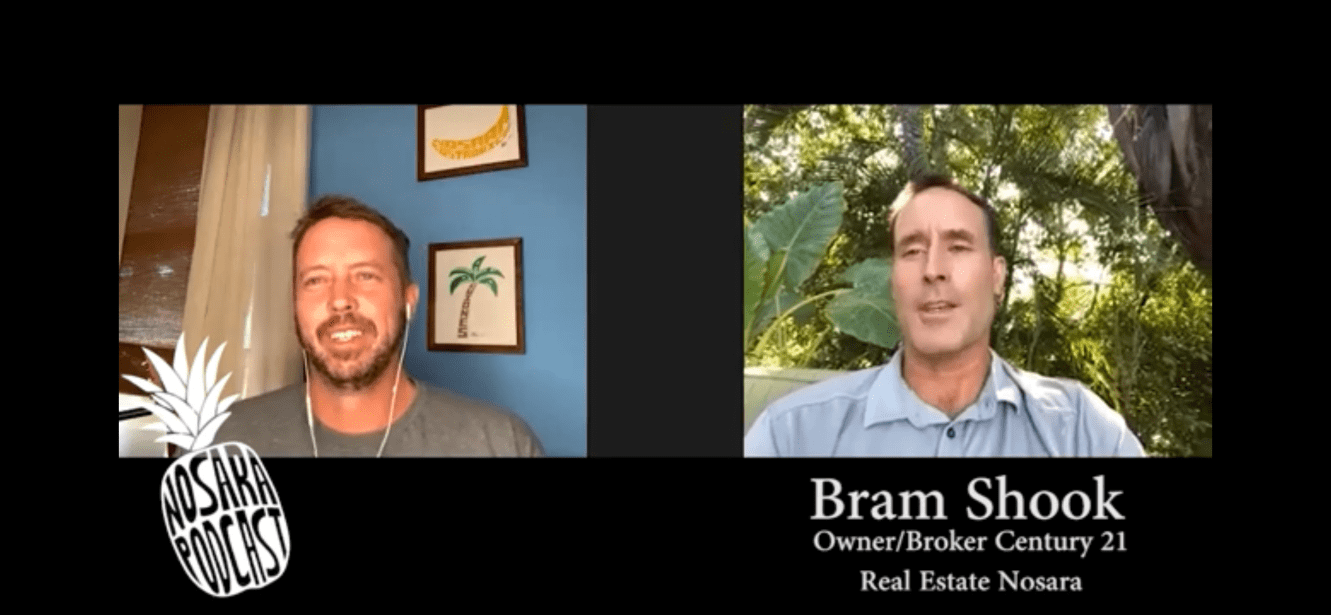
NP #158: Bram Shook’s Nosara Podcast, RE Episode 1; 2012 to 2021 Nosara Real Estate update
Bram was my first contact in 2002, recommended from someone named Harvey, I think. Anyways, I always remembered him and am grateful you can get to know him too in this episode.
Quick synopsis: Bram’s been here 20+ years, has a picture perfect family and seemingly lives about a good a life as anyone possibly can. He admits paradise isn’t perfect, yet Bram seems to have his comfort zone in line. He’s the subject of the very first Nosara Podcast Real Estate episode and I’m grateful to him for this. NP is hopeful other real estate professionals will participate in the future as well.
Here are the notes:
- Marketplace
- 2020 quiet for 6 or months hiatus but turned into frenzy
- Inventory as low as ever; supply & demand situation
- R asks if realtors creating this situation or is it the marketplace?
- B answers many people from LA Toronto etc working online and people with means want lifestyle of health and wellness with bilingual kids looking for better lifestyle & great place to enjoy their time
- R points out used to be surfers and yogis
- B explains surfers phased into yogis but now beyond that. It’s people with means, and often referrals of friends and family paying cash. It is not a standard marketplace with financing.
- R remembers 2 economic ups and downs and shares 2003 memories and economic destruction in FL & is confused by Nosara’s #’s seemingly too high. R then asks Bram what does the massive economic adjustment mean to him?
- B reiterates term frenzy and explains the new Nosara. It’s not affordable to everyone and RE is expensive… Restaurants are expensive too. It is what it is. Not everyone can afford to live everywhere and he can’t afford certain places in US. This is the new Nosara.
- R says L section owes him thanks for electricity…
- B says he can just send a bill (excellent and accurate joke)
- R thanks B for Del Mar Academy. B says others (just a couple are: Jessica, Haley, Inke, Carlos, etc etc all supporters, teachers, etc through the extremely challenging early years)
- He covers last years listings (ironically I sold them I think. They were huge winners for buyers in retrospect but sellers at time did excellent too)
- B struggles to predict 2022 and 2023
- R mentions Pelada reputation. B laughs how long gone and now a construction zone
- B says Esperanza and the Colony (Finca) or Bosque Verde exist.
- R says people ask for Guiones or view normally but after living here a while adjust
- B says all the cool people live in L section (we both live in L section, good joke)
- B says doesn’t use social media and R laughs jealously