


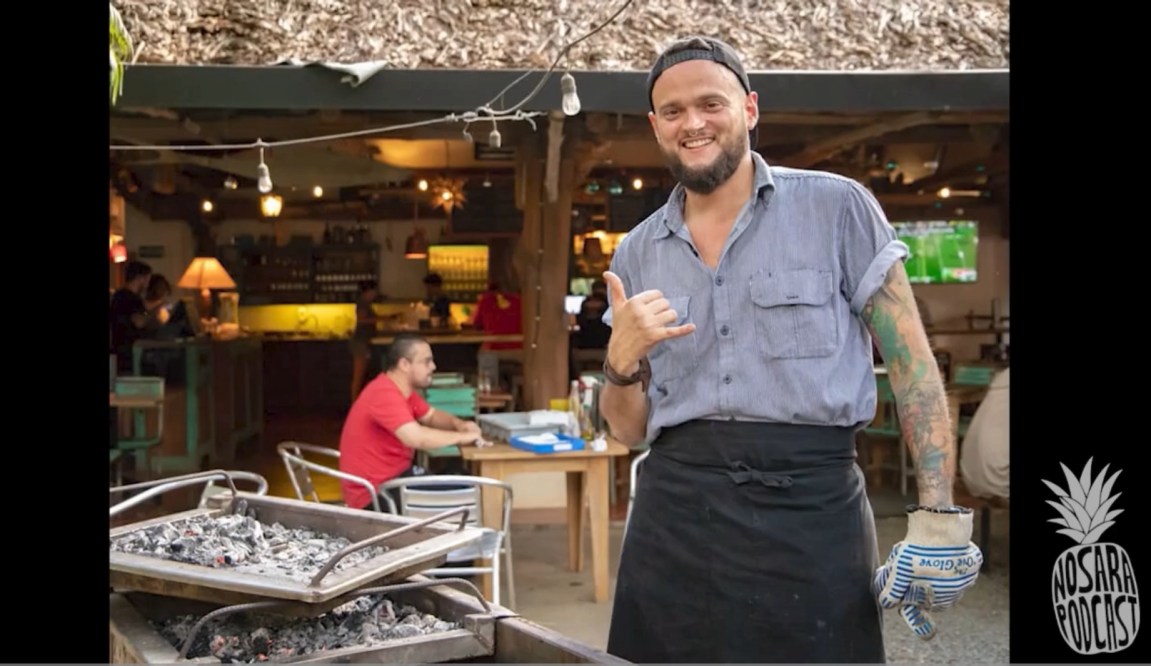
Chef Juan Pa (from Chancho’s BBQ) is a super interesting man. He was raised ‘fancy’ but chose the ‘streets.’ He’s filed with tattoos and interesting attire but at one time was in law school & a paralegal, then high end culinary before finding his rightful spot as a key member in helping “Keep Nosara Weird” as our wise sage Carl Wells popularized.
There’s all kinds of good shorts & amusing moments in this episode. I sure enjoyed it & hope you do, too.


Episode Transcript
Rich Burnam (Rich): Welcome to the podcast. Gracias. Hey, please introduce yourself and let’s get going.
Juan Pablo Berrocal (Juanpa): My name is Juan Pablo Berrocal. I come from Liberia. Proud son of this province. Proud cook.
Rich: You’re lots of things.
Juanpa: Well, you have to be growing up here, you know. Like, I tried to explain to many people when I was growing up, there wasn’t Lipton sweet tea in a powder—that sort of thing. You couldn’t get it on a shelf. People traveling to San Jose would come back and they would bring us candy bars, like Choice, which is a Costa Rican brand, and it would be like the newest thing. And I remember people that came from the States getting Snickers bars and Butterfingers and all sorts of that shitty candy. But for us, it was impossible. A bag of Lay’s—you couldn’t get it, it was unheard of here.
There were very specific, super expensive, super exclusive little supermarkets in Playa Potrero and Tamarindo when I was a kid. And you could go there, but it was something like paying, I don’t know, 20 bucks for a bag of chips. So the tourism brought those things which are so sweet and attractive and addictive. Fast forwarding through it, now we have Burger King in Nicoya and all types of stuff.
Rich: Well, yeah, globalization. You just can’t fight the advance of the machine. It’s still beautiful, but when I got here, there were only two houses on this street. Now, it’s very different. How do you feel about seeing the inevitable happen? Because even though I’m inside the machine from my day job, I never expected Nosara to do this. I never once thought it. It used to be very challenging to get here and people didn’t believe in the town. And I love that. But now it’s very popular and there’s lots of different stuff coming in. So what’s your take on that?
[02:30] Development with a Conscience: The Sweet Balance
Juanpa: Well, my dad developed a big part of Bahia Culebra where Papagayo is. Actually, the property where the Four Seasons sits on, that was like a glamping site when I was a kid. So back then, the whole thing of sustainable development was already ingrained in my DNA because my dad was doing it.
But my dad’s from San Jose and my mom is Liberiana. Her dad was a big cattle rancher who didn’t care about anything but his farm. So it was like that clash of cultures. Keep everything as is, we don’t want to invest in anything else that is not farm-related on one side. And then my dad and the whole school of thought of, “let’s develop this because it has more value to use this property for tourism as opposed to cattle ranching at the time.”
So for me, I’ve been immersed in development with a conscience and the sustainability part is very ingrained. Yeah, there’s excesses, as everywhere. But as long as it makes sense… there has to be a sweet balance between absolute conservationism and absolute development.
Rich: Oh man. You got to pause on what you just said. We got to trademark that—”there has to be a sweet balance.” So Sweet Balance is the name of the song that we’re going to write together. Your take is interesting because you’ve always lived very well in each world. And now I understand why, because you just explained your background.
Juanpa: You see, it’s… I mean, yeah, you can go to the excess of going off-grid and living off the land, which is awesome and admirable. But in real life and from my perspective, if you try to keep it as it was 30 years ago… I’m 37, so when I was growing up, Playa del Coco was very well developed. Tamarindo was 50 percent of what it is right now, and that was about it. Playa del Coco was the first settlement on the northern part of Guanacaste that was developed for tourism.
Rich: So you saw this firsthand?
Juanpa: Well, not firsthand, but second generation. My mom and her sisters and brothers, they were immersed in the first settlement of Playa del Coco.
Rich: I meant tourism. You saw the plane take off.
Juanpa: I mean, my family was always involved in the chamber of tourism even when Daniel Oduber Quirós—who was the first Guanacasteco president—was around. Daniel Oduber did a lot for the province, and then the airport got renamed to Daniel Oduber, who is from San Jose. But for us, it’s still Juan Llano Grande.
Rich: I didn’t know that.
Juanpa: Yeah, well, that’s a lot of history that people from San Jose keep hidden.
[05:45] Altura vs. Bajura: The Hidden Regional Tensions
Rich: Hey, why do people from different sections of Costa Rica fight so much? Like, if someone’s from San Jose and there’s a group of people from Nosara, the people from Nosara itself are like, “Hey, hey, you’re from Chepe.” But then at the same time, if someone from Nicaragua walks in, then the San Jose guy and the Nosara guys are on the same side, you see what I’m saying? And then if I walk in, it’s like, the gringo. How is that?
Juanpa: It’s regionalisms, right? So for example, La Bajura—Nicoya, Santa Cruz, Filadelfia, Carrillo, and then the Peninsula, Jicaral, Lepanto, Paquera, all of that. I call that La Bajura. And then Liberia, La Cruz, Bagaces, Cañas, Abangares, that is called La Altura. So, there is a bit of a collision between La Bajura and La Altura, but not all the cantones, right? Because people from Tilarán, for example, and Abangares are on the other side of the mountain. They were settled by people from the capital city, from Naranjo and Sarchí.
Rich: So there was a natural border there to create that.
Juanpa: Yeah. Go back to 1824, right? With the Annexation of the Partido de Nicoya. You have Liberia, what is La Cruz now, and then the ridge that separates a bit of Cañas and Bagaces were part of Costa Rica. So between the part that wanted to annex and the part that wanted everything to remain the same—which was Liberia—they’re still mad there. Well, they’re not mad about that, but there is always a collision. I played basketball all my life and I remember coming to La Bajura to play. It was always something. There were always, not always, but fistfights and dirty play.
Rich: There’s a tension that’s boiling. It seems like it’s hot. I thought I really thought it was football—soccer for people who don’t understand.
Juanpa: Well, you choose your flag. I wouldn’t say that’s the only reason. No.
Rich: But I thought that kept it alive.
Juanpa: Yes. And then people from the capital city—the Central Metropolitan Valley—used a long time ago to talk down about Guanacastecos, and they would call them Nicaragualos, right? So there is always something. It’s Guanacaste versus the Great Metropolitan Area, or Costa Rica versus Nicaragua, or Liberia versus Nicoya, Altura versus Bajura. But it’s still something, like we say here, eso se mama—you drink it, you’re nurtured by that, and you learn it, and it forms your identity, of sorts.
Rich: That makes sense. I’m from Florida and Florida is the landing spot of everywhere. Countries, not just states. So I just grew up where it didn’t matter any color or nationality to me, it just mattered who did the best job at this and who did people like.
Juanpa: Well, yeah. Like if you go north of the Mason-Dixon line or south, there’s always something. It’s like a mountain ridge, dude. It’s as old as time.
[09:15] Chancho: Good Food at Accessible Prices
Rich: Well, Nosara is kind of neat because we do have such a melting pot. And you’re interesting because you’re truly, even in your DNA, brought up that way. So this podcast is fun, I get to learn about people. Fast forward to here, now. What are you doing? What’s happening?
Juanpa: Uh, certainly the biggest novelty in my life is Chancho. The new barbecue joint in front of the Iguana, where Fish Bar used to be.
Rich: That’s new to a lot of people, they don’t know there’s actually a barbecue here in Guiones close to the beach, right in front of the Gilded Iguana. It doesn’t get more centered than that spot. So how are you feeling about it? What are you doing? And who should go there?
Juanpa: Everyone. I even have a smoked cauliflower for all the vegans. Although my Wi-Fi password is eatthevegans, but it’s just part of the brand values to make fun of everything.
Rich: I so love that approach of making fun of everything. That’s what we need to do now in this town, in my opinion.
Juanpa: Well, if you don’t make fun of everything, you’re taking life too seriously. I think Oscar Wilde said something like that, you know? Like, it doesn’t matter. One of the things we take very seriously is to have good food, at reasonable value, because nothing in Nosara is reasonable anymore. Cost-benefit, I think I’m the best offer. Hands down.
Sorry for all my colleagues, but that’s true. Granted, it’s a counter service, and it could be this and that, but the idea is to have good food at accessible prices, and it sells. We close down if it’s 5:30 and we have no more meat. We just close and we go surf. That is part of the brand values as well—to have a work balance.
This is my 18th year as a professional chef, and before I moved to Nosara, I only did fine dining. I was in Las Catalinas, I was the executive chef there, and it’s just too boring, man.
[11:40] Escaping Fine Dining & Finding the Kitchen Machine
Rich: I was going to say, how did fine dining work for you? Because you’re sitting here in boots and tattoos, and you’re this person who’s very much in nature. Like just yesterday, you crashed your kayak. Earlier today, you were stuck in some crazy situation. You’re an adventurous guy. I thought that from the moment I met you. You have an edge to you, but you also can get fancy like that. That’s not a normal combination.
Juanpa: Well, yeah. I mean, I chose the street, but I grew up fancy, you know? I was very well raised. That’s a good rap line. But there was a moment in my life before… because I paid my culinary school with my salary as a paralegal. I was in law school before, en la Universidad de Costa Rica, which is like one of the most prestigious, if not the most prestigious in Costa Rica for law. It just wasn’t making it for me. It was just too tight, too square. As much as lawyers want to say that law is dynamic, nothing changes.
Rich: And you’re not a sit-still guy. You’re the opposite.
Juanpa: I can’t. And then the kitchen received me, as it deals with all the people that never fit in, man. I’ve worked with former penitentiaries. I’ve worked with people that never learned to write their own name. I work with very talented people with God knows how many titles and certificates. Everyone that can’t figure it out ends up in the kitchen one way or another for a permanent or a temporary position. It really helps them either get the fuck out of the kitchen and find out what they really want, or it’s just the thing they want to do for the rest of their life. Like it happened to me.
Rich: Did that challenge—was that the hook? The forever addiction of the machine inside the kitchen, the fast pace, and the standing-upness?
Juanpa: Yeah, there is… I mean, it’s related to surfing, to skating, to all those stupid things I do that make my mom scared. There is an addiction to adrenaline, right? And that’s why I did also so many drugs and so many more, you know? So in the kitchen, you have to just go for it. And I don’t know why we tend, or at least I do, I tend to give godlike qualities to my chef and I was fearful of his wrath more than, I don’t know, messing up a legal deed when I was working in a big firm, you know?
The decision of going to culinary school wasn’t super well received by the family because back then, you were either a doctor, a lawyer, or you go back to the farm. And going back to the farm doesn’t mean that I was herding cattle or working with a machete. It meant you were the boss—finquero, you are not un peón.
Curiously enough, because my family on my mother’s side is Lebanese, so there’s a lot of love for hosting and food. And my grandfather on my dad’s side is French, so also a big eater.
Rich: Dude, you got an interesting genetic input.
Juanpa: Oh yeah, I’m a mutt. I’m from everywhere, man. And my mom loves to cook. When she was in the Chamber of Tourism that I was telling you about, in order to gain international status for the airport back then in Liberia, they started showing Aviación Civil that they were able to handle large groups of people. So, among many people, they would go into the kitchens of the then police headquarters, el cuartel—the military garrison in town. They had a huge institutional kitchen, and they would go and work. So my mom handled a lot of that cooking herself with a lot of people, but she was the chef—which just means “boss” in French.
So even though there was a lot of that, and she also had a restaurant when I was growing up, that decision of me going into culinary arts wasn’t so well received because I’ve always been challenging. I said, “Oh, you don’t want me to be a chef? I’m going to become the best fucking chef in this world.” And I just cranked it to the max and I forgot about sleep, forgot about people, forgot about my life, and just hit it in a kitchen for way too many years and had no life. My first happy hour drink was during COVID, because I was a child and then I was in a kitchen. Yeah, I had a little impasse when I was in school as a paralegal, but I just went in there and I forgot about everything. Personally, I don’t celebrate birthdays or anything because I just never had the opportunity to do it.
Rich: Ah, I gotcha. So you kind of created that groove in your brain. Okay, so that being said, why Nosara? Give me the overview.
[16:20] Falling in Love with Nosara & Serving the Bomberos
Juanpa: I sort of plateaued in my life and I realized that I didn’t exactly know what was next. It was either leaving the country to keep finding the highest levels… so I took a job with a very large hotel group and I came to know how to open that. In the midst of that, because it was a big change—they have hotels everywhere, so it was a good step up for me to just branch off—I came here and I started getting immersed in the community.
Most importantly, I’m a wildland firefighter with SINAC. So naturally, I came and I started volunteering with Bomberos de Nosara. Because of Bomberos, I started to know people and I really got immersed in the community and I fucking fell in love, and I’m here.
Rich: So the community did its thing. The same thing that ends up happening because it’s more expensive, it’s far away. The waves—if you want to get barreled and you’re a pretty big guy, it’s not that, it’s a soft wave. It actually doesn’t make sense. But at the same time, once you come here and feel it, if it hits you the right way, it makes all the sense.
Juanpa: The barreling is certainly not a decisive factor right now.
Rich: Stop crashing your kayak. Actually, hey, tell that story real quick.
[17:50] The Boca Kayak Incident: A Lesson in Humility
Juanpa: I needed to be humble, man. I was having a great fucking day and I was just fishing out of a sudden. I live in the Boca; I’ve lived there since I moved here. I’m pretty confident in my skills as a waterman and especially in the rivermouth area. Yeah, we had a rogue set. So when I saw it, I started paddling as hard as I could. I tried to surf it, and I just perled. And it’s a 14-foot kayak, so I just went like a catapult.
By the time I resurfaced—because I ate the whole set—the kayak was like 600 meters away, and in a rip, it just went. I started paddling back; it’s a long fucking swim. I keep paddling, I get to the shore again. And there’s no way I could land that thing without crashing again. Paddling again, tumbling again. And like the third time I ate shit, I just grabbed onto it like, “fuck it, here we go.” Dragged me to the beach and I was stumbling and hitting. I beached the kayak, I pulled it all the way up, started walking to my house to get a flashlight, regroup, catch my breath, get water. I put on messages because it was already like 6:30 by the time I got home, so I didn’t want my beautiful girlfriend to get worried. So I sent her a message. Then I texted you. Yeah, it was insane.
Rich: You had a full-circle day. You had too much fun here, so the universe had to make you balance it out with your experience. But then you got it back. I guess that’s living. What’s the bad about this place? Like what bothers you? What’s the thing that, if you could snap your fingers, what’s like two or three things, if you had a laser beam, you could just zap away that problem, what would you do for here?
Juanpa: Oh man, crowded lineups for sure. And the lack of awareness—of realizing where the fuck you are, you know? When I came to Nosara, you could sit at Chivo, and you would have someone in the billions on the left-hand side, and on the right-hand side, someone earning 2,000 colones an hour, you know? And it was a great fucking time. Beautiful.
Yeah, so I think after COVID that changed a bit because we had like an influx of people that really never connected, which is living. I feel it. I see it. And we’re trying—we’re slowly getting back that old tourism that is a little bit more connected. Not only tourism per se, but the new people who are coming to establish themselves here are more connected. And I think the pressure of the tight-knit community, because it’s getting tighter again, it really pushes people to either… como decimos en Guanacasteco, o cabrestea, o se ahorca con el cabresto. So you either lift your neck or you hang. Cabresto is for training horses, but it’s tight. So if you don’t lift your neck—which means like you either align yourself or you get the fuck out.
Rich: Interesting. Nosara has a way of sort of making that happen sometimes. A lot of people come from wherever they’re from, but there are so many successful people in the world coming here and they’re used to, “I’m number one in Toronto at this restaurant or this business,” or “I’m number one from England.” A lot of big egos come through. My opinion is if we tear down the walls and the barriers and we don’t just sit in our islands—like, “this was my realtor, this was my surf instructor, this was my yoga instructor, this was my attorney, so I’m just going to stay here”—we need that to eradicate, and information needs to flow.
[21:40] Ola del Mes: Bringing Back Community Cohesion
Juanpa: It’s very interesting that you’re saying about information has to flow because in an ever-more technological world, people no longer walk in just to walk in. You have to Google and TripAdvisor and social media, whatever the kids do these days. Which is some sort of robbing people, because a tourist will recommend it, so another tourist will go, so another tourist will recommend it… but that necessarily isn’t true. It wasn’t the authentic experience that I was trying to relay. And how do you get that? I have no idea.
Rich: Segue to what you’re doing right now. This is my favorite part of the podcast. 100%. You have events that everyone wants to go to. The poor gringo, the poor Tico, the rich Tico, the rich gringo—something that every socioeconomic demographic wants to go to. And that’s what you’re doing. And when you contacted me about this a couple of months ago, I’m like, I’m 100% in. I’m building all that up to introduce Ola del Mes, porfa. Like, explain what’s happening. You did one. What happened and what did you see? I get excited talking about this stuff. It was a great event. Well, you just linked everyone, and you just started in the peak of the rainy season. What if you can keep it going? I’m behind this one. What if you can keep it going?
Juanpa: No, we are going to keep it going. So Ola del Mes was a virtual tournament, if I can call it that, of a surf contest, but virtual. So it was super easy to participate. You just upload a picture or a video, I don’t remember anymore. Either or both, yeah. And then the person who uploaded the thing got the prize. And we had a panel of judges, and the idea is to keep changing them.
Rich: Explain the categories real quick for people who don’t know what we’re talking about.
Juanpa: So, we had best wipeout, which is my favorite. Yeah, best wave female, best wave male. You had best longboard. And then you had old people, young people, and an aerial. No, those we’re going to get more—we’re going to get Groms and more categories, but everyone’s invited to participate. Anyone, it doesn’t matter who.
It was designed to give the prize to the person uploading, because my idea was that the people more engaged with surf virtually are not necessarily surfers, right? It’s photographers and promoters and the boyfriend or girlfriend that had to sit down on the beach that day and take video of their significant other. Just everyone.
Rich: Everyone from every angle.
Juanpa: Kaiya won, actually Kenyi won, I just submitted it for him. Perfect. And EQ Surf covered it—oh my goodness, Esteban and Andy. So it was very easy to participate that way. And also because it has zero logistics and we didn’t want the heft of responsibility of a contest. Not only me as a business, but on the people participating. There’s no headache, is what you’re saying. Yeah. If you set the date, “okay, we’re going to do it this weekend,” and then the people can’t, you know? So it’s just easier because there are a lot of people doing it. Every day there are people posting pictures.
Rich: You just brought everyone together is the point that caught me. Everyone.
Juanpa: Most of us here… I want to say 70 percent of the people that live in Nosara surf. And, well, 50, I don’t know, you come up with a percentage. But it is certainly a big thing for people to move here. It’s like a lot of nature and wellness, and then there’s surf.
Rich: One of your categories was also just “most interesting photo.” Oh, yeah. So what I like about what we ought to do… I should have introduced it this way. At Chancho’s, once a month you have the vote and people come eat at your restaurant, hang out, and they get to have the party. And we all watch the slides.
My day job at Surfing Nosara, where I worked—this was pre-Facebook, pre-YouTube, pre any of that. The most fun of that job, hands down, was that the community was small and we all got together after the surf session to look at the photos. We sat there and slapped fives and it was like, “Oh, look at your wipeout!” and we all laughed. We had something together, then we left, we went to our lives, and then we came back, and we surfed and tried to get a little better, had more fun. And we celebrated the success and laughed at the failures. And it helped me feel welcome here. With locals that I couldn’t speak the language with, I didn’t connect—I’m this big white guy. It helped me feel good. And I think that what your events did.
Juanpa: Yeah, it’s also one of the things we wanted to do. Like, the big decider to move here is surfing, right? So everyone who surfs is immediately qualified to participate. So what happens? We had at the event, which was awesome, five different demographics. Like you with your family that surf, and then all the surf instructors that do that as a work. And we had people from San Jose that came here to surf and work in different things. It was just a weird mix of people, but everyone with a common thing of surfing.
Rich: It was also a barbecue.
Juanpa: Well, yeah, hopefully both. Sí, pero the barbecue was secondary, you know, because people were really there for the event. And it was awesome because at six—which is not something that happens in Costa Rica—everyone was there for the event. Yeah, we had a party and we danced and had fun after that, but from six to eight, just the event, everyone was there. And it was pretty cool seeing so many different people just hanging out, watching surf. It equalized them, you know?
Rich: That’s why I’m celebrating. I’m so excited. Just keep it going. Don’t stop.
Juanpa: It was awesome. No, it is. You just found a way to link the Grom to the old person in this whole place. And again, that’s what we need.
Juanpa: Yes. And in my eternal search for cohesion and, like I said, equalizing everyone in the community, it’s just easier when everyone knows everyone, you know?
[29:10] Supporting Local Kids & Inclusive Backyard Vibes
Rich: Bingo. So right now we have a lot of Tico surfers who want to enter contests, but they don’t have the money. It’s not that much money to many of the people, and if the people knew about it, then we might get there. Your event gives a chance for someone to come eat dinner, hang out, see the event, see these kids—like right now, Michael and Dorian needing money to go travel for contests, which is crazy.
Juanpa: Yeah.
Rich: That’s an example to this whole town and the whole community. It doesn’t matter if you dislike Dorian or Michael. It actually doesn’t. The greater good is for little kids across this whole place to see, “Oh, I can do that. I have hope,” and they have someone to look up to. There’s enough money around here.
Juanpa: There is. Also, one of the other things that we want to do with Chancho is keep it very reasonable so that it could be a repeat in a week. I’m coming up with outdoor games so kids can hang out, or adults too. But my idea is to, again, make it engaging with everyone. Like inclusive. Exactly, inclusive—thanks, that’s what I was looking for.
So, we’re also doing a pig picking on November 30th for the Bomberos. But in a pig picking event, or the whole thing about barbecue, my vision on barbecue is: “come hang out at my backyard,” you know? So you don’t have to think about it. You want a quick bite, you come in, you grab and you go. So the idea of this whole backyard is keeping it simple, keeping it good, in order to be a place you repeat. There is a selfish vision—repeat business for me—but it’s also like, you can play cornhole like I said before like with a billionaire or with a construction worker. It has the whole flow about your backyard. You don’t have to think about it. You just come in like you’re hanging out at your buddy’s place.
Rich: You have a foot in each thing. The guy sitting at the bar—you nailed it. It could be a billionaire, it could be a poor person. There’s no edge to you, and I enjoyed that. I felt welcome around you, so I appreciate it. I appreciate you coming on this. I have a couple more questions, the toughest ones right now. You ready? What’s your three favorite restaurants? Obviously not Chancho’s. What’s your three favorite restaurants around here and what do you like to get?
[31:45] Juanpa’s Top 3 Nosara Restaurant Picks
Juanpa Berrocal: Oh my… I’m a sucker for the avocado sauce fish in Pacífico Azul. Like, hands down, top number one. When I want to treat myself, that’s my place to go.
There is the beef bourguignon from Sofia at La Malacrianza down in Playa Garza. Like a beef stew they serve with corn. That’s also very fucking good.
Rich: I’ve heard Malacrianza several times. I’d never heard of the beef stew. That’s a good one. And Pacífico Azul, a bunch. Yeah, my favorite thing there is the fish avocado as well. That’s so good. Okay, so Malacrianza number two. How about number three?
Juanpa: Rancho Tico and the jalapeño cream sauce on steak. Solid, man.
Rich: All right. Chicken?
Juanpa: Well, I’m more of a… I don’t really eat chicken. I’m a pork guy.
Rich: I don’t eat red meat, so I go for a good chicken. But yeah, the sauce…
Juanpa: The sauce, you can put it on everything, man. It’s so good.
Rich: Hey, does jalapeño sauce work with fish?
Juanpa: Get it breaded. Because you’ll add a good texture, it won’t be pasty. Because if you just slap it on the griddle and you put the sauce, it’ll be pasty. But if you bread it, the cream and the texture of the breading will work.
Rich: I’m learning, man. I appreciate you, dude. Hey, are there any jokes or funny things or messages or shout-outs or anything that you’d like to get out there while you have this platform?
Juanpa: Mind how you’re driving and where you park, because we don’t have roads and it gets crazy in high season.
We have this pig picking benefit for the Bomberos on November 30th—which is my favorite organization. I know I’m biased, but donate.
And I don’t know, man, have fun. Keep it real. Keep an eye on the social media of Chancho for the Ola del Mes event. Just be real, man.
That’s the other thing, man. This is a town with a lot of two-faces and a lack of backbone. Like, I know that I’m loud and I stomp and I am not everyone’s cup of tea, but I’d rather strongly disagree with someone that’s stern than deal with mild people that just squiggle into shit. So be real.
Rich: I think that’s probably what you miss the most about Daniel.
Juanpa: Oh man. He was your counterpart for that. Yeah. We would go on and on, bantering like crazy.
Rich: Rest in peace to him, and let’s be more like him in that way. You need people that you… it says in the Bible, in the Old Testament, “Iron sharpens iron.”
Juanpa: Exactly. Yeah. So sometimes they want to whack me with iron, but I definitely understand.
Rich: Thanks for coming on. I really enjoyed it.
Juanpa: Yeah, buddy. Thank you, man. Pura vida, man.
Rich: Pura vida.